Results by title

4 books match the query 'Smith, Timothy J.'
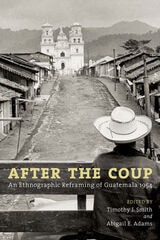
cover of After the Coup: An Ethnographic Reframing of Guatemala 1954

After the Coup

An Ethnographic Reframing of Guatemala 1954

Edited by Timothy J. Smith and Abigail E. Adams

University of Illinois Press, 2011

This exceptional collection revisits the aftermath of the 1954 coup that ousted the democratically elected Guatemalan president Jacobo Arbenz. Contributors frame the impact of 1954 not only in terms of the liberal reforms and coffee revolutions of the nineteenth century, but also in terms of post-1954 U.S. foreign policy and the genocide of the 1970s and 1980s. This volume is of particular interest in the current era of the United States' re-emerging foreign policy based on preemptive strikes and a presumed clash of civilizations.

Recent research and the release of newly declassified U.S. government documents underscore the importance of reading Guatemala's current history through the lens of 1954. Scholars and researchers who have worked in Guatemala from the 1940s to the present articulate how the coup fits into ethnographic representations of Guatemala. Highlighting the voices of individuals with whom they have lived and worked, the contributors also offer an unmatched understanding of how the events preceding and following the coup played out on the ground.

Contributors are Abigail E. Adams, Richard N. Adams, David Carey Jr., Christa Little-Siebold, Judith M. Maxwell, Victor D. Montejo, June C. Nash, and Timothy J. Smith.
[more]
cover of Anthropology and the Politics of Representation

Anthropology and the Politics of Representation

Gabriela Vargas-Cetina

University of Alabama Press, 2013

Examines the inherently problematic nature of representation and description of living people in ethnography and in anthropological work
 
In Anthropology and the Politics of Representation volume editor Gabriela Vargas-Cetina brings together a group of international scholars who, through their fieldwork experiences, reflect on the epistemological, political, and personal implications of their own work. To do so, they focus on such topics as ethnography, anthropologists’ engagement in identity politics, representational practices, the contexts of anthropological research and work, and the effects of personal choices regarding self-involvement in local causes that may extend beyond purely ethnographic goals.
 
Such reflections raise a number of ethnographic questions: What are ethnographic goals? Who sets the agenda for ethnographic writing? How does fieldwork change the anthropologist’s identity? Do ethnography and ethnographers have an impact on local lives and self-representation? How do anthropologists balance long-held respect for cultural diversity with advocacy for local people? How does an author choose what to say and write, and what not to disclose? Should anthropologists support causes that may require going against their informed knowledge of local lives?
[more]
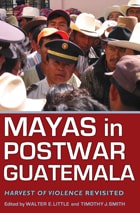
cover of Mayas in Postwar Guatemala: Harvest of Violence Revisited

Mayas in Postwar Guatemala

Harvest of Violence Revisited

Edited by Walter E. Little and Timothy J. Smith

University of Alabama Press, 2009

Like the original Harvest of Violence, published in 1988, this volume reveals how the contemporary Mayas contend with crime, political violence, internal community power struggles, and the broader impact of transnational economic and political policies in Guatemala. However, this work, informed by long-term ethnographic fieldwork in Mayan communities and commitment to conducting research in Mayan languages, places current anthropological analyses in relation to Mayan political activism and key Mayan intellectuals’ research and criticism. Illustrating specifically how Mayas in this post-war period conceive of their social and political place in Guatemala, Mayas working in factories, fields, and markets, and participating in local, community-level politics provide critiques of the government, the Maya movement, and the general state of insecurity and social and political violence that they continue to face on a daily basis. Their critical assessments and efforts to improve political, social, and economic conditions illustrate their resiliency and positive, nonviolent solutions to Guatemala’s ongoing problems that deserve serious consideration by Guatemalan and US policy makers, international non-government organizations, peace activists, and even academics studying politics, social agency, and the survival of indigenous people.
CONTRIBUTORS
Abigail E. Adams / José Oscar Barrera Nuñez / Peter Benson / Barbara Bocek / Jennifer L. Burrell / Robert M. Carmack / Monica DeHart / Edward F. Fischer / Liliana Goldín / Walter E. Little / Judith M. Maxwell / J. Jailey Philpot-Munson / Brenda Rosenbaum / Timothy J. Smith / David Stoll
[more]
cover of The Mormon History Association’s Tanner Lectures: The First Twenty Years

The Mormon History Association’s Tanner Lectures

The First Twenty Years

Edited by Dean L. May and Reid L. Neilsonwith Richard Lyman Bushman, Jan Shipps, and Thomas G. Alexander

University of Illinois Press, 2000

The Tanner lectures, now firmly entrenched as an institution at the annual Mormon History Association meetings, were established in 1980 as a means of providing scholars of Mormonism with a valuable new perspective for their historical record. All twenty-one lectures are presented by well-known non-Mormon scholars that were invited to prepare presentations in their own specialties that also encompass some aspect of Mormon history.   In the course of preparing their talks, the presenters are expected to immerse themselves for a year in current historical writings on Mormons and Mormonism. As this collection amply demonstrates, when these scholars do their homework, the results are enlightening.  This volume includes the Tanner lectures for the last two decades of the twentieth century, a general introduction, and specialized introductions to each individual lecture. 
 
[more]