Results by title
3 books match the query 'Smugglers'

Freebooters and Smugglers
The Foreign Slave Trade in the United States after 1808Ernest Obadele-Starks
University of Arkansas Press, 2007
In 1891 a young W. E. B. DuBois addressed the annual American Historical Association on the enforcement of slave trade laws: “Northern greed joined to Southern credulity was a combination calculated to circumvent any law, human or divine.” One law in particular he was referring to was the Abolition Act of 1808. It was specifically passed to end the foreign slave trade. However, as Ernest Obadele-Starks shows, thanks to profiteering smugglers like the Lafitte brothers and the Bowie brothers, the slave trade persisted throughout the south for a number of years after the law was passed. Freebooters and Smugglers examines the tactics and strategies that the adherents of the foreign slave trade used to challenge the law. It reassesses the role that Americans played in the continuation of foreign slave transshipments into the country right up to the Civil War, shedding light on an important topic that has been largely overlooked in the historiography of the slave trade.
[more]
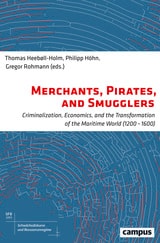
Merchants, Pirates, and Smugglers
Criminalization, Economics, and the Transformation of the Maritime World (1200–1600)Edited by Thomas Heebøll-Holm, Philipp Höhn, and Gregor Rohmann
Campus Verlag, 2019
Maritime history tends to draw stark lines between legal and illegal trading practices, with the naval and commercial vessels of sovereign states on one side and rogue pirates and smugglers on the other. This book reveals how, in the centuries before the emergence of the nation-state, maritime societies were shaped equally by both sanctioned and illicit trade—and that the line between the two was much less defined than it is now. The kind of high-seas activity now called piracy was often viewed in the early modern period as, at worst, a disruption of established distribution channels, but just often, it was viewed as simply another legitimate economic stream. Depending on one’s perspective, the same person could be seen as a bandit or an entrepreneur. Merchants, Pirates, and Smugglers tells the story of how these individuals came to be labelled as criminals as a way to enforce the codified economic and political positions that arose from sustained European state-building between the thirteenth and seventeenth centuries.
[more]

Smugglers, Brothels, and Twine
Historical Perspectives on Contraband and Vice in North America’s BorderlandsEdited by Elaine Carey and Andrae M. Marak
University of Arizona Press, 2011
In this volume the borders of North America serve as central locations for examining the consequences of globalization as it intersects with hegemonic spaces and ideas, national territorialism, and opportunities for—or restrictions on—mobility. The authors of the essays in this collection warn against falling victim to the myth of nation-states engaging in a valiant struggle against transnational flows of crime and vice. They take a long historical perspective, from Mesoamerican counterfeits of cacao beans used as currency to cattle rustling to human trafficking; from Canada’s and Mexico’s different approaches to the illegality of liquor in the United States during Prohibition to contemporary case studies of the transnational movement of people, crime, narcotics, vice, and even ideas.
By studying the historical flows of contraband and vice across North American borders, the contributors seek to bring a greater understanding of borderlanders, the actual agents of historical change who often remain on the periphery of most historical analyses that focus on the state or on policy.
To examine the political, economic, and social shifts resulting from the transnational movement of goods, people, and ideas, these contributions employ the analytical categories of race, class, modernity, and gender that underlie this evolution. Chapters focus on the ways power relations created opportunities for engaging in “deviance,” thus questioning the constructs of economic reality versus concepts of criminal behavior. Looking through the lens of transnational flows of contraband and vice, the authors develop a new understanding of nation, immigration, modernization, globalization, consumer society, and border culture.
[more]