Results by title
13 books match the query 'Smuggling'
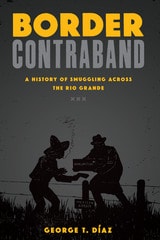
Border Contraband
A History of Smuggling across the Rio GrandeBy George T. Díaz
University of Texas Press, 2015
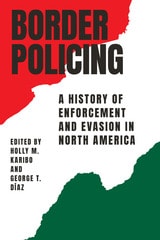
Border Policing
A History of Enforcement and Evasion in North AmericaEdited by Holly M. Karibo and George T. Díaz
University of Texas Press, 2020
An interdisciplinary group of borderlands scholars provide the first expansive comparative history of the way North American borders have been policed—and transgressed—over the past two centuries.
An extensive history examining how North American nations have tried (and often failed) to police their borders, Border Policing presents diverse scholarly perspectives on attempts to regulate people and goods at borders, as well as on the ways that individuals and communities have navigated, contested, and evaded such regulation.
The contributors explore these power dynamics though a series of case studies on subjects ranging from competing allegiances at the northeastern border during the War of 1812 to struggles over Indian sovereignty and from the effects of the Mexican Revolution to the experiences of smugglers along the Rio Grande during Prohibition. Later chapters stretch into the twenty-first century and consider immigration enforcement, drug trafficking, and representations of border policing in reality television. Together, the contributors explore the powerful ways in which federal authorities impose political agendas on borderlands and how local border residents and regions interact with, and push back against, such agendas. With its rich mix of political, legal, social, and cultural history, this collection provides new insights into the distinct realities that have shaped the international borders of North America.
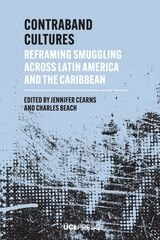
Contraband Cultures
Reframing Smuggling across Latin America and the CaribbeanEdited by Jennifer Cearns and Charles Beach
University College London, 2024
Contraband Cultures reframes smuggling activities across Latin America (including the Caribbean) and its diasporas through the lenses of kinship, political movements, economic exchange, and resistance to capitalist state hegemony, countering the popular representations of smuggling in the region as chaotic, lawless, violent, and exotic.
This book includes a broad range of chapters from social science and humanities scholars, and it uses various methodologies, theoretical traditions, and analytic approaches to explore the efficacy and valence of smuggling as a lens to examine personhood, materiality, statehood, and political (dis)connection across Latin America. Its combination of historic documentation and contemporary ethnographic research highlights the development of these cultural practices while grounding them in the capitalist and colonial refashioning of the entire region since the sixteenth century.

Drug Smugglers on Drug Smuggling
Lessons from the InsideScott H. Decker and Margaret Townsend Chapman
Temple University Press, 2008
Quoting frequently from their interviews, Decker and Chapman explain how individuals are recruited into smuggling, why they stay in it, and how their roles change over time. They describe the specific strategies their interviewees employed to bring drugs into the country and how they previously escaped apprehension. Over-all, the authors find that drug smuggling is organized in a series of networks which are usually unconnected.
This extraordinarily informative book will be of particular interest to law enforcement officials and policymakers, but it will appeal to anyone who wants to know how the drug business actually works.
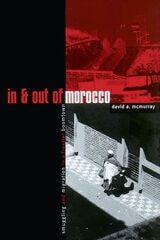
In And Out Of Morocco
Smuggling and Migration in a Frontier BoomtownDavid Mcmurray
University of Minnesota Press, 2001
A revealing inquiry into how global culture is lived locally.
Every summer for almost forty years, tens of thousands of Moroccan emigrants from as far away as Norway and Germany descend on the duty-free smugglers’ cove/migrant frontier boomtown of Nador, Morocco. David McMurray investigates the local effects of the multiple linkages between Nador and international commodity circuits, and analyzes the profound effect on everyday life of the free flow of bodies, ideas, and commodities into and out of the region.
Combining immigration and population statistics with street-level ethnography, In and Out of Morocco covers a wide range of topics, including the origin and nature of immigrant nostalgia, the historical evolution of the music of migration in the region, and the influence of migrant wealth on social distinctions in Nador. Groundbreaking in its attention to the performative aspects of life in a smuggling border zone, the book also analyzes the way in which both migration and smuggling have affected local structures of feeling by contributing to the spread of hyperconsumption. The result is a rare and revealing inquiry into how the global culture is lived locally.
Merchants, Pirates, and Smugglers
Criminalization, Economics, and the Transformation of the Maritime World (1200–1600)Edited by Thomas Heebøll-Holm, Philipp Höhn, and Gregor Rohmann
Campus Verlag, 2019

Seeing Like a Smuggler
Borders from BelowMahmoud Keshavarz and Shahram Khosravi
Pluto Press, 2022
Stories of smuggling as acts of resistance and decolonization.
'This conceptually vivid book refreshes our vision' - Ruth Wilson Gilmore
The word smuggler often unleashes a simplified, negative image painted by the media and the authorities. Such state-centric perspectives hide many social, political, and economic relations generated by smuggling. This book looks at the practice through the eyes of the smugglers, revealing how their work can be productive, subversive, and deeply sociopolitical.
By tracing the illegalized movement of people and goods across borders, Seeing Like a Smuggler shows smuggling as a contradiction within the nation-state system, and in a dialectical relation with the national order of things. It raises questions about how smuggling engages and unsettles the ethics, materialities, visualities, histories, and the colonial power relations that form borders and bordering.
Covering a wide spectrum of approaches from personal reflections and ethnographies to historical accounts, cultural analysis, and visual essays, the book spans the globe from Colombia to Ethiopia, Singapore to Guatemala, Afghanistan to Zimbabwe, and from Kurdistan to Bangladesh, to show how people deal with global inequalities and the restrictions of poverty and immobility.
Smuggled Chinese
Ko-Lin Chin
Temple University Press, 1999
When the Golden Venture ran aground off New York's coast in 1993 and ten of the 260 Chinese on board drowned, the public outcry about human smuggling became front-page news. Probing into the causes and consequences of this clandestine traffic, Ko-lin Chin has interviewed more than 300 people -- smugglers, immigrants, government officials, and business owners -- in the United States, China, and Taiwan. Their poignant and chilling testimony describes a flourishing industry in which smugglers -- big and little snakeheads -- command fees as high as $30,000 to move desperate but hopeful men and women around the world. For many who survive the hunger, filthy and crowded conditions, physical and sexual abuse, and other perils of the arduous journey, life in the United States, specifically in New York's Chinatown, is a disappointment if not a curse. Few will return to China, though, because their families depend on the money and status gained by having a relative in the States.
In Smuggled Chinese, Ko-lin Chin puts a human face on this intractable international problem, showing how flaws in national policies and lax law enforcement perpetuate the cycle of desperation and suffering. He strongly believes, however, that the problem of human smuggling will continue as long as China's citizens are deprived of fundamental human rights and economic security.
Smuggled Chinese will engage readers interested in human rights, Asian and Asian American studies, urban studies, and sociology.

Smugglers Secessionists & Loyal Citizens
On The Ghana-Togo FrontierPaul Nugent
Ohio University Press, 2002
Paul Nugent contends that whatever the origins of partition, border peoples quickly became knowing and active participants in the shaping of this international boundary. The study itself straddles the conventional divide between social and political history and offers a reconstruction of a long-range history of smuggling and a reappraisal of Ewe identity.
Addressing topics such as imperialism, cocoa, the Customs Preventive Service, Christianity, and Ewe unification, this study will be of interest to scholars and to others concerned with issues of criminality, identity, and the state.

Smugglers, Brothels, and Twine
Historical Perspectives on Contraband and Vice in North America’s BorderlandsEdited by Elaine Carey and Andrae M. Marak
University of Arizona Press, 2011
By studying the historical flows of contraband and vice across North American borders, the contributors seek to bring a greater understanding of borderlanders, the actual agents of historical change who often remain on the periphery of most historical analyses that focus on the state or on policy.
To examine the political, economic, and social shifts resulting from the transnational movement of goods, people, and ideas, these contributions employ the analytical categories of race, class, modernity, and gender that underlie this evolution. Chapters focus on the ways power relations created opportunities for engaging in “deviance,” thus questioning the constructs of economic reality versus concepts of criminal behavior. Looking through the lens of transnational flows of contraband and vice, the authors develop a new understanding of nation, immigration, modernization, globalization, consumer society, and border culture.

The Ocean Is a Wilderness
Atlantic Piracy and the Limits of State Authority, 1688-1856Guy Chet
University of Massachusetts Press, 2014
Chet shows how the traditional focus on the growth of the modern state overlooked the extent to which old attitudes and cultural practices continued to hold sway. Even as the British government extended its naval, legal, and bureaucratic reach, in many parts of the Atlantic world illegal trade was not only tolerated but encouraged. In part this was because Britain's constabulary command of the region remained more tenuous than some have suggested, and in part because maritime insurance and wartime tax policies ensured that piracy and smuggling remained profitable. When Atlantic piracy eventually waned in the early nineteenth century, it had more to do with a reduction in its profitability at port than with forceful confrontation at sea.
Challenging traditional accounts that chronicle forces of civilization taming a wild Atlantic frontier, this book is a valuable addition to a body of borderlands scholarship reevaluating the relationship between the emerging modern state and its imperial frontiers.
To Have and Have Not
Edited by Bruce F. Kawin; Tino T. Balio, Series Editor
University of Wisconsin Press, 1980
The story of the making of To Have and Have Not (1944) is an exciting and complex one, ranging from the widely reported romance between its stars, Humphrey Bogart and the unknown nineteen-year old Lauren Bacall, to one of the more subtle developments in the wartime alliance between the United States and the Batista regime in Cuba. Bruce F. Kawin's substantial and informed introduction reflects this excitement while explaining the complexities, helping all film scholars, students, and buffs to gain a fuller appreciation of one of Hollywood's most memoriable melodramas.
This is a story also of a collaboration amoung four important writers: Ernest Hemingway, Howard Hawks, Jules Furthman, and William Faulkner.