Results by title
3 books match the query 'Snyder, Gary'
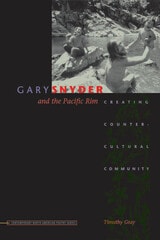
Gary Snyder and the Pacific Rim
Creating Countercultural CommunityTimothy Gray
University of Iowa Press, 2006
In Gary Snyder and the Pacific Rim, Timothy Gray draws upon previously unpublished journals and letters as well as his own close readings of Gary Snyder’s well-crafted poetry and prose to track the early career of a maverick intellectual whose writings powered the San Francisco Renaissance of the 1950s and 1960s. Exploring various aspects of cultural geography, Gray asserts that this west coast literary community seized upon the idea of a Pacific Rim regional structure in part to recognize their Orientalist desires and in part to consolidate their opposition to America’s cold war ideology, which tended to divide East from West. The geographical consciousness of Snyder’s writing was particularly influential, Gray argues, because it gave San Francisco’s Beat and hippie cultures a set of physical coordinates by which they could chart their utopian visions of peace and love.
Gray’s introduction tracks the increased use of “Pacific Rim discourse” by politicians and business leaders following World War II. Ensuing chapters analyze Snyder’s countercultural invocation of this regional idea, concentrating on the poet’s migratory or “creaturely” sensibility, his gift for literary translation, his physical embodiment of trans-Pacific ideals, his role as tribal spokesperson for Haight-Ashbury hippies, and his burgeoning interest in environmental issues. Throughout, Gray’s citations of such writers as Allen Ginsberg, Philip Whalen, and Joanne Kyger shed light on Snyder’s communal role, providing an amazingly intimate portrait of the west coast counterculture. An interdisciplinary project that utilizes models of ecology, sociology, and comparative religion to supplement traditional methods of literary biography, Gary Snyder and the Pacific Rim offers a unique perspective on Snyder’s life and work.
This book will fascinate literary and Asian studies scholars as well as the general reader interested in the Beat movement and multicultural influences on poetry.
[more]
Genesis, Structure, and Meaning in Gary Snyder's Mountains and Rivers Without End
Anthony Hunt
University of Nevada Press, 2016
When Gary Snyder’s long poem Mountains and Rivers Without End was published in 1996, it was hailed as a masterpiece of American poetry. Anthony Hunt offers a detailed historical and explicative analysis of this complex work using, among his many sources, Snyder’s personal papers, letters, and interviews. Hunt traces the work’s origins, as well as some of the sources of its themes and structure, including Nō drama; East Asian landscape painting; the rhythms of storytelling, chant, and song; Jungian archetypal psychology; world mythology; Buddhist philosophy and ritual; Native American traditions; and planetary geology, hydrology, and ecology. His analysis addresses the poem not merely by its content, but through the structure of individual lines and the arrangement of the parts, examining the personal and cultural influences on Snyder’s work. Hunt’s benchmark study will be rewarding reading for anyone who enjoys the contemplation of Snyder’s artistry and ideas and, more generally, for those who are intrigued by the cultural and intellectual workings of artistic composition.
[more]
Reading The Trail
Exploring The Literature And Natural History Of The California CrestCorey Lee Lewis
University of Nevada Press, 2005
A provocative new way to read and interpret the classic works of John Muir, Mary Austin, and Gary Snyder, and to bring their ideas into the discussion of ecological values and the current environmental crisis. Lewis combines a perceptive discussion of their work and ideas with an engaging account of his own trail experiences as hiker/backpacker and volunteer trail builder, proposing that such a field-based, interdisciplinary approach to literary study and outdoors experience can enrich our appreciation for the work of nature writers.
[more]