Results by title
3 books match the query 'Social Context'
Bioethics In Social Context
edited by Barry Hoffmaster
Temple University Press, 2001
The original essays in this volume use qualitative research methods to expose the multiple contexts within which the problems of bioethics arise, are defined and debated, and ultimately resolved. In a provocative concluding essay, one contributor asks his fellow ethnographers to reflect on the ethical problems of ethnography.
The Mode of Information
Poststructuralism and Social ContextMark Poster
University of Chicago Press, 1990
The difference, Mark Poster argues, is the profound effect electronic mediation exerts on the very way we perceive ourselves and reality. To help decode the linguistic dimensions of our multiple forms of social interaction, he plays upon Marx's theory of the mode of production—the shift to late capitalism has a parallel in the shift from the mode of production to that of information.
Enlisting poststructuralist theory, he links four modes of communication with four poststructuralists: TV ads with Baudrillard, data bases with Foucault, electronic writing with Derrida, and computer science with Lyotard. Mode of Information points the way to a poststructuralist strategy for writing history, a framework well suited to unearthing structures of domination and the means to their disruption.
"An informed, insightful, provocative account of phenomena that have transformed virtually every area of public and private life on our time."—Robert Anchor, American Historical Review
"The importance of Poster's book is unmistakable for he skillfully negotiates between and juxtaposes two wide theoretical domains—electronically mediated communications and poststructuralist theory—about which much has been written, but hardly with the acumen that he brings to bear in a long-awaited critical rapprochement."—Charles J. Stivale, Criticism
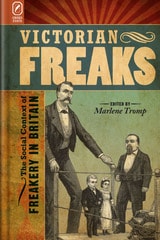
Victorian Freaks
The Social Context of Freakery in BritainMarlene Tromp
The Ohio State University Press, 2008
While “freaks” have captivated our imagination since well before the nineteenth century, the Victorians flocked to shows featuring dancing dwarves, bearded ladies, “missing links,” and six-legged sheep. Indeed, this period has been described by Rosemarie Garland-Thomson as the epoch of “consolidation” for freakery: an era of social change, enormously popular freak shows, and taxonomic frenzy. Victorian Freaks: The Social Context of Freakery in Britain, edited by Marlene Tromp, turns to that rich nexus, examining the struggle over definitions of “freakery” and the unstable and sometimes conflicting ways in which freakery was understood and deployed. As the first study centralizing British culture, this collection discusses figures as varied as Joseph Merrick, “The Elephant Man”; Daniel Lambert, “King of the Fat Men”; Julia Pastrana, “The Bear Woman”; and Laloo “The Marvellous Indian Boy” and his embedded, parasitic twin. The Victorian Freaks contributors examine Victorian culture through the lens of freakery, reading the production of the freak against the landscape of capitalist consumption, the medical community, and the politics of empire, sexuality, and art. Collectively, these essays ask how freakery engaged with notions of normalcy and with its Victorian cultural context.