Results by title
28 books match the query 'Social Themes'
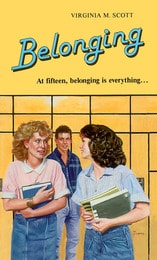
Belonging
Virginia Tibbs-Brelje
Gallaudet University Press, 1986
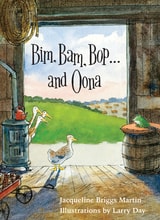
Bim, Bam, Bop . . . and Oona
Jacqueline Briggs Martin
University of Minnesota Press, 2019
An irresistible read-aloud picture book, in which a little odd-duck-out discovers her unique strengths
When these ducks go to the pond, it is Bim, Bam, Bop . . . and Oona, always last. They’re all ducks, but Bim, Bam, and Bop are runners, and Oona’s a waddler. “Last is a blot on my life,” she says to her frog friend, Roy. “I don’t feel as big as a duck should feel.” But she’s good with gizmos, Roy reminds her. So Oona tinkers with things, scraps, and strings, and eventually creates just the right gadget to get her to the pond first.
Spunky Oona will inspire and delight all who see her final triumphant creation. With its fun read-aloud words (from Brrrrrring to OOO-hoolie-hoo!), her story is wonderful to hear. Its charming illustrations invite readers to imagine our own new gizmos, and her victory reminds us to look for our own special gifts. A tale about being true to yourself, building confidence, and finding friendship, Bim, Bam, Bop . . . and Oona is sure to bring smiles to readers and listeners of all ages.
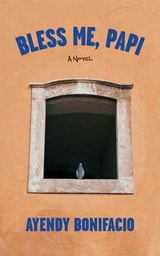
Bless Me, Papi
A NovelAyendy Bonifacio
Northwestern University Press, 2026
A coming-of-age tale of a young Dominican American boy facing a grave loss and a feathered phantom
Between the looming buildings of Brooklyn, a young Dominican American boy only ever called mijo by his family has just lost his father to brain cancer. In the wake of his grief, he begins to see his deceased father take the form of a pigeon and ghost, acting as protector and advisor in moments of duress and confusion. Determined to find out the truth behind his father’s appearances, he sets out on the streets of Brooklyn with his outspoken friend Naño, and in the hills of the Dominican Republic with his cousin Matias, in search of answers, only to discover more ghostly apparitions and inexplicable occurrences. In a world of lost things and in-betweens, the grief-stricken son must choose whether he can bear to let go of his father or accept the consequences of what we let haunt us.
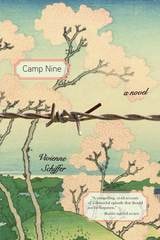
Camp Nine
A NovelVivienne Schiffer
University of Arkansas Press, 2011
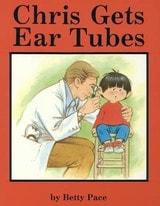
Chris Gets Ear Tubes
Betty Pace
Gallaudet University Press, 1987
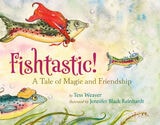
Fishtastic!
A Tale of Magic and FriendshipTess Weaver, illustrated by Jennifer Black Reinhardt
University of Iowa Press, 2021
Inspired by the fish sculptures installed along the walkways welcoming visitors to Hancher, Fishtastic! is a delightful blend of lovable characters and whimsical watercolor illustrations that celebrate the joy of discovering your own path to enchantment.
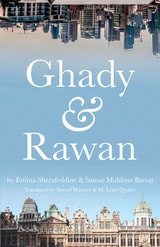
Ghady & Rawan
By Fatima Sharafeddine and Samar Mahfouz Barraj, translated by M. Lynx Qualey and Sawad Hussain
University of Texas Press, 2019
Ghady and Rawan is a heartfelt and timely novel by the award-winning author Fatima Sharafeddine (The Servant, Cappuccino) and Samar Mahfouz Barraj. The novel follows the close-knit friendship of two Lebanese teenagers, Ghady, who lives with his family in Belgium, and Rawan, who lives in Lebanon. Ghady’s family travels every summer to Beirut, where Ghady gets to spend all his time with Rawan and their other friends, enjoying their freedom from school. During the rest of the year, he and Rawan keep in touch by email. Through this correspondence, we learn about the daily ups and downs of their lives in Brussels and Beirut, including Ghady’s homesickness and his struggles with racism at school, as well as Rawan’s changing relationship to her family. The novel offers a glimpse into the lives of Lebanese adolescents while exploring a range of topics relevant to young people everywhere: bullying, parental conflicts, racism, belonging and identity, and peer pressure. Through the connection between the two main characters, Sharafeddine and Mahfouz Barraj show how the love and support of a good friend can help you through difficulties as well as sweeten life’s triumphs and good times.
God of Beer
Garret Keizer
University Press of New England, 2016
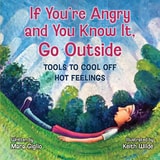
If You're Angry and You Know It, Go Outside
Tools to Cool Off Hot FeelingsMara Giglio and Keith Wilde
Ohio University Press, 2025
Children have big feelings that are sometimes difficult to manage. In If You’re Angry and You Know It, Go Outside, Mari is struggling with the death of her beloved dog and trying to deal with anger, sadness, and loss. Written simply for young children and illustrated with vibrant colors to reflect the range of Mari’s emotions, this book introduces self-regulation skills for both kids and adults. It emphasizes staying in or returning to our resilient zone—a state where we feel like our best selves and maintain a sense of agency.
The book highlights three key strategies for staying in the resilient zone or returning to it when emotions run high:
(1) Notice sensations. Recognizing physical sensations in the body helps us respond to feelings constructively rather than impulsively.
(2) Practice grounding. Grounding involves physical activities that anchor us in the present and calm our nervous system. Techniques include deep breathing, pushing against objects, stretching, dancing, or even playing video games.
(3) Focus on joy and love. Shifting attention to positive and joyful experiences can foster resilience. Ideas include writing a gratitude journal, creating a photo collage, or spending time with loved ones and pets.
Mari’s story is followed by a section for adults that explains the evidence-backed Community Resiliency Model (CRM), developed by the Trauma Resource Institute, and helps grown-ups guide children through big feelings.
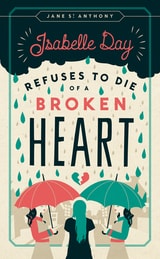
Isabelle Day Refuses to Die of a Broken Heart
Jane St. Anthony
University of Minnesota Press, 2018
In Milwaukee, Isabelle Day had a house. And she had a father. This year, on Halloween, she has half of a house in Minneapolis, a mother at least as sad as she is, and a loss that’s too hard to think—let alone talk—about. It’s the Midwest in the early 1960s, and dads just don’t die . . . like that.
Hovering over Isabelle’s new world are the duplex’s too-attentive landladies, Miss Flora (“a lovely dried flower”) and her sister Miss Dora (“grim as roadkill”), who dwell in a sea of memories and doilies; the gleefully demonic Sister Mary Mercy, who rules a school awash in cigarette smoke; and classmates steady Margaret and edgy Grace, who hold out some hope of friendship. As Isabelle’s first tentative steps carry her through unfamiliar territory—classroom debacles and misadventures at home and beyond, time trapped in a storm-tossed cemetery and investigating an inhospitable hospital—she begins to discover that, when it comes to pain and loss, she might actually be in good company.
In light of the elderly sisters’ lives, Grace and Margaret’s friendship, and her father’s memory, she just might find the heart and humor to save herself. With characteristic sensitivity and wit, Jane St. Anthony reveals how a girl’s life clouded with grief can also hold a world of promise.
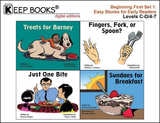
KEEP BOOKS Digital Editions Beginning First Set 1
Easy Stories for Early ReadersAndrea McCarrier
Keep Books, 2019
Stories include: Treats for Barney, Fingers, Fork, or Spoon?, Just One Bite, & Sundaes for Breakfast.
Age Level: 5-6
Grade Level: Beginning First
Reading level: C-D/4-7
KEEP BOOKS digital editions include text features and design elements that give beginning readers what they need to start reading on their own with high interest titles that they can easily manage.
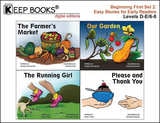
KEEP BOOKS Digital Editions Beginning First Set 2
Easy Stories for Early ReadersMary Fried
Keep Books, 2019
Stories include: The Farmer’s Market, Our Garden, The Running Girl, & Please and Thank You.
Age Level: 5-6
Grade Level: Beginning First
Reading level: D-E/6-8
KEEP BOOKS digital editions include text features and design elements that give beginning readers what they need to start reading on their own with high interest titles that they can easily manage.
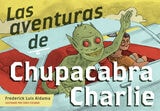
Las aventuras de Chupacabra Charlie
Frederick Luis Aldama / Ilustrado por Chris Escobar
The Ohio State University Press, 2021
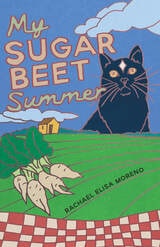
My Sugar Beet Summer
Rachael Elisa Moreno
Michigan State University Press, 2026
In 1928, nine-year-old Teresa leaves everything she knows in San Antonio—including her beloved cat Diamante—and boards a train bound for Michigan, where her parents have found work in the vast sugar beet fields of Saginaw. The long train north is a source of fascination, but stepping into Michigan feels like entering a different world—the cold wind, the strange houses, and the long days helping on the farm instead of going to school. Teresa cares for her little sisters while her parents tend to the sugar beets. She learns to navigate a life shaped by hard work, migration, and constant change. After the harvest, a new season begins, and the whole family must pack up and make the long trip back to Texas, to plant new roots. Based on the stories the author’s grandparents told her about their lives as Texas migrants in Michigan’s Thumb, My Sugar Beet Summer pulls the reader into Teresa and her family’s life in a new land, on a sugar beet farm on the eve of the Great Depression.
No More Bullies!/¡No Más Bullies
Owl in a Straw Hat 2Rudolfo Anaya
Museum of New Mexico Press, 2019
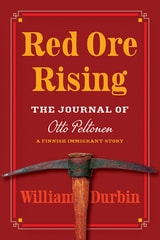
Red Ore Rising
The Journal of Otto Peltonen, a Finnish Immigrant StoryWilliam Durbin
University of Minnesota Press, 2026
A portrait of the Finnish immigrant experience in Minnesota during the early twentieth century
After journeying across the Atlantic with his mother and two sisters, young Otto Peltonen joins his father in the iron ore mines of northern Minnesota, experiencing the harsh labor conditions that were common at the time, as mining companies cared more about making a profit than for their workers’ safety. Writing in his journal about his family’s struggles and the hard life Finnish immigrants endured in the early twentieth century, Otto ultimately strengthens his resolve to find the freedom his family had first sought in America.
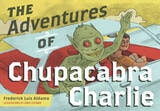
The Adventures of Chupacabra Charlie
Written by Frederick Luis AldamaIllustrated by Chris Escobar
The Ohio State University Press, 2020
With magical realism, allegory, and gentle humor, Aldama and Escobar have created a story that will resonate with young and old readers alike as it incorporates folklore into its subtle take on the current humanitarian crisis at the border.
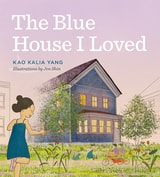
The Blue House I Loved
Kao Kalia Yang
University of Minnesota Press, 2026
A Hmong girl tells the story of her beloved aunt and uncle’s first home in America—long gone, but still alive in the family’s memories
The Blue House I Loved centers on a family of newly arrived Hmong refugees who move into the lower level of a duplex in St. Paul, Minnesota. The narrator loves her aunt and uncle’s home with its mismatched furniture, but it is too small for the large family. The boy cousins sleep in the three-season porch, where their wet hair freezes in wintertime, and the rest of the family crowds into two bedrooms. Yet this is the cherished home where they live and love, their own small corner of a very large and unfamiliar place, and in this blue house a young girl learns about her new country. Eventually, the family moves in search of more space, and years later the house is torn down. Where it was, green grass now grows. But for this girl and her family, the ghost of the house remains, its memories a strong thread that holds time at bay and hearts close together.
Combining Kao Kalia Yang’s lyrical prose with ethereal illustrations by artist and architect Jen Shin, The Blue House I Loved speaks to the multitude of refugee experiences around the world, honoring the challenges they face and the homes they create together.
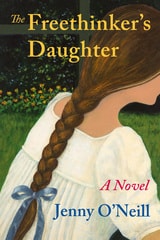
The Freethinker’s Daughter
A NovelJenny O'Neill
Ohio University Press, 2022
This historical and inspiring coming-of-age novel for young readers explores topics of both historical and contemporary relevance as it follows a harrowing year in the life of its intrepid teenaged narrator.
Lexington, Kentucky, 1833: Calendula “Cal” Farmer, a thirteen-year-old white girl, has been raised by her abolitionist, freethinking mother to reason for herself, consult her inner wisdom, and come to her own conclusions. But when a flash flood devastates her family’s home, Cal is unexpectedly thrust into domestic service in a wealthy family’s mansion. There, she encounters firsthand the physical, intellectual, and emotional brutalities of slavery. Later, a cholera outbreak kills a quarter of the population, including Cal’s mother, and Cal enters an orphanage, where she bravely begins another chapter in her young life.
Cal’s story is sure to captivate readers as she confronts the injustices and uncertainties of racism, class consciousness, epidemic disease, and personal loss with independent thinking, perseverance, and love.
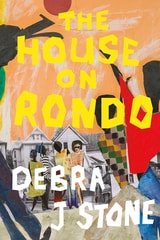
The House on Rondo
Debra J Stone
University of Minnesota Press, 2025
A young girl reckons with the demolition of a Black Saint Paul neighborhood to make way for the Interstate in the early 1960s
When thirteen-year-old Zenobia has to leave her friends and spend the summer at Grandma’s while Mama recovers from a stroke, life seems so unfair. But then the eviction letters start arriving throughout her grandparents’ neighborhood, and white men chalk arrows to mark the gas and water lines, and a new world of unfairness unfolds before her. It’s 1963, and Zenobia’s grandparents’ house on Rondo Avenue in Saint Paul—like all the homes in this thriving Black community—is targeted for demolition to make way for the new Interstate Highway 94.
As Zenobia gradually learns about what’s planned for the Rondo neighborhood and what this means for everyone who lives there, she discovers how her story is intertwined with the history of her family, all the way back to Great Grandma Zenobia and the secrets Grandma Essie held close about the reason for her light skin. With the destruction of the neighborhood looming, Zenobia takes a stand on behalf of her community, joining her no-nonsense neighbor, onetime cowgirl Mrs. Ruby Pearl, in a protest and ultimately getting arrested. Though Zenobia is grounded for a month, her punishment seems of little consequence in comparison to what is happening all around her. Even though the demolition continues, she is proud to discover the power and connection in protesting injustice.
The House on Rondo captures the heartbreak, resistance, and resilience that marks a community sacrificed in the name of progress—a “progress” that never seems to favor Black families and neighborhoods and that haunts cities like Saint Paul to this day. As Zenobia learns what can be destroyed and what cannot, her story teaches us that joy, community, and love persist, even amid violence and loss.
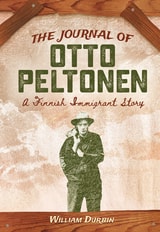
The Journal of Otto Peltonen
A Finnish Immigrant StoryWilliam Durbin
University of Minnesota Press, 2020
A portrait of the Finnish immigrant experience in Minnesota during the early twentieth century—now in paperback
After journeying across the Atlantic with his mother and two sisters, young Otto Peltonen joins his father in the iron ore mines of northern Minnesota, experiencing the harsh labor conditions that were common at the time, as mining companies cared more about making a profit than for their workers’ safety. Writing in his journal about his family’s struggles and the hard life Finnish immigrants endured in the early twentieth century, Otto ultimately strengthens his resolve to find the freedom his family had first sought in America.
The Little Baby Snoogle-Fleejer
Jimmy Carter
University of Arkansas Press, 2014
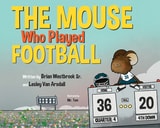
The Mouse Who Played Football
Written by Brian Westbrook Sr. and Lesley Van Arsdall
Temple University Press, 2022
Some folks think Brian the mouse is too small. He may be a tough little fella, but they are not sure Brian has what it takes. The Mouse Who Played Football, by former Philadelphia Eagles running back Brian Westbrook Sr. and sports reporter Lesley Van Arsdall, shows how Brian the mouse proves everyone wrong with unyielding confidence that his small size can be his strength.
This charming children’s book, featuring appealing and dynamic illustrations by Mr. Tom, demonstrates how Brian the mouse overcomes what others see as a “big problem.” His determination—as well as speed and toughness on the gridiron—helps him become a star player in high school, college, and eventually, the MFL, the Mouse Football League.
The Mouse Who Played Football, based on Westbrook’s own experiences,is an inspiring story that encourages young readers to believe in themselves and make their unique differences their strengths.
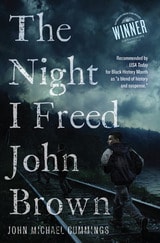
The Night I Freed John Brown
John Michael Cummings
West Virginia University Press, 2016
Winner of The Paterson Prize for Books for Young People
Recommended by USA Today for Black History Month as "a blend of history and suspense."
In this novel for young adults, Josh knows there is something about the tall Victorian House on the Harpers Ferry Hill, the one his father grew up in, that he can’t quite put his finger on. And his impossible father won’t give him any clues. He’s hiding something.
And then there’s the famous John Brown. The one who all the tourists come to hear about. The one whose statue looms over Josh’s house. Why does he seem to haunt Josh and his whole family? When the fancy Richmonds come to town and move right next door, their presence forces Josh to find the answers and stand up to the secrets of the House, to his father—and to John Brown, too.
The historic village of Harpers Ferry comes alive in this young boy’s brave search for answers and a place of his own in this brilliant first novel by John Michael Cummings.
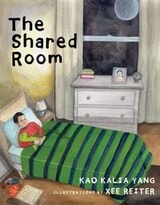
The Shared Room
Kao Kalia Yang
University of Minnesota Press, 2020
A family gradually moves forward after the loss of a child—a story for readers of all ages
When someone you love dies, you know what doesn’t die? Love. On the hot beach, among colorful umbrellas blooming beneath a bright sun, no one saw a little girl walk into the water. Now, many months later, her bedroom remains empty, her drawers hold her clothes, her pillows and sheets still have her scent, and her mother and father, brothers and sister carry her in their hearts, along with their grief, which takes up so much space. Then one snowy day, the mother and father ask the girl’s older brother, “Would you like a room of your own?” He wants to know, “Whose?” They say, “Your sister’s.”
Tenderly, and with refreshing authenticity, beloved Minnesota writer Kao Kalia Yang tells the story of a Hmong American family living with loss and tremendous love. Her direct and poignant words are accompanied by the evocative and expressive drawings of Hmong American artist Xee Reiter. The Shared Room brings a message of comfort and hope to readers young and old.
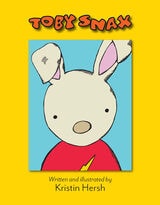
Toby Snax
Written and illustrated by Kristin Hersh
University of Texas Press, 2016
Toby Snax is a little bunny who’s reluctant to experience things away from home. When Mama asks him to join her on a trip, he needs a bit of encouragement. So Mama tells Toby about the wondrous things that await him out in the wide world, helping him to look forward to new adventures.
This charming, gentle book will resonate with any child who’s nervous about trying new things. The acclaimed musician Kristin Hersh created Toby Snax to encourage her son, Bodhi, to embrace the experiences of touring the world together while she performed both solo and with her bands 50 Foot Wave and Throwing Muses. The first edition of the book sold out immediately and has become highly collectible. This new edition makes Toby Snax available again for all fans of Hersh’s evocative storytelling, as well as children—or even adults—who need a little reassurance that the world is full of wonders.
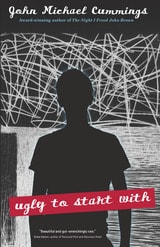
Ugly to Start With
John Michael Cummings
West Virginia University Press, 2011
Jason Stevens is growing up in picturesque, historic Harpers Ferry, West Virginia in the 1970s. Back when the roads are smaller, the cars slower, the people more colorful, and Washington, D.C. is way across the mountains—a winding sixty-five miles away.
Jason dreams of going to art school in the city, but he must first survive his teenage years. He witnesses a street artist from Italy charm his mother from the backseat of the family car. He stands up to an abusive husband—and then feels sorry for the jerk. He puts up with his father’s hard-skulled backwoods ways, his grandfather’s showy younger wife, and the fist-throwing schoolmates and eccentric mountain characters that make up Harpers Ferry—all topped off by a basement art project with a girl from the poor side of town.
Ugly to Start With punctuates the exuberant highs, bewildering midpoints, and painful lows of growing up, and affirms that adolescent dreams and desires are often fulfilled in surprising ways.
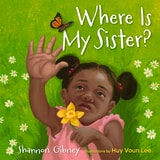
Where Is My Sister?
Shannon Gibney
University of Minnesota Press, 2026
A poignant resource for helping children and families through the loss of a sibling
Salome was going to be a big sister. Her brother, Gerald, told her so. They watched Mama’s tummy grow rounder and rounder, and their excitement grew, too. But then Mama went to the hospital, and she came home without a baby. The smiles stopped, and the house grew quiet except for Mama’s tears.
“Where is my sister?” Salome asks. Mama gathers her and Gerald onto her lap and tells them that baby Toni is in the cemetery, but she’ll always be their sister. Gerald says that she’s in the spirit world. Salome looks for her all over. Is Toni’s spirit in Mama’s tears? Is she in the family’s stories about her? Is she between Salome and her brother at the dinner table, or beside Salome’s favorite tree in the backyard? As her family begins to find peace, Salome understands something important: “My sister is everywhere.”
In Where Is My Sister? Shannon Gibney’s poetic voice captures the heartbreak of losing an infant and the love that joins family members together. Huy Voun Lee’s tender illustrations guide readers with quiet grace, honoring all those who passed from this world too soon. A resource for children and the parents, teachers, and community members who care for them, this book offers a powerful reflection for those who often feel alone during the painful and transformative experience of infant and sibling loss.