Results by title
2 books match the query 'Social conflict in mass media'
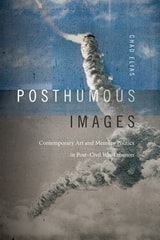
Posthumous Images
Contemporary Art and Memory Politics in Post–Civil War LebanonChad Elias
Duke University Press, 2018
For almost two decades of its history (1975-90), Lebanon was besieged by sectarian fighting, foreign invasions, and complicated proxy wars. In Posthumous Images, Chad Elias analyzes a generation of contemporary artists who have sought, in different ways, to interrogate the contested memory of those years of civil strife and political upheaval. In their films, photography, architectural projects, and multimedia performances, these artists appropriate existing images to challenge divisive and violent political discourses. They also create new images that make visible individuals and communities that have been effectively silenced, rendered invisible, or denied political representation. As Elias demonstrates, these practices serve to productively unsettle the distinctions between past and present, the dead and the living, official history and popular memory. In Lebanon, the field of contemporary art is shown to be critical to remembering the past and reimagining the future in a nation haunted by a violent and unresolved war.
[more]
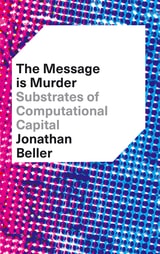
The Message Is Murder
Substrates of Computational CapitalJonathan Beller
Pluto Press, 2017
More than fifty years ago, Marshall McLuhan proclaimed that “the medium is the message,” profoundly influencing future generations of media theorists. A long-overdue wakeup call for the field of media studies, The Message is Murder analyzes the formations of violence still imbued in the everyday functions of the media. Jonathan Beller introduces the concept of computational capital to argue that contemporary media are not neutral, but rather they are technologies of political economy that became entangled with gendered and racialized capitalism in the twentieth and twenty-first centuries. Engaging with Borges, Turing, Hitchcock, and Marx, Beller offers an ambitious and provocative critique of contemporary media studies.
[more]