Results by title
7 books match the query 'Social indicators'
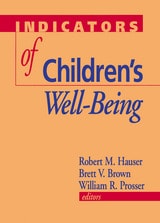
Indicators of Children's Well-Being
Robert M. Hauser
Russell Sage Foundation, 1997
The search for reliable information on the well-being of America's young is vital to designing programs to improve their lives. Yet social scientists are concerned that many measurements of children's physical and emotional health are inadequate, misleading, or outdated, leaving policymakers ill-informed. Indicators of Children's Well-Being is an ambitious inquiry into current efforts to monitor children from the prenatal period through adolescence. Working with the most up-to-date statistical sources, experts from multiple disciplines assess how data on physical development, education, economic security, family and neighborhood conditions, and social behavior are collected and analyzed, what findings they reveal, and what improvements are needed to create a more comprehensive and policy-relevant system of measurement. Today's climate of welfare reform has opened new possibilities for program innovation and experimentation, but it has also intensified the need for a clearly defined and wide-ranging empirical framework to pinpoint where help is needed and what interventions will succeed. Indicators of Children's Well-Being emphasizes the importance of accurate studies that address real problems. Essays on children's material well-being show why income data must be supplemented with assessments of housing, medical care, household expenditure, food consumption, and education. Other contributors urge refinements to existing survey instruments such as the Census and the Current Population Survey. The usefulness of records from human service agencies, child welfare records, and juvenile court statistics is also evaluated.
[more]

Metrics
What Counts in Global HealthVincanne Adams, editor
Duke University Press, 2016
This volume's contributors evaluate the accomplishments, limits, and consequences of using quantitative metrics in global health. Whether analyzing maternal mortality rates, the relationships between political goals and metrics data, or the links between health outcomes and a program's fiscal support, the contributors question the ability of metrics to solve global health problems. They capture a moment when global health scholars and practitioners must evaluate the potential effectiveness and pitfalls of different metrics—even as they remain elusive and problematic.
Contributors. Vincanne Adams, Susan Erikson, Molly Hales, Pierre Minn, Adeola Oni-Orisan, Carolyn Smith-Morris, Marlee Tichenor, Lily Walkover, Claire L. Wendland
[more]
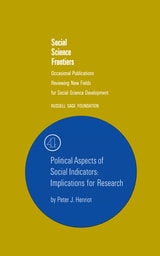
Political Aspects of Social Indicators
Implications for ResearchPeter J. Henriot
Russell Sage Foundation, 1972
Complementing the focus on the structural and social-psychological aspects of measuring social change, this report establishes a research approach relating social measurement to antecedent and consequent political considerations: political values, policy impact, power consequences, administrative influences, institutionalization, and so forth. This study is directed to any social scientist interested in political phenomena and in the issue of the relationship between social science and public policy.
[more]

Social Indicator Models
Kenneth C. Land
Russell Sage Foundation, 1975
Deals in comprehensive fashion with a diverse array of objective and subjective social indicators and shows how these indicators can be used, potentially, to inform and perhaps guide social policy. Written with clarity and authority, it will be of paramount interest to those concerned with the interpretation and analysis of social indicators and to those interested in their use. For the former, it serves as an illuminating introduction to some of the analytical tasks that lie ahead in the study of social indicators. For the latter, it provides a solid foundation upon which future policy analysis may be based.
[more]

The New American Reality
Who We Are, How We Got Here, Where We Are GoingReynolds Farley
Russell Sage Foundation, 1996
"A fascinating and authoritative account of American social history since 1960 as viewed through the prism of government statistics....[Farley] uses publicly available data, straight forward methods, and modest...language, to provide more information and insight about recent social trends than any other volume in print." —American Journal of Sociology "A brilliant piece of work. Farley is absolutely masterful at taking tens of thousands of national survey statistics and weaving from them a fascinating and beautifully illustrated tapestry of who we are." —Barry Bluestone, Frank L. Boyden Professor of Political Economy, University of Massachusetts, Boston The New American Reality presents a compelling portrait of an America strikingly different from what it was just forty years ago.Gone is the idealized vision of a two-parent, father-supported Ozzie and Harriet society. In its place is an America of varied races andethnic backgrounds, where families take on many forms and mothers frequently work outside the home. Drawing on a definitive analysis of the past four U.S. censuses, author Reynolds Farley reveals a country that offers new opportunities for a broader spectrum of people, while at the same time generating frustration and apprehension for many who once thought their futures secure. The trends that have so transformed the nation were kindled in the 1960s, a watershed period during which many Americans redefined their attitudes toward the rights of women and blacks. The New American Reality describes the activism, federal policymaking, and legal victories that eliminated overtracial and sexual discrimination. But along with open doors came new challenges. Divorce and out-of-wedlock births grew commonplace, forcing more women to raise children alone and—despite improved wages—increasing their chances of falling into poverty. Residential segregation, inadequate schooling, and a particularly high ratio of female-headed families severely impaired the economic progress of African Americans, many of whom were left behind in declining central cities as businesses migrated to suburbs. A new generation of immigrants from many nations joined the ranks of those working to support families and improve their prospects, and rapidly transformed the nation's ethnic composition. In the 1970s, unprecedented economic restructuring on a global scale created unexpected setbacks for the middle class. The long era of postwar prosperity ended as the nation's dominant industry shifted from manufacturing to services, competition from foreign producers increased, interest rates rose, and a new emphasis on technology and cost-cutting created a demand for more sophisticated skills in the workplace. The economic recovery of the 1980s generated greater prosperity for the well-educated and highly skilled, and created many low paying jobs, but offered little to remedy the stagnant and declining wages of the middle class. Income inequalitybecame a defining feature in the economic life of America: overall, the rich got richer while the poor and middle class found it increasingly difficult to meet their financial demands. The New American Reality reports some good news about America. Our lives are longer and healthier, the elderly are much better off than ever before, consumer spending power has increased, and minorities and women have many more opportunities. But this book does not shy away from the significant problems facing large portions of the population, and provides a valuable perspective on efforts to remedy them. The New American Reality offers the information necessary to understandthe critical trends affecting America today, from how we earn a living to how and when we form families, where we live, and whether or not we will continue to prosper. A Volume in the Russell Sage Founadtion Census Series
[more]

The Quality of American Life
Perceptions, Evaluations, and SatisfactionsAngus Campbell
Russell Sage Foundation, 1976
Considers how Americans define the quality of their life experiences, as expressed in their perceptions, evaluations, and satisfactions. Based on research conducted by the Institute for Social Research at the University of Michigan, the book uses data which are representative of the national population eighteen years of age and older, and employs the major social characteristics of class, age, education, and income. The authors cover such topics as the residential environment, the experience of work, marriage, and family life, and personal resources and competence. They also report on the situation of women and the quality of the life experience of black people.
[more]

The Seductions of Quantification
Measuring Human Rights, Gender Violence, and Sex TraffickingSally Engle Merry
University of Chicago Press, 2016
We live in a world where seemingly everything can be measured. We rely on indicators to translate social phenomena into simple, quantified terms, which in turn can be used to guide individuals, organizations, and governments in establishing policy. Yet counting things requires finding a way to make them comparable. And in the process of translating the confusion of social life into neat categories, we inevitably strip it of context and meaning—and risk hiding or distorting as much as we reveal.
With The Seductions of Quantification, leading legal anthropologist Sally Engle Merry investigates the techniques by which information is gathered and analyzed in the production of global indicators on human rights, gender violence, and sex trafficking. Although such numbers convey an aura of objective truth and scientific validity, Merry argues persuasively that measurement systems constitute a form of power by incorporating theories about social change in their design but rarely explicitly acknowledging them. For instance, the US State Department’s Trafficking in Persons Report, which ranks countries in terms of their compliance with antitrafficking activities, assumes that prosecuting traffickers as criminals is an effective corrective strategy—overlooking cultures where women and children are frequently sold by their own families. As Merry shows, indicators are indeed seductive in their promise of providing concrete knowledge about how the world works, but they are implemented most successfully when paired with context-rich qualitative accounts grounded in local knowledge.
With The Seductions of Quantification, leading legal anthropologist Sally Engle Merry investigates the techniques by which information is gathered and analyzed in the production of global indicators on human rights, gender violence, and sex trafficking. Although such numbers convey an aura of objective truth and scientific validity, Merry argues persuasively that measurement systems constitute a form of power by incorporating theories about social change in their design but rarely explicitly acknowledging them. For instance, the US State Department’s Trafficking in Persons Report, which ranks countries in terms of their compliance with antitrafficking activities, assumes that prosecuting traffickers as criminals is an effective corrective strategy—overlooking cultures where women and children are frequently sold by their own families. As Merry shows, indicators are indeed seductive in their promise of providing concrete knowledge about how the world works, but they are implemented most successfully when paired with context-rich qualitative accounts grounded in local knowledge.
[more]