Results by title
7 books match the query 'Social media and society'

Algorithmic Worldmaking
The Rhetorical Craft of Networked OrderJeremy David Johnson
University of Alabama Press, 2025
Illuminates how algorithms, intertwined with human biases, damage political discourse and civic engagement.
Algorithmic Worldmaking is an urgent exploration of the dynamic relationship between algorithms that encode their human creators’ assumptions and the humans whose choices are shaped by these algorithms in search engines, social media, and other digital spaces. Transcending discussions of one or the other, Jeremy David Johnson traces the corrupting political and social influences that arise from their mutual interaction.
Johnson uses the concept of kosmos in its sense of a dynamic order to frame the interplay between algorithms, humans, and their environments. He first shows how algorithms, far from being objective or unbiased, perpetuate human errors. Johnson then suggests a framework of four parts—navigation, exploration, maintenance, and monetization—to map the variety of political consequences to a society influenced by these four factors.
Citing controversies at major platforms such as Google, YouTube, and Facebook, Johnson demonstrates how algorithms limit and shape human thought. He makes several persuasive arguments. First, algorithms and humans share agency but humans have exceptional responsibility. Second, the algorithmic kosmos mirrors and shapes social oppression. Third, algorithms incentivize capitalist exploitation. Last, these influences damage democratic deliberation.
This landmark study is essential for scholars and students of political science, media studies, and those interested in the perilous implications of algorithmic systems on civic and political life.

Goin' Viral
Uncontrollable Black PerformanceGabriel A. Peoples
University of Illinois Press, 2025
Peoples’s analysis ranges from abolitionist and proslavery visual culture to Do the Right Thing to “Bed Intruder Song” and the cellphone video of Derrion Albert’s murder. After identifying these moments, he considers how performances go viral in Black ways. He also thinks through the ways Black virality circulates ideas that materially affect Black life. As he shows, an interacting person’s vulnerability to racialized gender and racialized sexuality knowledge inspires how they spread a performance. Non-iconic elements of viral moments reveal hard-to-find nuances of Black life while the artists and others represented in viral moments promote both collective and individual liberation by harnessing their visibility and audibility.
Rigorous and expansive, Goin’ Viral uses Black virality as a new way to understand and frame Black performances.
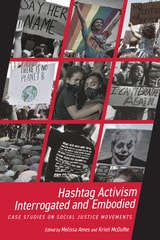
Hashtag Activism Interrogated and Embodied
Case Studies on Social Justice Movementsedited by Melissa Ames & Kristi McDuffie
Utah State University Press, 2022
The chapters capture twenty-first-century digital activism unfolding in different social and geopolitical climates. Delving into hashtag activism in various forms (tweets, memes, and personal narratives) and spaces (Twitter, Facebook, and in-person protests), these chapters reveal how participants question and construct online and offline identities and imagined and actualized communities. They also showcase the complicated ways hashtag activism intersects with consumer, popular, and celebrity cultures.
Hashtag Activism Interrogated and Embodied calls for broader inclusion in what is considered hashtag activism, such as digital fandom, how hashtags are co-opted for nefarious purposes, the effects of anti-activism, and the role of journalism and the media. It will appeal to a range of disciplines including rhetoric and composition, internet studies, communication studies, media studies, feminist studies, affect studies, cultural studies, technical communication, and sociology.
Contributors: Robert Barry, André Brock, Elizabeth Buchanan, Rosemary Clark-Parsons, Gabriel I. Green, Neha Gupta, Jeffrey J. Hall, Kyesha Jennings, Morgan K. Johnson, Salma Kalim, Megan McIntyre, Sean Milligan, Avishek Ray, Sarah Riddick, Stephanie Vie, Erin B. Waggoner, Holly M. Wells, William I. Wolff

J. K. Rowling and the Anti-Trans Panic
Gina Gwenffrewi
The Ohio State University Press, 2026
In J. K. Rowling and the Anti-Trans Panic, Gina Gwenffrewi weaves her own experience as a trans woman living in Edinburgh, Scotland, with analysis of political and pop cultural discourses and artifacts to deliver a trenchant study of how fellow Edinburgh resident J. K. Rowling’s emergence as a major anti-trans campaigner and the years-long entrenchment of existing anti-trans forces have converged. Analyzing Rowling’s output since 2020, a series of anti-trans events at the University of Edinburgh, the transphobic comedy of Ricky Gervais within the British media landscape, YouTube commentaries, and more, Gwenffrewi creates a potent taxonomy of the rhetorical devices and foundational assumptions of anti-trans discourse. While the 2020s UK has proved fertile ground for “gender-critical” feminism, she argues, it has also provided the foundation for sites of resistance and for bolstering transgender voices worldwide. In celebrating trans activism and trans joy amid adversity, Gwenffrewi beautifully captures the light and dark of being out as trans in the city that—if it can fairly be called ground zero for anti-trans fervor—also embodies liberatory possibilities for trans people worldwide.

Radicalizing Men
Fascist Desires, Great Replacement Propaganda, and Political ViolenceJessica Johnson
Duke University Press, 2026

The Afterlife of Data
What Happens to Your Information When You Die and Why You Should CareCarl Öhman
University of Chicago Press, 2024
A short, thought-provoking book about what happens to our online identities after we die.
So much of our lives takes place online—but what about our afterlives? Thanks to the digital trails that we leave behind, our identities can now be reconstructed after our death. In fact, AI technology is already enabling us to “interact” with the departed. Sooner than we think, the dead will outnumber the living on Facebook. In this thought-provoking book, Carl Öhman explores the increasingly urgent question of what we should do with all this data and whether our digital afterlives are really our own—and if not, who should have the right to decide what happens to our data.
The stakes could hardly be higher. In the next thirty years alone, about two billion people will die. Those of us who remain will inherit the digital remains of an entire generation of humanity—the first digital citizens. Whoever ends up controlling these archives will also effectively control future access to our collective digital past, and this power will have vast political consequences. The fate of our digital remains should be of concern to everyone—past, present, and future. Rising to these challenges, Öhman explains, will require a collective reshaping of our economic and technical systems to reflect more than just the monetary value of digital remains.

The Media Swirl
Politics, Audiovisuality, and AestheticsCarol Vernallis
Duke University Press, 2023