Results by title
16 books match the query 'Social participation'

Common Ground
Democracy and Collectivity in an Age of IndividualismJeremy Gilbert
Pluto Press, 2013
Common Ground explores the philosophical relationship between collectivity, individuality, affect and agency in the neoliberal era. Jeremy Gilbert argues that individualism is forced upon us by neoliberal culture, fatally limiting our capacity to escape the current crisis of democratic politics.
The book asks how forces and ideas opposed to neoliberal hegemony, and to the individualist tradition in Western thought, might serve to protect some form of communality, and how far we must accept assumptions about the nature of individuality and collectivity which are the legacy of an elitist tradition. Along the way it examines different ideas and practices of collectivity, from conservative notions of hierarchical and patriarchal communities to the politics of ‘horizontality’ and ‘the commons’ which are at the heart of radical movements today.
Exploring this fundamental faultline in contemporary political struggle, Common Ground proposes a radically non-individualist mode of imagining social life, collective creativity and democratic possibility.
Deaf to the Marrow
Deaf Social Organizing and Active Citizenship in Viet NamAudrey C. Cooper
Gallaudet University Press, 2017
Drawing on research data and work with Vietnamese Deaf colleagues covering an eight-year span, Cooper develops ethnographic and language-centered accounts of Deaf social organizing. These accounts illuminate the ways that Deaf citizens are assuming self-determining roles, or active citizenship, in decisions of local, national, and international importance. By placing Deaf social action in the historical context of state development and modernization projects, Cooper shows how educational structuring reflects dominant, spoken-language-centered views of Vietnamese Deaf people and signed languages. She also addresses the impact of international aid agendas on education, especially those related to disability. Deaf to the Marrow examines perspectives largely ignored in Deaf education, Deaf studies, signed-language linguistics, and anthropological literatures, thereby contributing to scholarship on language and sociopolitical formation broadly and the study of Deaf people’s citizenship practices specifically.
Entering Cultural Communities
Diversity and Change in the Nonprofit ArtsGrams, Diane
Rutgers University Press, 2008
The chapters in this book draw on interviews with leaders, staff, volunteers, and audience members from eighty-five nonprofit cultural organizations to explore how they are trying to increase participation and the extent to which they have been successful. The insiders' accounts point to the opportunities and challenges involved in such efforts, from the reinvention of programs and creation of new activities, to the addition of new departments and staff dynamics, to partnerships with new groups. The authors differentiate between "relational" and "transactional" practices, the former term describing efforts to build connections with local communities and the latter describing efforts to create new consumer markets for cultural products. In both cases, arts leaders report that, although positive results are difficult to measure conclusively, long-term efforts bring better outcomes than short-term activities.
The organizations discussed include large, medium, and small nonprofits located in urban, suburban, and rural areas—from large institutions such as the Smithsonian, the Walker Art Center, the Museum of Fine Arts Houston, and the San Francisco Symphony to many cultural organizations that are smaller, but often known nationally for their innovative work, such as AS220, The Loft Literary Center, Armory Center for the Arts, Appalshop, and the Western Folklife Center.
How Cities Work
Suburbs, Sprawl, and the Roads Not TakenBy Alex Marshall
University of Texas Press, 2001
Do cities work anymore? How did they get to be such sprawling conglomerations of lookalike subdivisions, megafreeways, and "big box" superstores surrounded by acres of parking lots? And why, most of all, don't they feel like real communities? These are the questions that Alex Marshall tackles in this hard-hitting, highly readable look at what makes cities work.
Marshall argues that urban life has broken down because of our basic ignorance of the real forces that shape cities—transportation systems, industry and business, and political decision making. He explores how these forces have built four very different urban environments—the decentralized sprawl of California's Silicon Valley, the crowded streets of New York City's Jackson Heights neighborhood, the controlled growth of Portland, Oregon, and the stage-set facades of Disney's planned community, Celebration, Florida.
To build better cities, Marshall asserts, we must understand and intelligently direct the forces that shape them. Without prescribing any one solution, he defines the key issues facing all concerned citizens who are trying to control urban sprawl and build real communities. His timely book will be important reading for a wide public and professional audience.
Mexican Hometown Associations in Chicagoacán
From Local to Transnational Civic EngagementBada, Xóchitl
Rutgers University Press, 0
Hometown associations (HTAs) consist of immigrants from the same town in Mexico and often begin quite informally, as soccer clubs or prayer groups. As Bada’s work shows, however, HTAs have become a powerful force for change, advocating for Mexican immigrants in the United States while also working to improve living conditions in their communities of origin. Focusing on a group of HTAs founded by immigrants from the state of Michoacán, the book shows how their activism has bridged public and private spheres, mobilizing social reforms in both inner-city Chicago and rural Mexico.
Bringing together ethnography, political theory, and archival research, Bada excavates the surprisingly long history of Chicago’s HTAs, dating back to the 1920s, then traces the emergence of new models of community activism in the twenty-first century. Filled with vivid observations and original interviews, Mexican Hometown Associations in Chicagoacán gives voice to an underrepresented community and sheds light on an underexplored form of global activism.
Music Making Community
Edited by Tony Perman and Stefan Fiol
University of Illinois Press, 2024
Making music offers enormous possibilities--and faces significant limitations--in its power to generate belonging and advance social justice. Tony Perman and Stefan Fiol edit essays focused on the forms of interplay between music-making and community-making as mutually creative processes. Contributors in the first section look at cases where music arrived in settings with little or no sense of community and formed social bonds that lasted beyond its departure. In the sections that follow, the essayists turn to stable communities that used musical forms to address social needs and both forged new social groups and, in some cases, splintered established communities. By centering the value of difference in productive feedback dynamics of music and community while asserting the need for mutual moral indebtedness, they foreground music’s potential to transform community for the better.
Contributors: Stephen Blum, Joanna Bosse, Sylvia Bruinders, Donna A. Buchanan, Rick Deja, Veit Erlmann, Stefan Fiol, Eduardo Herrera, David A. McDonald, Tony Perman, Thomas Solomon, and Ioannis Tsekouras
Sacred Assemblies and Civic Engagement
How Religion Matters for America's Newest ImmigrantsNumrich, Paul D
Rutgers University Press, 2007
Immigration to the United States has been a major source of population growth and cultural change throughout much of America’s history. Currently, about 40 percent of the nation’s annual population growth comes from the influx of foreign-born individuals and their children. As these new voices enter America’s public conversations, they bring with them a new understanding of Buddhism, Hinduism, Islam, Judaism, and Christianity to a society that has been marked by religious variety.
Sacred Assemblies and Civic Engagement takes an in-depth look at one particular urban area—the Chicago metropolitan region—and examines how religion affects the civic engagement of the nation’s newest residents. Chapters focus on important religious factors, including sectarianism, moral authority, and moral projects; on several areas of social life, including economics, education, marriage, and language, where religion impacts civic engagement; and on how notions of citizenship and community are influenced by sacred assemblies.

Skepticism
Aryeh Botwinick
Temple University Press, 1990
Aryeh Botwinick argues for the recovery of a radical democratic tradition that emphasizes the role of individual participation in the development and control of social and political institutions. Such involvement implies philosophical skepticism—the assumption that the truth about what is the best course of action cannot be known with certainty and that, therefore, every person’s opinion has an equal claim to be considered. The crucial stumbling block to reappropriating this radical egalitarian tradition is the supposed unviability of a consistent skepticism. In an effort to chart a new course of philosophical inquiry into political matters, Botwinick grapples with the formulation of a consistent version of skepticism, claiming that it provides "a continually renewing impetus for the expansion of political participation."
Twentieth-century philosophers have, for the most part, opted for some version of mitigated skepticism, which, the author argues, "has blinded them to the radical political implications of skepticism." Underscoring a pattern of convergence between Anglo-American and Continental philosophy, Botwinick proposes a number of strategies to rehabilitate the rationality of participatory democratic political institutions by articulating an acceptable version of consistent skepticism.
Strategies for Social Change
Gregory M. Maney
University of Minnesota Press, 2012
The theory and practice of social movements come together in strategy—whether, why, and how people can realize their visions of another world by acting together. Strategies for Social Change offers a concise definition of strategy and a framework for differentiating between strategies. Specific chapters address microlevel decision-making processes and creativity, coalition building in Northern Ireland, nonviolent strategies for challenging repressive regimes, identity politics, GLBT rights, the Christian right in Canada and the United States, land struggles in Brazil and India, movement-media publicity, and corporate social movement organizations.
Contributors: Jessica Ayo Alabi, Orange Coast College; Kenneth T. Andrews, U of North Carolina at Chapel Hill; Anna-Liisa Aunio, U of Montreal; Linda Blozie; Tina Fetner, McMaster U; James M. Jasper, CUNY; Karen Jeffreys; David S. Meyer, U of California, Irvine; Sharon Erickson Nepstad, U of New Mexico; Francesca Polletta, U of California, Irvine; Belinda Robnett, U of California, Irvine; Charlotte Ryan, U of Massachusetts–Lowell; Carrie Sanders, Wilfrid Laurier U; Kurt Schock, Rutgers U; Jackie Smith, U of Pittsburgh; Suzanne Staggenborg, U of Pittsburgh; Stellan Vinthagen, U West, Sweden; Nancy Whittier, Smith College.
The Future of Democracy
Developing the Next Generation of American CitizensPeter Levine
University Press of New England, 2015
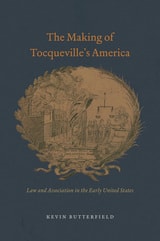
The Making of Tocqueville's America
Law and Association in the Early United StatesKevin Butterfield
University of Chicago Press, 2015
Butterfield explains that the first generations of American citizens found in the concept of membership—in churches, fraternities, reform societies, labor unions, and private business corporations—a mechanism to balance the tension between collective action and personal autonomy, something they accomplished by emphasizing law and procedural fairness. As this post-Revolutionary procedural culture developed, so too did the legal substructure of American civil society. Tocqueville, then, was wrong to see associations as the training ground for democracy, where people learned to honor one another’s voices and perspectives. Rather, they were the training ground for something no less valuable to the success of the American democratic experiment: increasingly formal and legalistic relations among people.
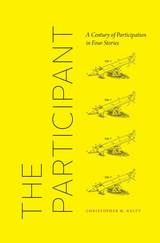
The Participant
A Century of Participation in Four StoriesChristopher M. Kelty
University of Chicago Press, 2019
In this book, Christopher M. Kelty traces four stories of participation across the twentieth century, showing how they are part of a much longer-term problem in relation to the individual and collective experience of representative democracy. Kelty argues that in the last century or so, the power of participation has dwindled; over time, it has been formatted in ways that cramp and dwarf it, even as the drive to participate has spread to nearly every kind of human endeavor, all around the world. The Participant is a historical ethnography of the concept of participation, investigating how the concept has evolved into the form it takes today. It is a book that asks, “Why do we participate?” And sometimes, “Why do we refuse?”
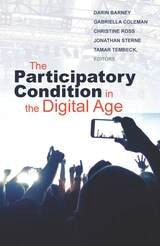
The Participatory Condition in the Digital Age
Darin Barney
University of Minnesota Press, 2016
Just what is the “participatory condition”? It is the situation in which taking part in something with others has become both environmental and normative. The fact that we have always participated does not mean we have always lived under the participatory condition. What is distinctive about the present is the extent to which the everyday social, economic, cultural, and political activities that comprise simply being in the world have been thematized and organized around the priority of participation.
Structured along four axes investigating the relations between participation and politics, surveillance, openness, and aesthetics, The Participatory Condition in the Digital Age comprises fifteen essays that explore the promises, possibilities, and failures of contemporary participatory media practices as related to power, Occupy Wall Street, the Arab Spring uprisings, worker-owned cooperatives for the post-Internet age; paradoxes of participation, media activism, open source projects; participatory civic life; commercial surveillance; contemporary art and design; and education.
This book represents the most comprehensive and transdisciplinary endeavor to date to examine the nature, place, and value of participation in the digital age. Just as in 1979, when Jean-François Lyotard proposed that “the postmodern condition” was characterized by the questioning of historical grand narratives, The Participatory Condition in the Digital Age investigates how participation has become a central preoccupation of our time.
Contributors: Mark Andrejevic, Pomona College; Bart Cammaerts, London School of Economics and Political Science (LSE); Nico Carpentier, Vrije Universiteit Brussel (VUB – Free University of Brussels) and Charles University in Prague; Julie E. Cohen, Georgetown University; Kate Crawford, MIT; Alessandro Delfanti, University of Toronto; Christina Dunbar-Hester, University of Southern California; Rudolf Frieling, California College of Arts and the San Francisco Art Institute; Salvatore Iaconesi, La Sapienza University of Rome and ISIA Design Florence; Jason Edward Lewis, Concordia University; Rafael Lozano-Hemmer; Graham Pullin, University of Dundee; Trebor Scholz, The New School in New York City; Cayley Sorochan, McGill University; Bernard Stiegler, Institute for Research and Innovation in Paris; Krzysztof Wodiczko, Harvard Graduate School of Design; Jillian C. York.
The Prison House of the Circuit
Politics of Control from Analog to DigitalJeremy Packer
University of Minnesota Press, 2023
Has society ceded its self-governance to technogovernance?
The Prison House of the Circuit presents a history of digital media using circuits and circuitry to understand how power operates in the contemporary era. Through the conceptual vocabulary of the circuit, it offers a provocative model for thinking about governance and media.
The authors, writing as a collective, provide a model for collective research and a genealogical framework that interrogates the rise of digital society through the lens of Foucault’s ideas of governance, circulation, and power. The book includes five in-depth case studies investigating the transition from analog media to electronic and digital forms: military telegraphy and human–machine incorporation, the establishment of national electronic biopolitical governance in World War I, media as the means of extending spatial and temporal policing, automobility as the mechanism uniting mobility and media, and visual augmentation from Middle Ages spectacles to digital heads-up displays. The Prison House of the Circuit ultimately demonstrates how contemporary media came to create frictionless circulation to maximize control, efficacy, and state power.
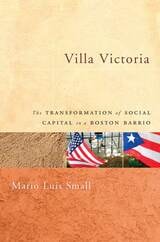
Villa Victoria
The Transformation of Social Capital in a Boston BarrioMario Luis Small
University of Chicago Press, 2004
This book examines a neglected Puerto Rican enclave in Boston to consider the pros and cons of social scientific thinking about the true nature of ghettos in America. Mario Luis Small dismantles the theory that poor urban neighborhoods are inevitably deprived of social capital. He shows that the conditions specified in this theory are vaguely defined and variable among poor communities. According to Small, structural conditions such as unemployment or a failed system of familial relations must be acknowledged as affecting the urban poor, but individual motivations and the importance of timing must be considered as well.
Brimming with fresh theoretical insights, Villa Victoria is an elegant work of sociology that will be essential to students of urban poverty.
We
Reviving Social HopeRonald Aronson
University of Chicago Press, 2017
Beneath today’s crisis Aronson examines our heartbreaking story: a century of catastrophic violence and the bewildering ambiguity of progress—all of which have contributed to the evaporation of social hope. As he shows, we are now in a time when hope is increasingly privatized, when—despite all the ways we are connected to each other—we are desperately alone, struggling to weather the maelstrom around us, demoralized by the cynicism that permeates our culture and politics, and burdened with finding personal solutions to social problems.
Yet, Aronson argues, even at a time when false hopes are rife, social hope still persists. Carefully exploring what we mean when we say we “hope” and teasing hope apart from its dangerously misconstrued sibling, “progress,” he locates seeds of real change. He argues that always underlying our experience—even if we completely ignore it—is the fact of our social belonging, and that this can be reactivated into a powerful collective force, an active we. He looks to various political movements, from the massive collective force of environmentalists to the movements around Sanders and Jeremy Corbyn, as powerful examples of socially energized, politically determined, and actionably engaged forms of hope. Even in this age of Donald Trump, the result is an illuminating and inspiring call that anyone can clearly hear: we can still create a better future for everyone, but only if we resist false hopes and act together.