Results by title
6 books match the query 'Social systems'
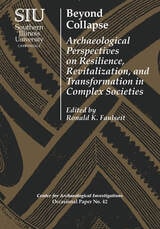
Beyond Collapse
Archaeological Perspectives on Resilience, Revitalization, and Transformation in Complex SocietiesEdited by Ronald K. Faulseit
Southern Illinois University Press, 2015
Essays in the book are arranged into five sections. The first section addresses previous research on the subject of collapse and reorganization as well as recent and historic theoretical trends. In the second section, contributors look at collapse and resilience through the concepts of collective action, eventful archaeology, and resilience theory. The third section introduces critical analyses of the effectiveness of resilience theory as a heuristic tool for modeling the phenomena of collapse and resilience. In the fourth section, contributors examine long-term adaptive strategies employed by prehistoric societies to cope with stresses. Essays in the fifth section make connections to contemporary research on post-decline societies in a variety of time periods and geographic locations.
Contributors consider collapse and reorganization not as unrelated phenomena but as integral components in the evolution of complex societies. Using archaeological data to interpret how ancient civilizations responded to various stresses—including environmental change, warfare, and the fragmentation of political institutions—contributors discuss not only what leads societies to collapse but also why some societies are resilient and others are not, as well as how societies reorganize after collapse. The implications of the fate of these societies for modern nations cannot be underestimated. Putting in context issues we face today, such as climate change, lack of social diversity, and the failure of modern states, Beyond Collapse is an essential volume for readers interested in human-environment interaction and in the collapse—and subsequent reorganization—of human societies.

Complex Systems in the Social and Behavioral Sciences
Theory, Method and ApplicationEuel Elliott and L. Douglas Kiel, eds.
University of Michigan Press, 2021
Complexity Systems in the Social and Behavioral Sciences provides a sophisticated yet accessible account of complexity science or complex systems research. Phenomena in the behavioral, social, and hard sciences all exhibit certain important similarities consistent with complex systems. These include the concept of emergence, sensitivity to initial conditions, and interactions between agents in a system that yield unanticipated, nonlinear outcomes. The topics discussed range from the implications for artificial intelligence and computing to questions about how to model complex systems through agent-based modeling, to complex phenomena exhibited in international relations, and in organizational behavior. This volume will be an invaluable addition for both the general reader and the specialist, offering new insights into this fascinating area of research.

Economic Organizations and Social Systems
Robert A. Solo
University of Michigan Press, 2000
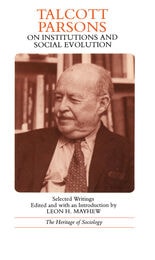
Talcott Parsons on Institutions and Social Evolution
Selected WritingsTalcott Parsons
University of Chicago Press, 1983
In his extensive introduction to this volume, Leon H. Mayhew brings a new focus and clarity to Talcott Parsons's work. Explicating Parsons on his own terms, Mayhew discusses the basic tools of Parsonian analysis and interprets the larger themes of his work. He provides a chronological account of the development of Parsons's thought, his presuppositions, and his position on the ideological spectrum of social thought.
Mayhew then presents twenty of Parsons's essays, touching on each of the major aspects of his work, including "action" theory and the celebrated four-function scheme. Other topics covered include the role of theory in social research, evolutionary universals in society, influence, control, and the mass media.
"Talcott Parsons on Institutions and Social Evolution will become a standard reference for those studying that development of his sociological ideas."—Martin Bulmer, The Times Higher Education Supplement

The Postclassic Mesoamerican World
Michael E Smith
University of Utah Press, 2003
Edited by Michael E. Smith and Frances F. Berdan
Anthropology and Archaeology
The past two decades have seen an explosion of research on Postclassic Mesoamerican societies. In this ambitious new volume, the editors and contributors seek to present a complete picture of the middle and late Postclassic period (ca. AD 1100-1500) employing a new theoretical framework.
Mesoamerican societies after the collapse of the great city-states of Tula and Chichen Itza stand out from earlier societies in a number of ways. They had larger regional populations, smaller polities, a higher volume of long-distance trade, greater diversity of trade goods, a more commercialized economy, and new standardized forms of pictorial writing and iconography. The emerging archaeological record reveals larger quantities of imported goods in Postclassic contexts, and ethnohistoric accounts describe marketplaces, professional merchants, and the use of money throughout Mesoamerica by the time of the Spanish conquest. The integration of this commercial economy with new forms of visual communication produced a dynamic world system that reached every corner of Mesoamerica.
Thirty-six focused articles by twelve authors describe and analyze the complexity of Postclassic Mesoamerica. After an initial theoretical section, chapters are organized by key themes: polities, economic networks, information networks, case studies, and comparisons. Covering a region from western Mexico to Yucatan and the southwestern Maya highlands, this volume should be in the library of anyone with a serious interest in ancient Mexico.

World-Systems Analysis
An IntroductionImmanuel Wallerstein
Duke University Press, 2004
Wallerstein explains the defining characteristics of world-systems analysis: its emphasis on world-systems rather than nation-states, on the need to consider historical processes as they unfold over long periods of time, and on combining within a single analytical framework bodies of knowledge usually viewed as distinct from one another—such as history, political science, economics, and sociology. He describes the world-system as a social reality comprised of interconnected nations, firms, households, classes, and identity groups of all kinds. He identifies and highlights the significance of the key moments in the evolution of the modern world-system: the development of a capitalist world-economy in the sixteenth-century, the beginning of two centuries of liberal centrism in the French Revolution of 1789, and the undermining of that centrism in the global revolts of 1968. Intended for general readers, students, and experienced practitioners alike, this book presents a complete overview of world-systems analysis by its original architect.