Results by title
2 books match the query 'Socialist realism in literature'
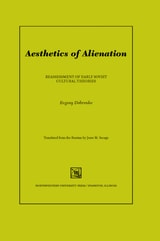
Aesthetics of Alienation
Reassessment of Early Soviet Cultural TheoriesEvgeny Dobrenko
Northwestern University Press, 2005
This provocative work takes issue with the idea that Socialist Realism was mainly the creation of party leaders and was imposed from above on the literati who lived and worked under the Soviet regime. Evgeny Dobrenko, a leading expert on Soviet literature, argues instead--and offers persuasive evidence--that the aesthetic theories underpinning Socialist Realism arose among the writers themselves, born of their proponents' desire for power in the realm of literary policymaking. Accordingly, Dobrenko closely considers the evolution of these theories, deciphering the power relations and social conditions that helped to shape them.
In chapters on Proletkult, RAPP, LEF, and Pereval, Dobrenko reexamines the theories generated by these major Marxist literary groupings of the early Soviet Union. He shows how each approached the problems of literature's response to the presumed social mandate of the young communist society, and how Socialist Realism emerged as a conglomerate of these earlier, revolutionary theories. With extensive and detailed reference to supporting testimony and documents, Dobrenko clearly demonstrates how Socialist Realism was created from within the revolutionary culture, and how this culture and its disciples fully participated in this creative process. His work represents a major breakthrough in our current understanding of the complex sources that contributed to early Soviet culture.
In chapters on Proletkult, RAPP, LEF, and Pereval, Dobrenko reexamines the theories generated by these major Marxist literary groupings of the early Soviet Union. He shows how each approached the problems of literature's response to the presumed social mandate of the young communist society, and how Socialist Realism emerged as a conglomerate of these earlier, revolutionary theories. With extensive and detailed reference to supporting testimony and documents, Dobrenko clearly demonstrates how Socialist Realism was created from within the revolutionary culture, and how this culture and its disciples fully participated in this creative process. His work represents a major breakthrough in our current understanding of the complex sources that contributed to early Soviet culture.
[more]
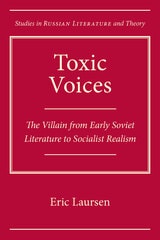
Toxic Voices
The Villain from Early Soviet Literature to Socialist RealismEric Laursen
Northwestern University Press, 2013
Satire and the fantastic, vital literary genres in the 1920s, are often thought to have fallen victim to the official adoption of socialist realism. Eric Laursen contends that these subversive genres did not just vanish or move underground. Instead, key strategies of each survive to sustain the villain of socialist realism. Laursen argues that the judgment of satire and the hesitation associated with the fantastic produce a narrative obsession with controlling the villain’s influence. In identifying a crucial connection between the questioning, subversive literature of the 1920s and the socialist realists, Laursen produces an insightful revision of Soviet literary history.
[more]