Results by title
2 books match the query 'Sociolinguistic Variation'
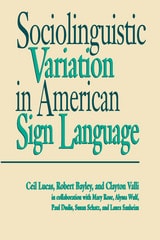
Sociolinguistic Variation in American Sign Language
Ceil Lucas
Gallaudet University Press, 2001
The culmination of a seven-year project, this volume provides a complete description of American Sign Language (ASL) variation. For four decades, linguists have studied how people from varying regions and backgrounds have different ways of saying the same thing. For example, in English some people say “test,” while others say “tes’”, dropping the final “t.” Noted scholars Ceil Lucas, Robert Bayley, and Clayton Valli led a team of exceptional researchers in applying techniques for analyzing spoken language variation to ASL. Their observations at the phonological, lexical, morphological, and syntactic levels demonstrate that ASL variation correlates with many of the same driving social factors of spoken languages, including age, socioeconomic class, gender, ethnic background, region, and sexual orientation. Internal constraints that mandate variant choices for spoken languages have been compared to ASL as well, with intriguing results. Sociolinguistic Variation in American Sign Language stands alone as the new standard for students and scholars committed to this discipline.
[more]
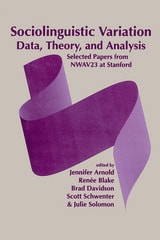
Sociolinguistic Variation
Data, Theory, and AnalysisEdited by Jennifer Arnold, Renee Blake, and Brad Davidson
CSLI, 1996
This volume collects selected papers from the twenty-third New Ways of Analyzing Variation (NWAV23) conference held at Stanford University. It is a collection of innovative papers on the newest developments in research on variation. The range of topics covered in this collection include: phonological variation, morphosyntactic variation, register and style, discourse, codeswitching, and language change. A foreword by John Rickford ties the collection together. This volume will be of interest to sociolinguists, sociologists, and any scholar interested in comparative linguistics.
[more]