Results by title
135 books match the query 'Sociological aspects' and 10 start with a

A Social Ecology of Capital
Éric Pineault
Pluto Press, 2022
An original theory of contemporary capitalist growth and its socio-ecological contradictions
Capital is pushing into motion ever larger global material flows. In doing so it has come to depend on massive expenditures of energy, putting to work fossil fuels and the machines they animate to transform the world, accumulate power and grow the economy. The ecological relations and crises of today’s societies are driven by the processes of extraction of the elements that come together as a throughput of material and energy flows controlled by capital and shaped by its imperative of valorization.
In A Social Ecology of Capital, Éric Pineault proposes an original model of the fossil social metabolism that has sustained the growth of advanced capitalism in the last century.
Drawing on ecological economics and critical political economy, the book analyses how the social structures of accumulation, production, consumption and waste determine and regulate the material flow and the accumulation of material artifacts. Showing how social relations shape the ecology of capital, the book highlights the contradictions humanity now faces.
Academic Ableism
Disability and Higher EducationJay Timothy Dolmage
University of Michigan Press, 2017
Academic Ableism
Disability and Higher EducationJay Timothy Dolmage
University of Michigan Press, 2017

Academic Disciplines
Holland's Theory and the Study of College Students and FacultyJohn C. Smart
Vanderbilt University Press, 2000
Using as a framework the "theory of careers" developed by John L. Holland, the authors of this volume examine the patterns of student stability and change inherent in the college experience, as well as the variations in professional attitudes and behaviors of college faculty. Their goal is to learn more about what colleges and universities might do to facilitate the retention, satisfaction, and learning of their students.
For example, why should faculties split over student-oriented teaching strategies, one group favoring the formal, structured classroom, the other a freer, more spontaneous environment? Why do some undergraduates become independent thinkers with strong analytical, mathematical, and scientific competencies while others develop powerful interpersonal and group leadership skills?
Holland's theory--at its core a person-environment fit theory--assumes that there are six personality types and six analogous academic environments and that the educational persistence, satisfaction, and achievement of students are a function of the congruence or "fit" between students and their academic environments. The authors also assume that there are circumstances under which the environments of the major field exert more influence on students than do the students' own personality traits. Applying Holland's theory to distinctive clusters of academic disciplines, the authors have found that the answers to such fundamental questions as those asked above emanate from a basic understanding of the influences of academic disciplines and the manner by which they shape the patterns of thought and behavior of both college students and faculty.
Academic Disciplines will benefit researchers and graduate students who study college students and faculty, as well as administrators and policymakers responsible for the performance of colleges and universities.
Adapting VALUEs
Tracing the Life of a Rubric through Institutional EthnographyJennifer Grouling
University Press of Colorado, 2023
After Genocide
Memory and Reconciliation in RwandaNicole Fox
University of Wisconsin Press, 2023
In the wake of unthinkable atrocities, it is reasonable to ask how any population can move on from the experience of genocide. Simply remembering the past can, in the shadow of mass death, be retraumatizing. So how can such momentous events be memorialized in a way that is productive and even healing for survivors? Genocide memorials tell a story about the past, preserve evidence of the violence that occurred, and provide emotional support to survivors. But the goal of amplifying survivors’ voices can fade amid larger narratives entrenched in political motivations.
In After Genocide,Nicole Fox investigates the ways memorials can shape the experiences of survivors decades after mass violence has ended. She examines how memorializations can both heal and hurt, especially when they fail to represent all genders, ethnicities, and classes of those afflicted. Drawing on extensive interviews with Rwandans, Fox reveals their relationships to these spaces and uncovers those voices silenced by the dominant narrative—arguing that the erasure of such stories is an act of violence itself. The book probes the ongoing question of how to fit survivors in to the dominant narrative of healing and importantly demonstrates how memorials can shape possibilities for growth, national cohesion, reconciliation, and hope for the future.

Against Money
J. W. Mason and Arjun Jayadev
University of Chicago Press, 2026
A powerful deconstruction of humanity’s most influential invention, from the acclaimed economists J. W. Mason and Arjun Jayadev.
Money is everywhere in our daily lives. It lurks in the swipe of a card at the grocery store, in looming student-loan debts, in the prices of things we want, and in our subconscious navigation of the modern world. Money is an invisible convenience that saves us, as a society, the hassle of bartering for goods and services—a reflection, in our pockets and on our phones, of the hard facts of scarcity and desire. Or is it something more?
In this revelatory book, economists J. W. Mason and Arjun Jayadev explain how and why money is so deeply misunderstood by the world it dominates—as well as the dangerous social implications of this misunderstanding. Against Money tackles the most dearly held “truths” of economics, arguing that the world of money has never been an impartial representation of the world of things. Instead, its existence in different forms—debt, capital, liquidity, and interest—increasingly shapes events in the real world rather than just reflecting them. Sometimes money enables new forms of cooperation; more oftenit facilitates domination. Human existence is not just facilitated by money but also governed by it.
In the tradition of works by Thomas Piketty and David Graeber, Against Money is an erudite, disruptive exposé of the illusions and tyrannies of money. Mason and Jayadev present a radically different way of thinking about money—imagining a hopeful future in which it no longer dictates the possibilities of our collective existence.
An Epidemic of Uncertainty
Navigating HIV and Young Adulthood in MalawiJenny Trinitapoli
University of Chicago Press, 2023
An Epidemic of Uncertainty advances a new framework for studying social life by emphasizing something social scientists routinely omit from their theories, models, and measures–what people know they don’t know. Taking Malawi’s ongoing AIDS epidemic as an entry point, Jenny Trinitapoli shows that despite admirable declines in new HIV infections and AIDS-related mortality, an epidemic of uncertainty persists; at any given point in time, fully half of Malawian young adults don’t know their HIV status. Reckoning with the impact of this uncertainty within the bustling trading town of Balaka, Trinitapoli argues that HIV-related uncertainty is measurable, pervasive, and impervious to biomedical solutions, with consequences that expand into multiple domains of life, including relationship stability, fertility, and health. Over the duration of a groundbreaking decade-long longitudinal study, rich survey data and poignant ethnographic vignettes vividly depict how individual lives and population patterns unfold against the backdrop of an ever-evolving epidemic. Even as HIV is transformed from a progressive, fatal disease to a chronic and manageable condition, the accompanying epidemic of uncertainty remains fundamental to understanding social life in this part of the world.
Insisting that known unknowns can and should be integrated into social-scientific models of human behavior, An Epidemic of Uncertainty treats uncertainty as an enduring aspect, a central feature, and a powerful force in everyday life.
An Unexpected Minority
White Kids in an Urban SchoolMorris, Edward
Rutgers University Press, 2005
In An Unexpected Minority, sociologist Edward Morris addresses these far-reaching questions by exploring attitudes about white identity in a Texas middle school composed predominantly of African Americans, Latinos, and Asians. Based on his ethnographic research, Morris argues that lower-income white students in urban schools do not necessarily maintain the sort of white privilege documented in other settings. Within the student body, African American students were more frequently the "cool" kids, and white students adopted elements of black culture-including dress, hairstyle, and language-to gain acceptance. Morris observes, however, that racial inequalities were not always reversed. Stereotypes that cast white students as better behaved and more academically gifted were often reinforced, even by African American teachers.
Providing a new and timely perspective to the significant role that non-whites play in the construction of attitudes about whiteness, this book takes an important step in advancing the discussion of racial inequality and its future in this country.
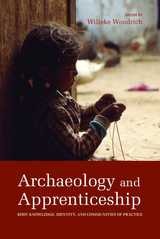
Archaeology and Apprenticeship
Body Knowledge, Identity, and Communities of PracticeEdited by Willeke Wendrich
University of Arizona Press, 2012
Apprenticeship is broadly defined as the transmission of culture through a formal or informal teacher–pupil relationship. This collection invites a wide discussion, citing case studies from all over the world and yet focuses the scholarship into a concise set of contributions. The chapters in this volume demonstrate how archaeology can benefit greatly from the understanding of the social dimensions of knowledge transfer. This book also examines apprenticeship in archaeology against a backdrop of sociological and cognitive psychology literature, to enrich the understanding of the relationship between material remains and enculturation.
Each of the authors in this collection looks specifically at how material remains can reveal several specific aspects of ancient cultures: What is the human potential for learning? How do people learn? Who is teaching? Why are they learning? What are the results of such learning? How do we recognize knowledge transfer in the archaeological record? These fundamental questions are featured in various forms in all chapters of the book. With case studies from the American Southwest, Alaska, Egypt, Ancient Greece, and Mesopotamia, this book will have broad appeal for scholars—particularly those concerned with cultural transmission and traditions of learning and education—all over the world.