Results by title
40 books match the query 'Sociological jurisprudence'

Archiving Sovereignty
Law, History, ViolenceStewart Motha
University of Michigan Press, 2018
Sovereignty is often cast as a limit-concept, constituent force, determining the boundary of law. Archiving Sovereignty reverses this to explain how judicial pronouncements inscribe and sustain extravagant claims to exceptionality and sovereign solitude. This wide-ranging, critical work distinguishes between myths that sustain neocolonial orders and fictions that generate new forms of political and ethical life.

Beyond Monopoly
Lawyers, State Crises, and Professional EmpowermentTerence C. Halliday
University of Chicago Press, 1987
In this pathbreaking study of the legal profession, Terence Halliday raises and addresses these questions combining extensive data from the rich archives o the Chicago Bar Association, one of the nation's largest and wealthiest bar organizations, with data from a national survey of bar legislative and judicial action. Beyond Monopoly demonstrates that the primary commitment of lawyers to economic monopoly has long been complemented by "civic professionalism" as the legal profession takes on more responsibility in the American democratic system when state capabilities diminish.
Through his examination of three types of state crises in the 1950s and 1960s—the challenges to legitimacy in the legal system, the crisis of individual rights during McCarthyism and the civil rights eras, and the fiscal crises of various state governments—Halliday shows that large bar associations can have extensive influence on any institution that is regulated by law. He argues that lawyers have the capability of turning social and political issues into technical legal matters in what he calls an "idiom of legalism." Under technical guise, lawyers come to exercise moral authority.
Halliday maintains that the American legal profession over the past century has gone from a formative stage, when controlling its market in the delivery of legal services was paramount, to an established phase in the past two decades, when it has committed extensive resources to the complex needs of the modern state. A de facto bargain has been struck: if the state leaves the profession's monopoly fairly intact, the profession can use its expert resources to help the state adapt to strain and crisis. It can do so not only in the legal system, where it has been championing "autonomous" law, but in other spheres as well—from the economy to the private sphere of individual rights.
Halliday confirms that the legal profession deploys its expertise not merely to attain professional dominance, to control a market, or to purvey an ideology, but to increase the viability of democratic institutions. Beyond Monopoly introduces a pioneering approach to a historical and comparative sociology of the professions that will be of vital interest not only to sociologists, but to political scientists and lawyers as well.
Conceptual Activism
Radical Sense-Making and the Struggle for GenderDavina Cooper
Duke University Press, 2026
Crossing Boundaries
Traditions and Transformations in Law and Society ResearchAustin Sarat
Northwestern University Press, 1998
Cultural Analysis, Cultural Studies, and the Law
Moving Beyond Legal RealismAustin Sarat and Jonathan Simon, eds.
Duke University Press, 2003
Drawing on legal scholarship, literary criticism, psychoanalytic theory, and anthropology, the essays collected here exemplify the contributions cultural analysis and cultural studies make to interdisciplinary legal study. Some of these broad-ranging pieces describe particular approaches to the cultural study of the law, while others look at specific moments where the law and culture intersect. Contributors confront the deep connections between law, social science, and post-World War II American liberalism; examine the traffic between legal and late-nineteenth- and early-twentieth-century scientific discourses; and investigate, through a focus on recovered memory, the ways psychotherapy is absorbed into the law. The essayists also explore specific moments where the law is forced to comprehend the world beyond its boundaries, illuminating its dependence on a series of unacknowledged aesthetic, psychological, and cultural assumptions—as in Aldolph Eichmann’s 1957 trial, hiv-related cases, and the U.S. Supreme Court’s recent efforts to define the role of race in the construction of constitutionally adequate voting districts.
Contributors. Paul Berman, Peter Brooks, Wai Chee Dimock, Anthony Farley, Shoshanna Felman, Carol Greenhouse, Paul Kahn, Naomi Mezey, Tobey Miller, Austin Sarat, Jonathan Simon, Alison Young
Cultural Pluralism, Identity Politics, and the Law
Austin Sarat and Thomas R. Kearns, Editors
University of Michigan Press, 2001
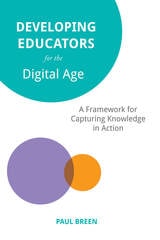
Developing Educators for The Digital Age
A Framework for Capturing Knowledge in ActionPaul Breen
University of Westminster Press, 2018
Evaluating skills and knowledge capture lies at the cutting edge of contemporary higher education where there is a drive towards increasing evaluation of classroom performance and use of digital technologies in pedagogy. Developing Educators for the Digital Age is a book that provides a narrative account of teacher development geared towards the further usage of technologies (including iPads, MOOCs and whiteboards) in the classroom presented via the histories and observation of a diverse group of teachers engaged in the multiple dimensions of their profession.
Drawing on the insights of a variety of educational theories and approaches (including TPACK) it presents a practical framework for capturing knowledge in action of these English language teachers – in their own voices – indicating how such methods, processes and experiences shed light more widely on related contexts within HE and may be transferable to other situations.
This book will be of interest to the growing body of scholars interested in TPACK theory, or communities of practice theory and more widely anyone concerned with how new pedagogical skills and knowledge with technology may be incorporated in better practice and concrete instances of teaching.
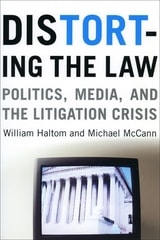
Distorting the Law
Politics, Media, and the Litigation CrisisWilliam Haltom and Michael McCann
University of Chicago Press, 2004
Scholars have argued for years that this common view of the depraved ruin of our civil legal system is a myth, but their research and statistics rarely make the news. William Haltom and Michael McCann here persuasively show how popularized distorted understandings of tort litigation (or tort tales) have been perpetuated by the mass media and reform proponents. Distorting the Law lays bare how media coverage has sensationalized lawsuits and sympathetically portrayed corporate interests, supporting big business and reinforcing negative stereotypes of law practices.
Based on extensive interviews, nearly two decades of newspaper coverage, and in-depth studies of the McDonald's coffee case and tobacco litigation, Distorting the Law offers a compelling analysis of the presumed litigation crisis, the campaign for tort law reform, and the crucial role the media play in this process.

Foucault and Law
Towards a Sociology of Law As GovernanceAlan Hunt and Gary Wickham
Pluto Press, 1994
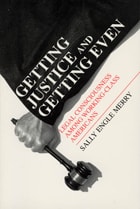
Getting Justice and Getting Even
Legal Consciousness among Working-Class AmericansSally Engle Merry
University of Chicago Press, 1990
Getting Justice and Getting Even concerns the legal consciousness of working class Americans and their experiences with court and mediation. Following cases into and through the courts, Sally Engle Merry provides an ethnographic study of local law and of the people who use it in a New England city. The litigants, primarily white, native-born, and working class, go to court because as part of mainstream America they feel entitled to use its legal system. Although neither powerful nor highly educated, they expect the law's support when they face intolerable infringements of their rights, privacy, and safety. Yet as personal problems enter the legal system and move through mediation sessions, clerk's hearings, and prosecutor's conferences, the citizen plaintiff rapidly loses control of the process. Court officials and mediators interpret and characterize the meaning of these experiences, reframing and categorizing them in different discourses. Some plaintiffs yield to these interpretations, but others resist, struggling to assert their own version of the problem.
Ultimately, Merry exposes the paradox of legal entitlement. While going to court allows an individual to dominate domestic relationships, the litigant must increasingly yield control of the situation to the court that supplies that power.
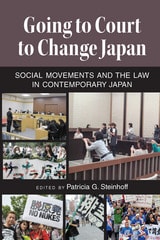
Going to Court to Change Japan
Social Movements and the Law in Contemporary JapanPatricia G. Steinhoff, Editor
University of Michigan Press, 2014
Happiness and the Law
John Bronsteen, Christopher Buccafusco, and Jonathan S. Masur
University of Chicago Press, 2014
Drawing on new research in psychology, neuroscience, and economics, the authors of Happiness and the Law assess how the law affects people’s quality of life—and how it can do so in a better way. Taking readers through some of the common questions about and objections to the use of happiness research in law and policy, they consider two areas in depth: criminal punishment and civil lawsuits. More broadly, the book proposes a comprehensive approach to assessing human welfare—well-being analysis—that is a valuable alternative to the strictly economically based cost-benefit analyses currently dominating how we evaluate public policy. The study of happiness is the next step in the evolution from traditional economic analysis of the law to a behavioral approach. Happiness and the Law will serve as the definitive, yet accessible, guide to understanding this new paradigm.
How Does Law Matter?
Fundamental Issues in Law And SocietyBryant G. Garth and Austin Sarat
Northwestern University Press, 1998
These essays show how law is relevant in both an "instrumental" and a "constitutive" sense, as a tool to accomplish particular purposes and as an important force in shaping the everyday worlds in which we live. Essays examine these issues by focusing on legal consciousness, the body, discrimination, and colonialism as well as on more traditional legal concerns such as juries and criminal justice.
Invitation to Law and Society, Second Edition
An Introduction to the Study of Real LawKitty Calavita
University of Chicago Press, 2016
With this second edition of Invitation to Law and Society, Calavita brings up to date what is arguably the leading introduction to this exciting, evolving field of inquiry and adds a new chapter on the growing law and cultural studies movement.
Invitation to Law and Society
An Introduction to the Study of Real LawKitty Calavita
University of Chicago Press, 2010
Law and Society is a rapidly-growing interdisciplinary field that turns on its head the conventional, idealized view of the “Law” as a magisterial abstraction. Kitty Calavita’s Invitation to Law and Society brilliantly brings to life the ways in which law shapes and manifests itself in the institutions and interactions of human society, while inviting the reader into conversations that introduce the field’s dominant themes and most lively disagreements.
Deftly interweaving scholarship with familiar personal examples, Calavita shows how scholars in the discipline are collectively engaged in a subversive exposé of law’s public mythology. While surveying prominent issues and distinctive approaches to the use of the law in everyday life, as well as its potential as a tool for social change, this volume provides a view of law that is more real but just as compelling as its mythic counterpart. In a field of inquiry that has long lacked a sophisticated yet accessible introduction to its ways of thinking, Invitation to Law and Society will serve as an engaging and indispensible guide.
Just Words
Law, Language, and Power, Third EditionJohn M. Conley, William M. O'Barr, and Robin Conley Riner
University of Chicago Press, 2019
John M. Conley, William M. O'Barr, and Robin Conley Riner show how the microdynamics of the legal process and the largest questions of justice can be fruitfully explored through the field of linguistics. Each chapter covers a language-based approach to a different area of the law, from the cross-examinations of victims and witnesses to the inequities of divorce mediation. Combining analysis of common legal events with a broad range of scholarship on language and law, Just Words seeks the reality of power in the everyday practice and application of the law. As the only study of its type, the book is the definitive treatment of the topic and will be welcomed by students and specialists alike. This third edition brings this essential text up to date with new chapters on nonverbal, or “multimodal,” communication in legal settings and law, language, and race.
Justifying Law
The Debate over Foundations, Goals, and MethodsRaymond Belliotti
Temple University Press, 1994
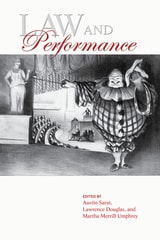
Law and Performance
Austin Sarat
University of Massachusetts Press, 2018
In considering law through the lens of performance studies, the contributors in this volume emphasize the embodied, affective, and reiterative qualities that move law off the printed page and into the thick world of lived experience. They consider the blurring of lines between performance and the enactment of law, the transformative exchanges between the law and its many and varied stagings, and the impact or resonance of performativity in situations where innocence and guilt may be determined. In addition to the editors, the contributors include Joshua Chambers-Letson, Catherine M. Cole, Ryan Hartigan, Lara D. Nielsen, Julie Stone Peters, Ann Pellegrini, and Karen Shimakawa.
Law and the Social Sciences
Leon Lipson
Russell Sage Foundation, 1987
The notion of law as a social phenomenon would have surprised educators and scholars a century ago. For them, law was a science and the library was the ultimate source of all legal knowledge. Our contemporary willingness to see law in a social context—reflecting social relations, for example, or precipitating social changes—is a relatively recent development, spurred during the last quarter century by the work of a generation of scholars (mostly social scientists and law professors) who believe the perspectives of the social sciences are essential to a better understanding of the law.
Law and the Social Sciences provides a unique and authoritative assessment of modern sociolegal research. Its impressive range and depth, the centrality of its concerns, and the stature of its contributors all attest to the vitality of the law-and-society movement and the importance of interdisciplinary work in this field.
Each chapter is both an exposition of its author’s point of view and a survey of the pertinent literature. In treating such topics as law and the economic order, legal systems of the world, the deterrence doctrine, and access to justice, the authors explore overlapping themes—the tension between public and private domains, between diffused and concentrated power, between the goals of uniformity and flexibility, between costs and benefits—that are significant to observers not only of our legal institutions but of other social systems as well.
Law by Night
Jonathan Goldberg-Hiller
Duke University Press, 2023

Law in Everyday Japan
Sex, Sumo, Suicide, and StatutesMark D. West
University of Chicago Press, 2005
Compiling case studies based on seven fascinating themes—karaoke-based noise complaints, sumo wrestling, love hotels, post-Kobe earthquake condominium reconstruction, lost-and-found outcomes, working hours, and debt-induced suicide—Law in Everyday Japan offers a vibrant portrait of the way law intermingles with social norms, historically ingrained ideas, and cultural mores in Japan. Each example is informed by extensive fieldwork. West interviews all of the participants-from judges and lawyers to defendants, plaintiffs, and their families-to uncover an everyday Japan where law matters, albeit in very surprising ways.
Legal Secrets
Equality and Efficiency in the Common LawKim Lane Scheppele
University of Chicago Press, 1988
Kim Lane Scheppele answers the question, Which secrets are legal secrets and what makes them so? She challenges the economic theory of law, which argues that judges decide cases in ways that maximize efficiency, and she shows that judges use equality as an important principle in their decisions. In the course of thinking about secrets, Scheppele also explores broader questions about judicial reasoning—how judges find meaning in legal texts and how they infuse every fact summary with the values of their legal culture. Finally, the specific insights about secrecy are shown to be consistent with a general moral theory of law that indicates what the content of law should be if the law is to be legitimate, a theory that sees legal justification as the opportunity to attract consent.
This is more than a book about secrets. It is also a book about the limits of an economic view of law. Ultimately, it is a work in constructive legal theory, one that draws on moral philosophy, sociology, economics, and political theory to develop a new view of legal interpretation and legal morality.
Lives in the Law
Austin Sarat, Lawrence Douglas, and Martha Merrill Umphrey, Editors
University of Michigan Press, 2002
Managing Legal Uncertainty
Elite Lawyers in the New DealRonen Shamir
Duke University Press, 1995
Applying the insights of Weber and Bourdieu to the sociology of the legal profession, Shamir shows that elite members of the bar had a keen self-interest in blocking the expansion of administrative law. He dismisses as oversimplified the view that elite lawyers were "hired guns" who argued that New Deal legislation was unconstitutional solely because of their duty to represent their capitalist clients. Instead, Shamir suggests, their alignment with the capitalist class was an incidental result of their attempt to articulate their vision of the law as scientific, apolitical, and judicially oriented—and thereby to defend their own position within the law profession. The academic legal realists on the other side of the constitutional debates criticized the rigidity of the traditional judicial process and insisted that flexibility of interpretation and the uncertainty of legal outcomes was at the heart of the legal system. The author argues that many legal realists, encouraged by the experimental nature of the New Deal, seized an opportunity to improve on their marginal status within the legal profession by moving their discussions from academic circles to the national policy agenda.
SEE
Andrea Pavoni, Danilo Mandic, Caterina Nirta and Andreas Philippopoulos-Mihalopoulos
University of Westminster Press, 2018
Vision traditionally occupies the height of the sensorial hierarchy. The sense of clarity and purity conveyed by vision, allows it to be explicitly associated with truth and knowledge. The law has always relied on vision and representation, from eye-witnesses to photography, to imagery and emblems. The law and its normative gaze can be understood as that which decrees what is permitted to be and become visible and what is not. Indeed, even if law’s perspectival view is bound to be betrayed by the realities of perception, it is nonetheless productive of real effects on the world.
This first title in the interdisciplinary series ‘Law and the Senses’ asks how we can develop new theoretical approaches to law and seeing that go beyond a simple critique of the legal pretension to truth. This volume aims to understand how law might see and unsee, and how in its turn is seen and unseen. It explores devices and practices of visibility, the evolution of iconology and iconography, and the relation between the gaze of the law and the blindness of justice. The contributions, all radically interdisciplinary, are drawn from photography, legal theory, philosophy, and poetry.
Social Research in the Judicial Process
Cases, Readings, and TextWallace D. Loh
Russell Sage Foundation, 1984
Social Science, Social Policy, and the Law
Patricia Ewick
Russell Sage Foundation, 1999
Society And Legal Change 2Nd Ed
Alan Watson, foreword by Paul Finkelman
Temple University Press, 2001
In this first U.S. edition of a classic work of comparative legal scholarship, Alan Watson argues that law fails to keep step with social change, even when that change is massive. To illustrate the ways in which law is dysfunctional, he draws on the two most innovative western systems, of Rome and England, to show that harmful rules continue for centuries. To make his case, he uses examples where, in the main, "the law benefits no recognizable group or class within the society (except possibly lawyers who benefit from confusion) and is generally inconvenient or positively harmful to society as a whole or to large or powerful groups within the society."
Widely respected for his "fearless challenge of the accepted or dominant view and his own encyclopedic knowledge of Roman law" (The Encyclopedia of Historians and Historical Writing), Watson considers the development of law in global terms and across the centuries. His arguments centering on how societies borrow from other legal systems and the continuity of legal systems are particularly instructive for those interested in legal development and the development of a common law for the European Union.
postamble();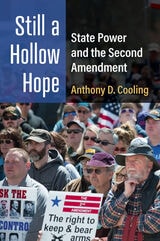
Still a Hollow Hope
State Power and the Second AmendmentAnthony D. Cooling
University of Michigan Press, 2022
The U.S. Supreme Court increasingly matters in American political life when those across the political spectrum look at the Court for relief from policies they oppose and as another venue for advancing their own policy agendas. However, the evidence is mounting, to include this book in a big way, that courts are more of a sideshow to the culture war. While court decisions, especially Supreme Court decisions, do have importance, the decisions emanating from the Court reflect social, cultural, and political change that occurred long prior to their decision ever being made.
This book tests how much political and social change has been made primarily through Gerald Rosenberg’s framework from his seminal work, The Hollow Hope: Can Courts Bring About Social Change, but it also utilizes Daniel Elazar’s Political Culture Theory to explain state level variations in political and social change. The findings indicate that while courts are not powerless institutions, reformers will not have success unless supported by the public and the elected branches, and most specifically, that preexisting state culture is a determining factor in the amount of change courts make. In short, federalism still matters.
TASTE
Andrea Pavoni, Danilo Mandic, Caterina Nirta and Andreas Philippopoulos-Mihalopoulos
University of Westminster Press, 2018

TOUCH
Caterina Nirta, Danilo Mandic, Andrea Pavoni and Andreas Philippopoulos-Mihalopoulos
University of Westminster Press, 2020
Described by Aristotle as the most vital of senses, touch contains both the physical and the metaphysical in its ability to express the determination of being. To manifest itself, touch makes a movement outwards, beyond the body, and relies on a specific physical involvement other senses do not require: to touch is already to be active and to activate. This fundamental ontology makes touch the most essential of all senses.
This volume of ‘Law and the Senses’ attempts to illuminate and reconsider the complex and interflowing relations and contradictions between the tactful intrusion of the law and the untactful movement of touch. Compelling contributors from arts, literature and social science disciplines alongside artist presentations explore touch’s boundaries and formal and informal ‘laws’ of the senses. Each contribution unveils a multi-faceted new dimension to the force of touch, its ability to form, deform and reform what it touches. In unique ways, each of the several contributions to this volume recognises the trans-corporeality of touch to traverse the boundaries on the body and entangle other bodies and spaces, thus challenging the very notion of corporeal integrity and human being.
The Common Place of Law
Stories from Everyday LifePatricia Ewick and Susan S. Silbey
University of Chicago Press, 1998
One narrative is based on an idea of the law as magisterial and remote. Another views the law as a game with rules that can be manipulated to one's advantage. A third narrative describes the law as an arbitrary power that is actively resisted. Drawing on these extensive case studies, Ewick and Silbey present individual experiences interwoven with an analysis that charts a coherent and compelling theory of legality. A groundbreaking study of law and narrative, The Common Place of Law depicts the institution as it is lived: strange and familiar, imperfect and ordinary, and at the center of daily life.
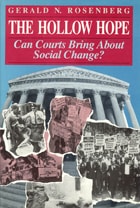
The Hollow Hope
Can Courts Bring About Social Change?Gerald N. Rosenberg
University of Chicago Press, 1991
Rosenberg presents, with remarkable skill, an overwhelming case that efforts to use the courts to generate significant reforms in civil rights, abortion, and women's rights were largely failures.
"The real strength of The Hollow Hope . . . is its resuscitation of American Politics—the old-fashioned representative kind—as a valid instrument of social change. Indeed, the flip side of Mr. Rosenberg's argument that courts don't do all that much is the refreshing view that politics in the best sense of the word—as deliberation and choice over economic and social changes, as well as over moral issues—is still the core of what makes America the great nation it is. . . . A book worth reading."—Gary L. McDowell, The Washington Times
The Hollow Hope
Can Courts Bring About Social Change?Gerald N. Rosenberg
University of Chicago Press, 2023
Since its first publication in 1991, The Hollow Hope has spurred debate and challenged assumptions on both the left and the right about the ability of courts to bring about durable political and social change. What Gerald N. Rosenberg argued then, and what he confirms today through new evidence in this edition, is that it is nearly impossible to generate significant reforms through litigation: American courts are ineffective and relatively weak, far from the uniquely powerful sources for change they are often portrayed to be.
This third edition includes new data and a substantially updated analysis of civil rights, abortion rights and access, women’s rights, and marriage equality. Addressing changes in the political and social environment, Rosenberg draws lessons from the re-segregation of public schools, victories in marriage equality, and new obstacles to abortion access. Through these and other cases, the third edition confirms the power of the book’s original explanatory framework and deepens our understanding of the limits of judicial action in support of social reform, as well as the conditions under which courts do produce change. Up-to-date, thorough, and thought-provoking, The Hollow Hope remains vital reading.
The Hollow Hope
Can Courts Bring About Social Change? Second EditionGerald N. Rosenberg
University of Chicago Press, 2008
Finding that the answer is still a resounding no, Rosenberg reaffirms his powerful contention that it’s nearly impossible to generate significant reforms through litigation. The reason? American courts are ineffective and relatively weak—far from the uniquely powerful sources for change they’re often portrayed as. Rosenberg supports this claim by documenting the direct and secondary effects of key court decisions—particularly Brown v. Board of Education and Roe v. Wade. He reveals, for example, that Congress, the White House, and a determined civil rights movement did far more than Brown to advance desegregation, while pro-choice activists invested too much in Roe at the expense of political mobilization. Further illuminating these cases, as well as the ongoing fight for same-sex marriage rights, Rosenberg also marshals impressive evidence to overturn the common assumption that even unsuccessful litigation can advance a cause by raising its profile.
Directly addressing its critics in a new conclusion, The Hollow Hope, Second Edition promises to reignite for a new generation the national debate it sparked seventeen years ago.
The Legal Analyst
A Toolkit for Thinking about the LawWard Farnsworth
University of Chicago Press, 2007
There are two kinds of knowledge law school teaches: legal rules on the one hand, and tools for thinking about legal problems on the other. Although the tools are far more interesting and useful than the rules, they tend to be neglected in favor of other aspects of the curriculum. In The Legal Analyst, Ward Farnsworth brings together in one place all of the most powerful of those tools for thinking about law.
From classic ideas in game theory such as the “Prisoner’s Dilemma” and the “Stag Hunt” to psychological principles such as hindsight bias and framing effects, from ideas in jurisprudence such as the slippery slope to more than two dozen other such principles, Farnsworth’s guide leads readers through the fascinating world of legal thought. Each chapter introduces a single tool and shows how it can be used to solve different types of problems. The explanations are written in clear, lively language and illustrated with a wide range of examples.
The Legal Analyst is an indispensable user’s manual for law students, experienced practitioners seeking a one-stop guide to legal principles, or anyone else with an interest in the law.
The Legal System
A Social Science PerspectiveLawrence M. Friedman
Russell Sage Foundation, 1975
Total Justice
Lawrence M. Friedman
Russell Sage Foundation, 1985
When Formality Works
Authority and Abstraction in Law and OrganizationsArthur L. Stinchcombe
University of Chicago Press, 2001
We have come to assume that governing our social activities by advance planning—by creating abstract descriptions of what ought to happen and adjusting these descriptions as situations change—is not as efficient and responsive as dealing directly with the real substance of the situation at hand. Stinchcombe argues the opposite. When a plan is designed to correct itself and keep up with the reality it is meant to govern, it can be remarkably successful. He points out a wide range of examples where this is the case, including architectural blueprints, immigration law, the construction of common law by appeals courts, Fannie Mae's secondary mortgage market, and scientific paradigms and programs.
Arguing that formality has been misconceived as consisting mainly of its defects, Stinchcombe shows how formality, at its best, can serve us much better than ritual obedience to poorly laid plans or a romantic appeal to "real life."
Working Law
Courts, Corporations, and Symbolic Civil RightsLauren B. Edelman
University of Chicago Press, 2016
One reason for the limited success of antidiscrimination policies, argues Lauren B. Edelman, is that the law regulating companies is broad and ambiguous, and managers therefore play a critical role in shaping what it means in daily practice. Often, what results are policies and procedures that are largely symbolic and fail to dispel long-standing patterns of discrimination. Even more troubling, these meanings of the law that evolve within companies tend to eventually make their way back into the legal domain, inconspicuously influencing lawyers for both plaintiffs and defendants and even judges. When courts look to the presence of antidiscrimination policies and personnel manuals to infer fair practices and to the presence of diversity training programs without examining whether these policies are effective in combating discrimination and achieving racial and gender diversity, they wind up condoning practices that deviate considerably from the legal ideals.