Results by title

9 books match the query 'Sokolowski, Robert'
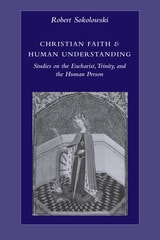
cover of Christian faith & human understanding: studies on the Eucharist, Trinity, and the human person

Christian faith & human understanding

studies on the Eucharist, Trinity, and the human person

Robert Sokolowski

Catholic University of America Press, 2006
In this collection of essays, renowned philosopher Robert Sokolowski illustrates how Christian faith is not an alternative to reason, but rather an enhancement of it.
[more]
cover of Edmund Husserl and the Phenomenological Tradition

Edmund Husserl and the Phenomenological Tradition

Robert Sokolowski

Catholic University of America Press, 2018

A collection of papers meant to illustrate the richness of Edmund Husserl's own work and the tradition he began.
[more]
cover of Ethics and Theological Disclosures: The Thought of Robert Sokolowski

Ethics and Theological Disclosures

The Thought of Robert Sokolowski

Guy Mansini, O.S.B.

Catholic University of America Press, 2003

[more]
cover of Eucharistic Presence: A Study in the Theology of Disclosure

Eucharistic Presence

A Study in the Theology of Disclosure

Robert Sokolowski

Catholic University of America Press, 1994
[more]
cover of Husserlian Meditations: How Words Present Things

Husserlian Meditations

How Words Present Things

Robert Sokolowski

Northwestern University Press, 1974
The structure and key elements of Husserl's philosophy are analyzed in this chronological examination of his doctrines.
[more]
cover of Moral Action: A Phenomenological Study

Moral Action

A Phenomenological Study

Robert Sokolowski

Catholic University of America Press, 2017
“In this carefully written study of the constituents of human decision making, Robert Sokolowski lays an elaborate groundwork to develop the importance of the distinction between choice and the voluntary in moral discourse…offers a new way of looking at m
[more]
cover of Pictures, Quotations, and Distinctions: Fourteen Essays in Phenomenology

Pictures, Quotations, and Distinctions

Fourteen Essays in Phenomenology

Robert Sokolowski

Catholic University of America Press, 2022

One of the major contributions of Husserl’s phenomenology has been to show that things present themselves to us in strikingly different ways. There are various kinds of presentations and something like logical structures in them that allow the truth of things to appear. Being pictured is different from being named, and also different from being distinguished from something else. The fourteen essays in this volume provide concrete and colorful examples of strategic forms of presentation, and they also shed light on us as persons who exercise our intelligence when we let things appear in these various ways. Even our moral conduct takes place because something appears to us as to be done or to be avoided in a situation that calls for action. When we quote what someone has said, for example, we express things as they have been expressed by someone else, and we invoke the authority of that other speaker. In measurement, we either bring external units, such as inches or yards, to determine the “how much” of things; or we engage in “internal measurement” and use one part of the object to determine the size of the whole. In moral action, the deep core of what we do involves either benevolence or malevolence, and in such conduct we shape or confirm ourselves as good or bad. Even the timing of things, the measurement of their motions and the determination of their before and after, in both clock and calendar time, cannot take place without the involvement of the person’s own interwoven perceptions, remembrances, and anticipations, all held together by the underlying flow of personal as well as worldly temporality. The essays in this book are an attempt to blend the philosophical approaches of Aristotle and Husserl, the classical and the modern, to help us appreciate what Aristotle called “being as the true,” and to show how the human person is involved in this enterprise.
[more]
cover of Teleology and the Conceptual Genesis of the Modern State: Essays on the Nature of Philosophy

Teleology and the Conceptual Genesis of the Modern State

Essays on the Nature of Philosophy

Francis Slade

Catholic University of America Press, 2027
This volume is a collection of thirteen essays written by the late Francis Slade, a contemporary philosopher who has made an original contribution to political philosophy through the clarity of distinction he achieves between the modern state and the natural city/civitas/polis. Slade’s distinction between these two political forms is made in terms of their differing relation to philosophy. The city, as the political form belonging properly to human nature, exists independently of philosophical thought; the form of the state, on the other hand, with its genesis in the deliberate and creative design of philosophical thought, is dependent on philosophy for its coming to be. Slade’s distinction illuminates the radical transformation in what philosophy understood itself to be that occurs with advent of modernity: the contemplative philosophy of premodernity is displaced in favor of modern philosophy’s active generation of ideal forms, of which the state is an instance. Philosophy is transformed by the erasure of the distinction between theoria and praxis. And it is a differing view of nature that underlies the two versions of philosophy Slade presents in these essays: the givenness of ends as constitutive of natural things is at the heart of the issue. Slade’s work thus has important consequences for the recovery of natural things in their ordinary givenness, a givenness overwhelmed into obscurity by the dominance of the various forms of philosophical idealism and their remarkably successful imposition on nature. Slade’s essays point to the “theological” stance (improperly) adopted by modern idealism, as it constructs a stance from outside nature which confounds the philosophic voice that originally and properly voices what is from within nature. These essays are introduced by the distinguished philosopher, Robert Sokolowski, a long-time friend of Francis Slade, whom Sokolowski gratefully acknowledges as having had a significant influence on his thought.
[more]
cover of The Phenomenological Study of Religion: Key Texts and Sources

The Phenomenological Study of Religion

Key Texts and Sources

Christina M. Gschwandtner

Northwestern University Press, 2026

Presenting a wide-ranging selection of works and commentary in religious phenomenology

Phenomenology is a central method employed to study religious phenomena within religious studies, philosophy of religion, and philosophical theology. This expertly edited collection brings together historical sources and newly commissioned essays from various ways of investigating religion phenomenologically both to diversify the field and to make available important works that have not been previously translated into English. The Phenomenological Study of Religion includes not only representative texts from well-known phenomenological philosophers and scholars of religion but also selections from significant thinkers that have not been studied as widely, along with contributions from leading contemporary voices. This volume offers scholars and students at all levels of expertise broad exposure to the various configurations of the phenomenological study of religion.

[more]