Results by title
2 books match the query 'Solar energy'

Geographies of Solar Energy Transitions
Conflicts, Controversies and Cognate AspectsEdited by Siddharth Sareen and Abigail Martin
University College London, 2024
An overdue criticism of large-scale solar energy adoption.
Solar energy is the world’s largest growing source of power. Recently, this energy transition has produced a series of cognate challenges and conflicts in diverse geographies, yielding effects far beyond electricity generation. Geographies of Solar Energy Transitions illustrates how solar energy governance—both state-based and market-driven—is evolving to address these conflicts. Throughout the book, leading energy scholars examine relevant case studies, drawing necessary attention to the multitude of issues with solar power use, including formulating new place-specific solar energy visions and strategies, financing specific deployment scales, expanding and replacing electricity infrastructure, accessing land, resolving conflicts with competing land uses, incorporating charging technologies for transport and storage, adopting flexible energy production/consumption relationships, displacing fossil fuel energy production with renewables, enabling new energy ownership models, and addressing environmental and social injustices across the value chain of solar expansion.
Solar energy is the world’s largest growing source of power. Recently, this energy transition has produced a series of cognate challenges and conflicts in diverse geographies, yielding effects far beyond electricity generation. Geographies of Solar Energy Transitions illustrates how solar energy governance—both state-based and market-driven—is evolving to address these conflicts. Throughout the book, leading energy scholars examine relevant case studies, drawing necessary attention to the multitude of issues with solar power use, including formulating new place-specific solar energy visions and strategies, financing specific deployment scales, expanding and replacing electricity infrastructure, accessing land, resolving conflicts with competing land uses, incorporating charging technologies for transport and storage, adopting flexible energy production/consumption relationships, displacing fossil fuel energy production with renewables, enabling new energy ownership models, and addressing environmental and social injustices across the value chain of solar expansion.
[more]
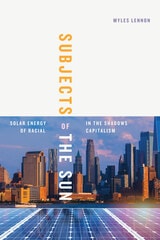
Subjects of the Sun
Solar Energy in the Shadows of Racial CapitalismMyles Lennon
Duke University Press, 2025
In the face of accelerating climate change, anticapitalist environmental justice activists and elite tech corporations increasingly see eye to eye. Both envision solar-powered futures where renewable energy redresses gentrification, systemic racism, and underemployment. However, as Myles Lennon argues in Subjects of the Sun, solar power is no less likely to exploit marginalized communities than dirtier forms of energy. Drawing from ethnographic research on clean energy corporations and community solar campaigns in New York City, Lennon argues that both groups overlook solar’s extractive underside because they primarily experience energy from the sun in the virtual world of the cloud. He shows how the material properties of solar technology—its shiny surfaces, decentralized spatiality, and modularity—work closely with images, digital platforms, and quantitative graphics to shape utopic visions in which renewable energy can eradicate the constitutive tensions of racial capitalism. As a corrective to this virtual world, Lennon calls for an equitable energy transition that centers the senses and sensibilities neglected by screenwork: one’s haptic care for their local environment; the full-bodied feel of infrastructural labor; and the sublime affect of the sun.
[more]