Results by title
6 books match the query 'Solomon, Matthew'
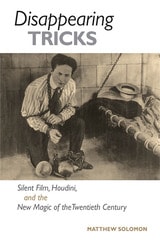
Disappearing Tricks
Silent Film, Houdini, and the New Magic of the Twentieth CenturyMatthew Solomon
University of Illinois Press, 2010
Disappearing Tricks revisits the golden age of theatrical magic and silent film to reveal how professional magicians shaped the early history of cinema. Where others have called upon magic as merely an evocative metaphor for the wonders of cinema, Matthew Solomon focuses on the work of the professional illusionists who actually made magic with moving pictures between 1895 and 1929.
The first to reveal fully how powerfully magic impacted the development of cinema, the book combines film and theater history to uncover new evidence of the exchanges between magic and filmmaking in the United States and France during the silent period. Chapters detailing the stage and screen work of Harry Houdini and Georges Méliès show how each transformed theatrical magic to create innovative cinematic effects and thrilling new exploits for twentieth-century mass audiences. The book also considers the previously overlooked roles of anti-spiritualism and presentational performance in silent film.
Highlighting early cinema's relationship to the performing body, visual deception, storytelling, and the occult, Solomon treats cinema and stage magic as overlapping practices that together revise our understanding of the origins of motion pictures and cinematic spectacle.
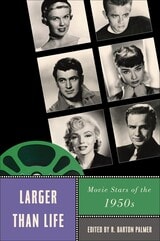
Larger Than Life
Movie Stars of the 1950sPalmer, R. Barton
Rutgers University Press, 2010
Larger Than Life offers a comprehensive view of the star system in 1950s Hollywood and also in-depth discussions of the decade's major stars, including Montgomery Clift, Judy Holliday, Jerry Lewis, James Mason, Marilyn Monroe, Kim Novak, Bing Crosby, Gene Kelly, Jayne Mansfield, and Audrey Hepburn.
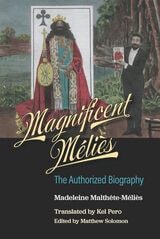
Magnificent Méliès
The Authorized BiographyMadeleine Malthête-Méliès, translated by Kel Pero, edited by Matthew Solomon
University of Michigan Press, 2022
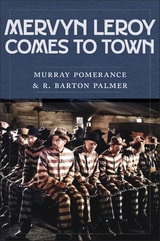
Mervyn LeRoy Comes to Town
Murray Pomerance
Rutgers University Press, 2025
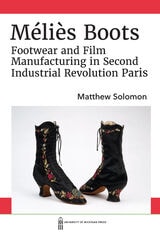
Méliès Boots
Footwear and Film Manufacturing in Second Industrial Revolution ParisMatthew Solomon
University of Michigan Press, 2022
Winner of the 2024 Society for Cinema and Media Studies Katherine Singer Kovacs Book Award
Before he became an influential cinematic innovator, Georges Méliès (1861–1938) was a maker of deluxe French footwear, an illusionist, and a caricaturist. Proceeding from these beginnings, Méliès Boots traces how the full trajectory of Georges Méliès’ career during the late-nineteenth and early-twentieth centuries, along with the larger cultural and historical contexts in which Méliès operated, shaped his cinematic oeuvre. Solomon examines Méliès’ unpublished drawings and published caricatures, the role of laughter in his magic theater productions, and the constituent elements of what Méliès called "the new profession of the cinéaste." The book also reveals Méliès' connections to the Incohérents, a group of ephemeral artists from the 1880s, demonstrating the group’s relevance for Méliès, early cinema, and modernity. By positioning Méliès in relation to the material culture of his time, Solomon demonstrates that Méliès’ work was expressive of a distinctly modern, and modernist, sensibility that appeared in France during the 1880s in the wake of the Second Industrial Revolution.
Thinking in the Dark
Cinema, Theory, PracticePomerance, Murray
Rutgers University Press, 2015
Thinking in the Dark introduces readers to twenty-one key theorists whose work has made a great impact on film scholarship today, including Rudolf Arnheim, Sergei Eisenstein, Michel Foucault, Siegfried Kracauer, and Judith Butler. Rather than just discussing each theorist’s ideas in the abstract, the book shows how those concepts might be applied when interpreting specific films by including an analysis of both a classic film and a contemporary one. It thus demonstrates how theory can help us better appreciate films from all eras and genres: from Hugo to Vertigo, from City Lights to Sunset Blvd., and from Young Mr. Lincoln to A.I. and Wall-E.
The volume’s contributors are all experts on their chosen theorist’s work and, furthermore, are skilled at explaining that thinker’s key ideas and terms to readers who are not yet familiar with them. Thinking in the Dark is not only a valuable resource for teachers and students of film, it’s also a fun read, one that teaches us all how to view familiar films through new eyes.
Theorists examined in this volume are: Rudolf Arnheim, Béla Balázs, Roland Barthes, André Bazin, Walter Benjamin, Judith Butler, Stanley Cavell, Michel Chion, Gilles Deleuze, Jean Douchet, Sergei Eisenstein, Jean Epstein, Michel Foucault, Siegfried Kracauer, Jacques Lacan, Vachel Lindsay, Christian Metz, Hugo Münsterberg, V. F. Perkins, Jacques Rancière, and Jean Rouch.