Results by title
6 books match the query 'Somali diaspora'
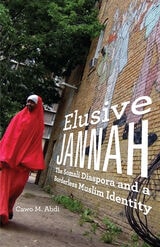
Elusive Jannah
The Somali Diaspora and a Borderless Muslim IdentityCawo M. Abdi
University of Minnesota Press, 2015
As a Somali working since high school in the United Arab Emirates, Osman considers himself “blessed” to be in a Muslim country, though citizenship, with the security it offers, remains elusive. For Ardo, smuggled out of Somalia to join her husband in South Africa, insecurities are of a more immediate, physical kind, and her economic prospects and legal status are more uncertain. Adam, in the United States—a destination often imagined as an earthly Eden, or jannah, by so many of his compatriots—now sees heaven in a return to Somalia.
The stories of these three people are among the many that emerge from mass migration triggered by the political turmoil and civil war plaguing Somalia since 1988. And they are among the diverse collection presented in eloquent detail in Elusive Jannah, a remarkable portrait of the very different experiences of Somali migrants in the UAE, South Africa, and the United States. Somalis in the UAE, a relatively closed Muslim nation, are a minority within a large South Asian population of labor migrants. In South Africa, they are part of a highly racialized and segregated postapartheid society. In the United States they find themselves in a welfare state with its own racial, socioeconomic, and political tensions. A comparison of Somali settlements in these three locations clearly reveals the importance of immigration policies in the migrant experience.
Cawo M. Abdi’s nuanced analysis demonstrates that a full understanding of successful migration and integration must go beyond legal, economic, and physical security to encompass a sense of religious, cultural, and social belonging. Her timely book underscores the sociopolitical forces shaping the Somali diaspora, as well as the roles of the nation-state, the war on terror, and globalization in both constraining and enabling their search for citizenship and security.
Making Refuge
Somali Bantu Refugees and Lewiston, MaineCatherine Besteman
Duke University Press, 2016
Rhetorics of Refusal
Medical Dissent and the US-Somali DiasporaKari Campeau
The Ohio State University Press, 2025
Rhetorics of Refusal focuses on a recent public health crisis—Minnesota’s 2017 measles outbreak—to recast vaccine refusals less as products of poor health literacy or disinformation and more as strategic and generative acts of noncompliance. The outbreak, which primarily affected unvaccinated Somali children, occurred at the nexus of declining vaccination rates, spiking autism concerns, antivaccination predation, and a fraying public health infrastructure. However, during a year-long ethnographic study at a Somali health center, Kari Campeau found that personal stories from parents offered a much different picture of vaccine refusal than the one painted by news media. Tracking refusals across four sites, Campeau argues for the importance of approaching refusals as rhetorical and participatory strategies that hold institutions accountable, press for change, and practice care within emergent biosocial communities. Moreover, she views refusal as necessary and potentially transformative in situations where refusers have little access to power or platform. By contextualizing refusals in longer cultural and political histories, Campeau unsettles traditional narratives of medical dissent while offering new entry points into discussions on racialized biopolitics, care, disability, and public health.
Somalis Abroad
Clan and Everyday Life in FinlandStephanie R. Bjork
University of Illinois Press, 2017
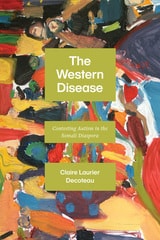
The Western Disease
Contesting Autism in the Somali DiasporaClaire Laurier Decoteau
University of Chicago Press, 2021
Because autism is an increasingly common diagnosis, North Americans are familiar with its symptoms and treatments. But what we know and think about autism is shaped by our social relationship to health, disease, and the medical system. In The Western Disease Claire Laurier Decoteau explores the ways that recent immigrants from Somalia to Canada and the US make sense of their children’s diagnosis of autism. Having never heard of autism before migrating to North America, they often determine that it must be a Western disease. Given its apparent absence in Somalia, they view it as Western in nature, caused by environmental and health conditions unique to life in North America.
Following Somali parents as they struggle to make sense of their children's illness and advocate for alternative care, Decoteau unfolds how complex interacting factors of immigration, race, and class affect Somalis’ relationship to the disease. Somalis’ engagement with autism challenges the prevailing presumption among Western doctors that their approach to healing is universal. Decoteau argues that centering an analysis on autism within the Somali diaspora exposes how autism has been defined and institutionalized as a white, middle-class disorder, leading to health disparities based on race, class, age, and ability. The Western Disease asks us to consider the social causes of disease and the role environmental changes and structural inequalities play in health vulnerability.
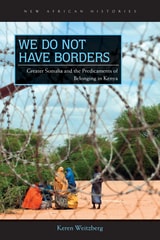
We Do Not Have Borders
Greater Somalia and the Predicaments of Belonging in KenyaKeren Weitzberg
Ohio University Press, 2017
Though often associated with foreigners and refugees, many Somalis have lived in Kenya for generations, in many cases since long before the founding of the country. Despite their long residency, foreign and state officials and Kenyan citizens often perceive the Somali population to be a dangerous and alien presence in the country, and charges of civil and human rights abuses have mounted against them in recent years.
In We Do Not Have Borders, Keren Weitzberg examines the historical factors that led to this state of affairs. In the process, she challenges many of the most fundamental analytical categories, such as “tribe,” “race,” and “nation,” that have traditionally shaped African historiography. Her interest in the ways in which Somali representations of the past and the present inform one another places her research at the intersection of the disciplines of history, political science, and anthropology.
Given tragic events in Kenya and the controversy surrounding al-Shabaab, We Do Not Have Borders has enormous historical and contemporary significance, and provides unique inroads into debates over globalization, African sovereignty, the resurgence of religion, and the multiple meanings of being African.