Results by title
7 books match the query 'Sophists (Greek philosophy)'
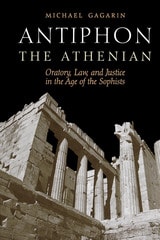
Antiphon the Athenian
Oratory, Law, and Justice in the Age of the SophistsBy Michael Gagarin
University of Texas Press, 2002
Winner, Friends of the Dallas Public Library Award from the Texas Institute of Letters, 2003
Antiphon was a fifth-century Athenian intellectual (ca. 480-411 BCE) who created the profession of speechwriting while serving as an influential and highly sought-out adviser to litigants in the Athenian courts. Three of his speeches are preserved, together with three sets of Tetralogies (four hypothetical paired speeches), whose authenticity is sometimes doubted. Fragments also survive of intellectual treatises on subjects including justice, law, and nature (physis), which are often attributed to a separate Antiphon the Sophist. Were these two Antiphons really one and the same individual, endowed with a wide-ranging mind ready to tackle most of the diverse intellectual interests of his day?
Through an analysis of all these writings, this book convincingly argues that they were composed by a single individual, Antiphon the Athenian. Michael Gagarin sets close readings of individual works within a wider discussion of the fifth-century Athenian intellectual climate and the philosophical ferment known as the sophistic movement. This enables him to demonstrate the overall coherence of Antiphon's interests and writings and to show how he was a pivotal figure between the sophists and the Attic orators of the fourth century. In addition, Gagarin's argument allows us to reassess the work of the sophists as a whole, so that they can now be seen as primarily interested in logos (speech, argument) and as precursors of fourth-century rhetoric, rather than in their usual role as foils for Plato.
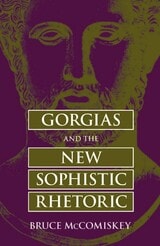
Gorgias and the New Sophistic Rhetoric
Bruce McComiskey
Southern Illinois University Press, 2002
In Gorgias and the New Sophistic Rhetoric, Bruce McComiskey achieves three rhetorical goals: he treats a single sophist's rhetorical technê (art) in the context of the intellectual upheavals of fifth-century bce Greece, thus avoiding the problem of generalizing about a disparate group of individuals; he argues that we must abandon Platonic assumptions regarding the sophists in general and Gorgias in particular, opting instead for a holistic reading of the Gorgianic fragments; and he reexamines the practice of appropriating sophistic doctrines, particularly those of Gorgias, in light of the new interpretation of Gorgianic rhetoric offered in this book.
In the first two chapters, McComiskey deals with a misconception based on selective and Platonic readings of the extant fragments: that Gorgias's rhetorical technê involves the deceptive practice of manipulating public opinion. This popular and ultimately misleading interpretation of Gorgianic doctrines has been the basis for many neosophistic appropriations. The final three chapters deal with the nature and scope of neosophistic rhetoric in light of the non-Platonic and holistic interpretation of Gorgianic rhetoric McComiskey postulates in his opening chapters. He concludes by examining the future of communication studies to discover what roles neosophistic doctrines might play in the twenty-first century.
McComiskey also provides a selective bibliography of scholarship on sophistic rhetoric and philosophy in English since 1900.
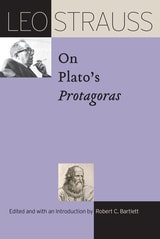
Leo Strauss on Plato’s "Protagoras"
Leo Strauss
University of Chicago Press, 2022
This book offers a transcript of Strauss’s seminar on Plato’s Protagoras taught at the University of Chicago in the spring quarter of 1965, edited and introduced by renowned scholar Robert C. Bartlett. These lectures have several important features. Unlike his published writings, they are less dense and more conversational. Additionally, while Strauss regarded himself as a Platonist and published some work on Plato, he published little on individual dialogues. In these lectures Strauss treats many of the great Platonic and Straussian themes: the difference between the Socratic political science or art and the Sophistic political science or art of Protagoras; the character and teachability of virtue, its relation to knowledge, and the relations among the virtues, courage, justice, moderation, and wisdom; the good and the pleasant; frankness and concealment; the role of myth; and the relation between freedom of thought and freedom of speech.
In these lectures, Strauss examines Protagoras and the sophists, providing a detailed discussion of Protagoras as it relates to Plato’s other dialogues and the work of modern thinkers. This book should be of special interest to students both of Plato and of Strauss.
Seeming and Being in Plato’s Rhetorical Theory
Robin Reames
University of Chicago Press, 2018
Robin Reames’s Seeming & Being in Plato’s Rhetorical Theory marks a shift in Plato scholarship. Reames argues that an appropriate understanding of rhetorical theory in Plato’s dialogues illuminates how he developed the technical vocabulary needed to construct the very distinctions between seeming and being that separate true from false speech. By engaging with three key movements of twentieth- and twenty-first-century Plato scholarship—the rise and subsequent marginalization of “orality and literacy theory,” Heidegger’s controversial critique of Platonist metaphysics, and the influence of literary or dramatic readings of the dialogues—Reames demonstrates how the development of Plato’s rhetorical theory across several of his dialogues (Gorgias, Phaedrus, Protagoras, Theaetetus, Cratylus, Republic, and Sophist) has been both neglected and misunderstood.
Sophistry and Political Philosophy
Protagoras' Challenge to SocratesRobert C. Bartlett
University of Chicago Press, 2016
With Sophistry and Political Philosophy, Robert C. Bartlett provides the first close reading of Plato’s two-part presentation of Protagoras. In the “Protagoras,” Plato sets out the sophist’s moral and political teachings, while the “Theaetetus,” offers a distillation of his theoretical and epistemological arguments. Taken together, the two dialogues demonstrate that Protagoras is attracted to one aspect of conventional morality—the nobility of courage, which in turn is connected to piety. This insight leads Bartlett to a consideration of the similarities and differences in the relationship of political philosophy and sophistry to pious faith. Bartlett’s superb exegesis offers a significant tool for understanding the history of philosophy, but, in tracing Socrates’s response to Protagoras’ teachings, Bartlett also builds toward a richer understanding of both ancient sophistry and what Socrates meant by “political philosophy.”
Stock Characters Speaking
Eight Libanian Declamations Introduced and TranslatedRobert J. Penella
University of Michigan Press, 2023
Declamations were composed and orally delivered in the Roman Empire by sophists, or teachers of rhetoric, of whom the Greek-speaking Libanius was one of the most distinguished. Stock Characters Speaking may be thought of as emerging from three developments of recent decades: an explosive interest in late antiquity, a newly sympathetic interest in rhetoric (including ancient declamation), and a desire to bring Libanius’s massive corpus into English and other modern languages.
In this book, author Robert J. Penella translates eight of Libanius’s declamations: 29, 30, 34, 35, 37, 45, 46, 47, and, in an appendix, the thirteenth-century Gregory of Cyprus’s response to Declamation 34. Each translation is accompanied by an introduction, in which Penella examines the themes, structure, and the stasis, or key issue, of the declamations. Figures who appear in the translated declamations include a parasite who has lost his patron, a man envious of his rich neighbor, a miser’s son, a poor man willing to die for his city, a rich war-hero accused of aiming at tyranny, and a convict asking for exile. Three of these declamations have appeared in German; otherwise, these translations are the first into a modern language.
The Being of the Beautiful
Plato's Theaetetus, Sophist, and StatesmanPlato
University of Chicago Press, 1984
“The translations are masterpieces of literalness. . . . They are honest, accurate, and give the reader a wonderful sense of the Greek.”—Drew A. Hyland, Review of Metaphysics