Results by title
7 books match the query 'Sorrow'
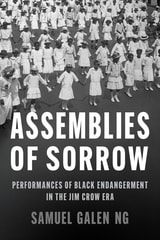
Assemblies of Sorrow
Performances of Black Endangerment in the Jim Crow EraSamuel Galen Ng
University of Illinois Press, 2026
Samuel Galen Ng illuminates this Black consciousness as it emanated from feelings of collective endangerment. The dissemination and intensification of such feelings became a pivotal way of solidifying a national Black consciousness on the eve of the Civil Rights Movement. Ng examines how performances of Black endangerment performed political work that provided Black people with important means of political organizing and insurgency. As Ng shows, the grief and mourning that took place at the performances provided public spaces for individuals and communities to observe specific losses capable of impacting Americans across the country.
Ambitious and interdisciplinary, Assemblies of Sorrow explores an overlooked facet of Black organizing and protest and traces how activists shaped fear and grief into political action.

Beneath the Skin of Sorrow
Improvisations on LossNnenna Freelon
Duke University Press, 2025
Part love story, part homage to jazz, and part guide to creative practice within bereavement, Beneath the Skin of Sorrow follows Freelon’s difficult and personal journey to healing. Calling on the improvisational skills that she had built over her forty-year career as a jazz singer, Freelon crafted her new reality by improvising—thinking about grieving as a series of small, daily engagements with the world around her. Slowly, Freelon regained the pieces of her musical sensibility, realizing that flowing between words spoken and words sung allowed her to understand what could not be fully realized in either realm.
By improvising a new life, Freelon forged a new companionship between grief, art, and daily life. In the essays, poems, lyrics, and explorations of jazz standards that comprise this lyrical and elegiac memoir, Freelon shows how thinking about grief as an exercise in improvisation can lead to a creative coexistence with grief in all its forms.

Euripides and the Poetics of Sorrow
Art, Gender, and Commemoration in Alcestis, Hippolytus, and HecubaCharles Segal
Duke University Press, 1993
Alcestis, Hippolytus, and Hecuba, the three early plays interpreted here, are linked by common themes of violence, death, lamentation and mourning, and by their implicit definitions of male and female roles. Segal shows how these plays draw on ancient traditions of poetic and ritual commemoration, particularly epic song, and at the same time refashion these traditions into new forms. In place of the epic muse of martial glory, Euripides, Segal argues, evokes a muse of sorrows who transforms the suffering of individuals into a "common grief for all the citizens," a community of shared feeling in the theater.
Like his predecessors in tragedy, Euripides believes death, more than any other event, exposes the deepest truth of human nature. Segal examines the revealing final moments in Alcestis, Hippolytus, and Hecuba, and discusses the playwright's use of these deaths--especially those of women--to question traditional values and the familiar definitions of male heroism. Focusing on gender, the affective dimension of tragedy, and ritual mourning and commemoration, Segal develops and extends his earlier work on Greek drama. The result deepens our understanding of Euripides' art and of tragedy itself.

Love, Sorrow, And Rage
Alisse Waterston
Temple University Press, 1999
From drug addiction and the spread of AIDS to the growing gap between rich and poor in the U.S., the topics in this book get front-page coverage in daily newspapers across the country. Waterston seeks to understand, to explain, and to solve the human crisis that surrounds us. Towards this end, she challenges us to look at the ways in which our society and the workings of our political, economic, and popular culture contribute to the suffering experienced by our most vulnerable citizens. An important corrective to popular depictions of the urban poor, Love, Sorrow, and Rage provides a penetrating analysis of the causes and consequences of poverty. It offers a deeper understanding of what leads to and perpetuates poverty and of the human complex of love, sorrow, and rage felt by those who experience it.
Love, Sorrow, and Rage will engage readers interested in urban studies, women's studies, social issues and policies, anthropology, sociology, political economy, and New York City life.
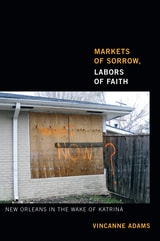
Markets of Sorrow, Labors of Faith
New Orleans in the Wake of KatrinaVincanne Adams
Duke University Press, 2013
Filled with the often desperate voices of residents who returned to New Orleans, Markets of Sorrow, Labors of Faith describes the human toll of disaster capitalism and the affect economy it has produced. While for-profit companies delayed delivery of federal resources to returning residents, faith-based and nonprofit groups stepped in to rebuild, compelled by the moral pull of charity and the emotional rewards of volunteer labor. Adams traces the success of charity efforts, even while noting an irony of neoliberalism, which encourages the very same for-profit companies to exploit these charities as another market opportunity. In so doing, the companies profit not once but twice on disaster.

Paradise in the Sea of Sorrow
Our Minamata DiseaseIshimure Michiko
University of Michigan Press, 2003

Women and Alcohol in a Highland Maya Town
Water of Hope, Water of SorrowBy Christine Eber
University of Texas Press, 1995
Healing roles and rituals involving alcohol are a major source of power and identity for women and men in Highland Chiapas, Mexico, where abstention from alcohol can bring a loss of meaningful roles and of a sense of community. Yet, as in other parts of the world, alcohol use sometimes leads to abuse, whose effects must then be combated by individuals and the community.
In this pioneering ethnography, Christine Eber looks at women and drinking in the community of San Pedro Chenalhó to address the issues of women’s identities, roles, relationships, and sources of power. She explores various personal and social strategies women use to avoid problem drinking, including conversion to Protestant religions, membership in cooperatives or Catholic Action, and modification of ritual forms with substitute beverages.
The book’s women-centered perspective reveals important data on women and drinking not reported in earlier ethnographies of Highland Chiapas communities. Eber’s reflexive approach, blending the women’s stories, analyses, songs, and prayers with her own and other ethnographers’ views, shows how Western, individualistic approaches to the problems of alcohol abuse are inadequate for understanding women’s experiences with problem and ritual drinking in a non-Western culture.
In a new epilogue, Christine Eber describes how events of the last decade, including the Zapatista uprising, have strengthened women's resolve to gain greater control over their lives by controlling the effects of alcohol in the community.