Results by title
2 books match the query 'Soussloff, Catherine M.'
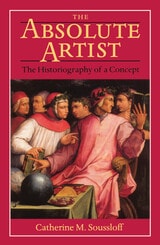
Absolute Artist
The Historiography of a ConceptCatherine M. Soussloff
University of Minnesota Press, 1997
Analyzes the myth of the artist in western culture.
The myth of the artist-genius has long had a unique hold on the imagination of Western culture. Iconoclastic, temperamental, and free from the constraints of society, these towering figures have been treated as fixed icons regardless of historical context or individual situation. In The Absolute Artist, Catherine M. Soussloff challenges this view in an engaging consideration of the social construction of the artist from the fifteenth century to the present.
Traditional art history has held that the concept of the artist-genius arose in the Enlightenment. Soussloff disputes this, arguing that earlier writings—artists’ biographies written as long ago as the early fifteenth century-determined and continue to determine our understanding of the myth of the artist. Moving chronologically, Soussloff shifts from fifteenth-century Florence to nineteenth-century Germany, the birthplace of the discipline of art history in its academic form, and considers the cultural historiography of Aby Warburg and Jacob Burckhardt. She discusses intellectual life in early-twentieth-century Vienna, demonstrating the rich cross-fertilization that occurred between art history and psychoanalysis, and scrutinizes the historical situation of Jewish art historians and psychoanalysts in Vienna in the 1930s, considering the impact of exile and an assimilationist ethic on the discourse of art history. Soussloff concludes with a groundbreaking analysis of one of the earliest and most persistent elements of biography, the “artist anecdote,” demonstrating that it is essential in the construction of the figure of the artist. Singular in its breadth and ambition, The Absolute Artist is the first book to analyze the artist’s biography as a rhetorical form and literary genre rather than as an unassailable source of fact and knowledge.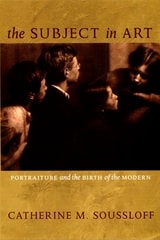
The Subject in Art
Portraiture and the Birth of the ModernCatherine M. Soussloff
Duke University Press, 2006
Soussloff combines a historically grounded examination of art and art historical thinking in Vienna with subsequent theories of portraiture and a careful historiography of philosophical and psychoanalytic approaches to human consciousness from Hegel to Sartre and from Freud to Lacan. She chronicles the emergence of a social theory of art among the art historians of the Vienna School, demonstrates how the Expressionist painter Oskar Kokoschka depicted the Jewish subject, and explores the development of pictorialist photography. Reflecting on the implications of the visualized, modern subject for textual and linguistic analyses of subjectivity, Soussloff concludes that the Viennese art historians, photographers, and painters will henceforth have to be recognized as precursors to such better-known theorists of the subject as Sartre, Foucault, and Lacan.