Results by title

9 books match the query 'South Korea'

cover of Brazil and South Korea: Economic Crisis and Restructuring

Brazil and South Korea

Economic Crisis and Restructuring

Edited by Edmund Amann and Ha-Joon Chang

University of London Press, 2003

The 1990s saw lower- and middle-income countries throughout the world come under pressure to open their domestic markets to international trade and investment. Despite the progressive implementation of market-friendly policies, many emerging market countries experienced financial market volatility, exchange rate collapse, and slumps in output. These problems profoundly affected two of the world's largest middle-income industrialized countries - Brazil and South Korea. Despite superficial similarities, prior to the onset of crisis both countries had very different models of industrialization and had adopted contrasting approaches to trade and market reform. This collection analyzes the factors underlying the economic crises in South Korea and Brazil, pointing out areas of similarity and divergence. It also reviews the paths of recovery taken by both economies, examining the role of policy and variations in structural characteristics.
Contributors include Andre Averburg (United Nations Development Programme/ Banco Nacional de Desenvolvimento Economico e Social, Brazil), Fabio Giambiagi (Banco Nacional de Desenvolvimento Economico e Social), Andrea Goldstein (OECD Development Centre), Louise Haagh (Department of Politics, University of York, USA), Tat Yan Kong (School of Oriental and African Studies, University of London, UK), Jose Ricardo Ramalho (Federal University of Rio de Janeiro, Brazil), Ben Ross Schneider (Center for International and Comparative Studies, Northwestern University, USA), and Jaang-Sup Shin (Department of Economics, National University of Singapore).
[more]
cover of Critically Capitalist: The Spirit of Asset Capitalism in South Korea

Critically Capitalist

The Spirit of Asset Capitalism in South Korea

Bohyeong Kim

University of Michigan Press, 2025

Critically Capitalist presents an ethnography of South Korea’s asset seekers, including amateur stock investors, real estate enthusiasts, and money coaches, to demonstrate how financialized asset capitalism is sustained. As they hunt for profit margins, rent, and dividends, they simultaneously critique capitalism and posit their pursuit of assets as a form of resistance. Bohyeong Kim theorizes this new spirit of capitalism in South Korea as “critical capitalism,” arguing that it reflects the popular discontent with both national development and financial neoliberalism. As a paradoxical critique and legitimation, Bohyeong Kim argues that critical capitalism valorizes the capitalist economy not through a triumphant narrative, but by highlighting the emotional wounds, destroyed communities, and oppressive tactics of modern capitalism. 

Drawing on multi-sited ethnography and in-depth interviews with a broad community of aspiring millionaires, Critically Capitalist illuminates how contemporary capitalism thrives by channeling discontent into financial and real estate markets, which in turn has cemented critical capitalism as the cultural and affective backbone of South Korea’s economy.
[more]
cover of Cultures of Yusin: South Korea in the 1970s

Cultures of Yusin

South Korea in the 1970s

Youngju Ryu, Editor

University of Michigan Press, 2018
Cultures of Yusin examines the turbulent and yet deeply formative years of Park Chung Hee’s rule in South Korea, focusing on the so-called Yusin era (1972–79). Beginning with the constitutional change that granted dictatorial powers to the president and ending with his assassination, Yusin was a period of extreme political repression coupled with widespread mobilization of the citizenry towards the statist gospel of modernization and development. While much has been written about the political and economic contours of this period, the rich complexity of its cultural production remains obscure. This edited volume brings together a wide range of scholars to explore literature, film, television, performance, music, and architecture, as well as practices of urban and financial planning, consumption, and homeownership. Examining the plural forms of culture’s relationship to state power, the authors illuminate the decade of the 1970s in South Korea and offer an essential framework for understanding contemporary Korean society. 
[more]
cover of Militarized Modernity and Gendered Citizenship in South Korea

Militarized Modernity and Gendered Citizenship in South Korea

Seungsook Moon

Duke University Press, 2005

This pathbreaking study presents a feminist analysis of the politics of membership in the South Korean nation over the past four decades. Seungsook Moon examines the ambitious effort by which South Korea transformed itself into a modern industrial and militarized nation. She demonstrates that the pursuit of modernity in South Korea involved the construction of the anticommunist national identity and a massive effort to mold the populace into useful, docile members of the state. This process, which she terms “militarized modernity,” treated men and women differently. Men were mobilized for mandatory military service and then, as conscripts, utilized as workers and researchers in the industrializing economy. Women were consigned to lesser factory jobs, and their roles as members of the modern nation were defined largely in terms of biological reproduction and household management.

Moon situates militarized modernity in the historical context of colonialism and nationalism in the twentieth century. She follows the course of militarized modernity in South Korea from its development in the early 1960s through its peak in the 1970s and its decline after rule by military dictatorship ceased in 1987. She highlights the crucial role of the Cold War in South Korea’s militarization and the continuities in the disciplinary tactics used by the Japanese colonial rulers and the postcolonial military regimes. Moon reveals how, in the years since 1987, various social movements—particularly the women’s and labor movements—began the still-ongoing process of revitalizing South Korean civil society and forging citizenship as a new form of membership in the democratizing nation.
[more]
cover of Queer Throughlines: Spaces of Queer Activism in South Korea and the Korean Diaspora

Queer Throughlines

Spaces of Queer Activism in South Korea and the Korean Diaspora

Ju Hui Judy Han

University of Michigan Press, 2025
Queer Throughlines draws on years of direct participation, interviews, and ethnography to examine transnational Korean LGBTQ+ activism since the 1990s. Han maps the sites and routes of leftist and queer political movements, highlighting challenges posed by Christian conservatives in both South Korea and the United States. The book uses the concept of “throughlines” to weave together a web of movement stories across time and space: a coalition of Los Angeles–based LGBTQ+ activists and allies fighting an anti-gay petition campaign led by Korean immigrant churches; queer activists involved in anti-war protests in Seoul; progressive clergy embracing inclusivity and risking heresy charges and excommunication; and queer and trans activists refusing to be sidelined from visions of political change underway. These moments do not always line up in a straightforward narrative of victory or progress, yet they create powerful lines of solidarity, community, and kinship.
[more]
cover of Redefining Multicultural Families in South Korea: Reflections and Future Directions

Redefining Multicultural Families in South Korea

Reflections and Future Directions

Minjeong Kim

Rutgers University Press, 2022
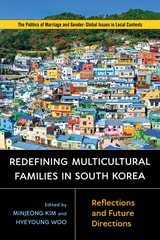
Redefining Multicultural Families in South Korea provides an in-depth look at the lives of families in Korea that include immigrants. Ten original chapters in this volume, written by scholars in multiple social science disciplines and covering different methodological approaches, aim to reinvigorate contemporary discussions about these multicultural families. Specially, the volume expands the scope of “multicultural families” by examining the diverse configurations of families with immigrants who crossed the Korean border during and after the 1990s, such as the families of undocumented migrant workers, divorced marriage immigrants, and the families of Korean women with Muslim immigrant husbands. Second, instead of looking at immigrants as newcomers, the volume takes a discursive turn, viewing them as settlers or first-generation immigrants in Korea whose post-migration lives have evolved and whose membership in Korean society has matured, by examining immigrants’ identities, need for political representation, their fights through the court system, and the aspirations of second-generation immigrants.
[more]
cover of Service Economies: Militarism, Sex Work, and Migrant Labor in South Korea

Service Economies

Militarism, Sex Work, and Migrant Labor in South Korea

Jin-kyung Lee

University of Minnesota Press, 2010

Service Economies presents an alternative narrative of South Korean modernity by examining how working-class labor occupies a central space in linking the United States and Asia to South Korea's changing global position from a U.S. neocolony to a subempire.

Making surprising and revelatory connections, Jin-kyung Lee analyzes South Korean military labor in the Vietnam War, domestic female sex workers, South Korean prostitution for U.S. troops, and immigrant/migrant labor from Asia in contemporary South Korea. Foregrounding gender, sexuality, and race, Lee reimagines the South Korean economic "miracle" as a global and regional articulation of industrial, military, and sexual proletarianization.

Lee not only addresses these under-studied labors individually but also integrates and unites them to reveal an alternative narrative of a changing South Korean working class whose heterogeneity is manifested in its objectification. Delving into literary and popular cultural sources as well as sociological work, Lee locates South Korean development in its military and economic interactions with the United States and other Asian nation-states, offering a unique perspective on how these practices have shaped and impacted U.S.-South Korea relations.
[more]
cover of The Internet of Elsewhere: The Emergent Effects of a Wired World

The Internet of Elsewhere

The Emergent Effects of a Wired World

Farivar, Cyrus

Rutgers University Press, 2011

Through the lens of culture, The Internet of Elsewhere looks at the role of the Internet as a catalyst in transforming communications, politics, and economics. Cyrus Farivar explores the Internet's history and effects in four distinct and, to some, surprising societies—Iran, Estonia, South Korea, and Senegal. He profiles Web pioneers in these countries and, at the same time, surveys the environments in which they each work. After all, contends Farivar, despite California's great success in creating the Internet and spawning companies like Apple and Google, in some areas the United States is still years behind other nations.

Surprised? You won't be for long as Farivar proves there are reasons that:

  • Skype was invented in Estonia—the same country that developed a digital ID system and e-voting;
  • Iran was the first country in the world to arrest a blogger, in 2003;
  • South Korea is the most wired country on the planet, with faster and less expensive broadband than anywhere in the United States;
  • Senegal may be one of sub-Saharan Africa's best chances for greater Internet access.

The Internet of Elsewhere brings forth a new complex and modern understanding of how the Internet spreads globally, with both good and bad effects.
[more]
cover of The Minjung Art Movement: Decolonization and Democracy in South Korea

The Minjung Art Movement

Decolonization and Democracy in South Korea

Sohl Lee

Duke University Press, 2026

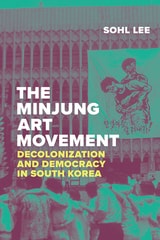
Emerging as multifaceted cultural activism, the minjung (people’s) art movement defined the aesthetics of the pro-democracy movements in the 1970s and 1980s in South Korea. Tracing minjung art’s history and legacy, Sohl Lee explores how artists associated with the movement mobilized images, print, and performance to build movement publics and reimagine sovereignty. Hundreds of artists questioned the underlying assumptions of liberal democracies and the art-making practices of the global Cold War. Their decolonial critiques of international modernism were inseparable from reimagining democracy and refiguring the relationship between art and democracy. Recuperating overlooked performance-oriented practices and the protest aesthetics that helped usher in parliamentary democracy in 1987, Lee shows that South Korea’s globalization in the 1990s and its rise as cultural soft power in the new millennium cannot be understood apart from a pro-democracy culture that was both political and popular.
[more]