Results by title

3 books match the query 'South Side (Chicago, Ill.)'
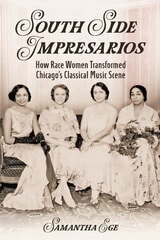
cover of South Side Impresarios: How Race Women Transformed Chicago's Classical Music Scene

South Side Impresarios

How Race Women Transformed Chicago's Classical Music Scene

Samantha Ege

University of Illinois Press, 2024

Between the world wars, Chicago Race women nurtured a local yet widely resonant Black classical music community entwined with Black civic life. Samantha Ege tells the stories of the Black women whose acumen and energy transformed Chicago’s South Side into a wellspring of music making.

Ege focuses on composers like Florence Price, Nora Holt, and Margaret Bonds not as anomalies but as artists within an expansive cultural flowering. Overcoming racism and sexism, Black women practitioners instilled others with the skill and passion to make classical music while Race women like Maude Roberts George, Estella Bonds, Neota McCurdy Dyett, and Beulah Mitchell Hill built and fostered institutions central to the community. Ege takes readers inside the backgrounds, social lives, and female-led networks of the participants while shining a light on the scene’s audiences, supporters, and training grounds. What emerges is a history of Black women and classical music in Chicago and the still-vital influence of the world they created.

A riveting counter to a history of silence, South Side Impresarios gives voice to an overlooked facet of the Black Chicago Renaissance.
[more]
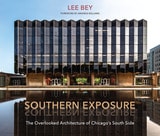
cover of Southern Exposure: The Overlooked Architecture of Chicago's South Side

Southern Exposure

The Overlooked Architecture of Chicago's South Side

Lee Bey; Foreword by Amanda Willliams

Northwestern University Press, 2019

Southern Exposure: The Overlooked Architecture of Chicago’s South Side is the first book devoted to the South Side’s rich and unfairly ignored architectural heritage. With lively, insightful text and gallery-quality color photographs by noted Chicago architecture expert Lee Bey, Southern Exposure documents the remarkable and largely unsung architecture of the South Side. The book features an array of landmarks—from a Space Age dry cleaner to a nineteenth-century lagoon that meanders down the middle of a working-class neighborhood street—that are largely absent from arts discourse, in no small part because they sit in a predominantly African American and Latino section of town better known as a place of disinvestment, abandonment, and violence. 

Inspired by Bey’s 2017 Chicago Architecture Biennial exhibition, Southern Exposure visits sixty sites, including lesser-known but important work by luminaries such as Jeanne Gang, Frank Lloyd Wright, and Eero Saarinen, as well as buildings by pioneering black architects such as Walter T. Bailey, John Moutoussamy, and Roger Margerum. 

Pushing against the popular  narrative that depicts Chicago’s South Side as an architectural wasteland, Bey shows beautiful and intact buildings and neighborhoods  that reflect the value—and potential—of the area. Southern Exposure offers much to delight architecture aficionados and writers, native Chicagoans and guests to the city alike.
[more]
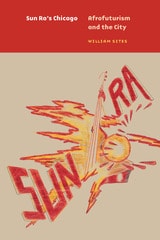
cover of Sun Ra's Chicago: Afrofuturism and the City

Sun Ra's Chicago

Afrofuturism and the City

William Sites

University of Chicago Press, 2020

Sun Ra (1914–93) was one of the most wildly prolific and unfailingly eccentric figures in the history of music. Renowned for extravagant performances in which his Arkestra appeared in neo-Egyptian garb, the keyboardist and bandleader also espoused an interstellar cosmology that claimed the planet Saturn as his true home. In Sun Ra’s Chicago, William Sites brings this visionary musician back to earth—specifically to the city’s South Side, where from 1946 to 1961 he lived and relaunched his career. The postwar South Side was a hotbed of unorthodox religious and cultural activism: Afrocentric philosophies flourished, storefront prophets sold “dream-book bibles,” and Elijah Muhammad was building the Nation of Islam. It was also an unruly musical crossroads where the man then known as Sonny Blount drew from an array of intellectual and musical sources—from radical nationalism, revisionist Christianity, and science fiction to jazz, blues, Latin dance music, and pop exotica—to construct a philosophy and performance style that imagined a new identity and future for African Americans. Sun Ra’s Chicago shows that late twentieth-century Afrofuturism emerged from a deep, utopian engagement with the city—and that by excavating the postwar black experience of Sun Ra’s South Side milieu, we can come to see the possibilities of urban life in new ways.
[more]