Results by title
4 books match the query 'Southeast Asian Americans'
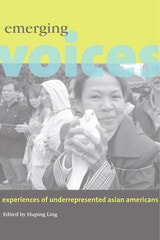
Emerging Voices
Experiences of Underrepresented Asian AmericansLing, Huping
Rutgers University Press, 2008
While a growing number of popular and scholarly works focus on Asian Americans, most are devoted to the experiences of larger groups such as Chinese, Japanese, Korean, Filipino, and Indian Americans. As the field grows, there is a pressing need to understand the smaller and more recent immigrant communities. Emerging Voices fills this gap with its unique and compelling discussion of underrepresented groups, including Burmese, Indonesian, Mong, Hmong, Nepalese, Romani, Tibetan, and Thai Americans.
Unlike the earlier and larger groups of Asian immigrants to America, many of whom made the choice to emigrate to seek better economic opportunities, many of the groups discussed in this volume fled war or political persecution in their homeland. Forced to make drastic transitions in America with little physical or psychological preparation, questions of “why am I here,” “who am I,” and “why am I discriminated against,” remain at the heart of their post-emigration experiences.
Bringing together eminent scholars from a variety of disciplines, this collection considers a wide range of themes, including assimilation and adaptation, immigration patterns, community, education, ethnicity, economics, family, gender, marriage, religion, sexuality, and work.
Heartwood
The First Generation of Theravada Buddhism in AmericaWendy Cadge
University of Chicago Press, 2004
Wendy Cadge first provides a historical overview of Theravada Buddhism and considers its specific origins here in the United States. She then brings her findings to bear on issues of personal identity, immigration, cultural assimilation, and the nature of religion in everyday life. Her work is the first systematic comparison of the ways in which immigrant and convert Buddhists understand, practice, and adapt the Buddhist tradition in America. The men and women whom Cadge meets and observes speak directly to us in this work, both in their personal testimonials and as they meditate, pray, and practice Buddhism.
Creative and insightful, Heartwood will be of enormous value to sociologists of religion and anyone wishing to understand the rise of Buddhism in the Western world.
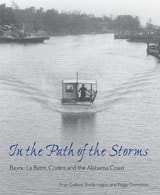
In the Path of the Storms
Bayou La Batre, Coden, and the Alabama CoastFrye Gaillard
University of Alabama Press, 2008
A Powerful Portrait of Resilience, Heritage, and Change on Alabama's Gulf Coast.
The Gulf Coast villages of Bayou La Batre and Coden are two of Alabama’s most distinctive, with roots going back to the French settlements of the 18th century. For generations, the proud inhabitants of these communities have extracted their modest livings from the sea, sustained by a lesson handed down over time— that providing for the needs of one’s family is the only true measure of success. But the world has changed drastically for them. A global economy of higher gas prices and cheap imported seafood has threatened the lifeblood of the area. And in recent years a rash of hurricanes, culminating with Hurricane Katrina, has battered the hopes and dreams of these Bayou towns.
But they have known hard times and massive changes before. In the 1970s, refugees from Vietnam, Cambodia, and Laos flooded into the area and within a few years made up a third of the local population. Three Buddhist temples soon took their places among the Catholic, Baptist, and Pentecostal churches that predominated, and for a time the different ethnic groups coexisted in a kind of uneasy peace. But now they are learning to pull together in an uncertain struggle to rebuild their communities.
In the Path of the Storms is a powerful portrait in words and photographs of a unique and unforgettable place. It is a story of tradition, and forces of change, and the epic struggle of these Gulf Coast communities to survive and thrive.
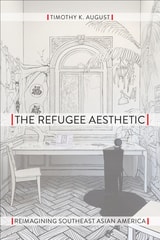
The Refugee Aesthetic
Reimagining Southeast Asian AmericaTimothy August
Temple University Press, 2021
The refugee is conventionally considered a powerless figure, eagerly cast aside by both migrant and host communities. In his book, The Refugee Aesthetic, Timothy August investigates how and why a number of Southeast Asian American artists and writers have recently embraced the figure of the refugee as a particularly transformative position. He explains how these artists, theorists, critics, and culture-makers reconstruct their place in the American imagination by identifying and critiquing the underlying structures of power that create refugees in the contemporary world.
August looks at the outside forces that shape refugee representation and how these expressions are received. He considers the visual legacy of the Southeast Asian refugee experience by analyzing music videos, graphic novels, and refugee artwork. August also examines the power of refugee literature, showing how and why Southeast Asian American writers look to the refugee position to disentangle their complicated aesthetic legacy.
Arguing that “aesthetics” should be central to the conceptualization of critical refugee studies, August shows how representational structures can galvanize or marginalize refugees, depending on how refugee aesthetics are used and circulated.