Results by title
4 books match the query 'Southern Women'
Circling Faith
Southern Women on SpiritualityWendy Reed
University of Alabama Press, 2012
Half Sisters of History
Southern Women and the American PastCatherine Clinton
Duke University Press, 1994
This collection of essays by pioneering scholars surveys the roots and development of southern women’s history and examines the roles of white women and women of color across the boundaries of class and social status from the founding of the nation to the present. Authors including Anne Firor Scott, Elizabeth Fox-Genovese, Jacquelyn Dowd Hall, and Nell Irwin Painter, among others, analyze women’s participation in prewar slavery, their representation in popular fiction, and their involvement in social movements. In no way restricted to views of the plantation South, other essays examine the role of women during the American Revolution, the social status of Native American women, the involvement of Appalachian women in labor struggles, and the significance of women in the battle for civil rights. Because of their indelible impact on gender relations, issues of class, race, and sexuality figure centrally in these analyses.
Half Sisters of History will be important not only to women’s historians, but also to southern historians and women’s studies scholars. It will prove invaluable to anyone in search of a full understanding of the history of women, the South, or the nation itself.
Contributors. Catherine Clinton, Sara Evans, Elizabeth Fox-Genovese, Jacquelyn Dowd Hall, Jacqueline Jones, Suzanne D. Lebsock, Nell Irwin Painter, Theda Perdue, Anne Firor Scott, Deborah Gray White
Scarlett Doesn't Live Here Anymore
SOUTHERN WOMEN IN THE CIVIL WAR ERALaura F. Edwards
University of Illinois Press, 2000
Positing the household as the central institution of southern society, Edwards delineates the inseparable links between domestic relations and civil and political rights in ways that highlight women's active political role throughout the nineteenth century. She draws on diaries, letters, newspaper accounts, government records, legal documents, court proceedings, and other primary sources to explore the experiences and actions of individual women in the changing South, demonstrating how family, kin, personal reputation, and social context all merged with gender, race, and class to shape what particular women could do in particular circumstances.
Meet Harriet Jacobs, the escaped slave who hid in a tiny, unheated attic on her master's property for seven years until she could free her children and herself. Marion Singleton Deveaux Converse, the southern belle who leaped out a second-story window to escape her second husband's "discipline" and received temporary shelter from her slaves. Sarah Guttery, a white, poor, unwed mother of two, whose hard work and clean living earned her community's respect despite her youthful transgressions. Aunt Lucy, who led her fellow slaves in taking over her master's abandoned plantation and declared herself the new mistress.
Through vivid portraits of these and other slaves, free blacks, common whites, and the white elite, Edwards shows how women's domestic situations determined their lives before the war and their responses to secession and armed conflict. She also documents how women of various classes entered into the process of rebuilding, asserting new rights and exploring new roles after the war.
An ideal basic text on society in the Civil War era, Scarlett Doesn't Live Here Anymore demonstrates how women on every step of the social ladder worked actively throughout the period to shape southern society in ways that fulfilled their hopes for the future. They used the resources at their disposal to fashion their own positive identities, to create the social bonds that sustained them in difficult times, and to express powerful social critiques that helped them make sense of their lives.
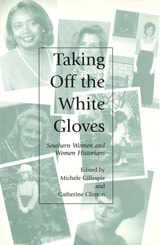
Taking Off the White Gloves
Southern Women and Women HistoriansEdited & Intro by Michele Gillespie & Catherine Clinton
University of Missouri Press, 1998
When southern women remove their gloves, they speak their minds. The ten timely and provocative essays in Taking Off the White Gloves represent the collective wisdom of some of the finest scholars on women's history in the American South. On the eve of the thirtieth anniversary of the Southern Association for Women Historians, this volume brings together some of the outstanding lectures delivered by distinguished members of the association over the past fifteen years.
Spanning four centuries of women's experiences in the South, the topics featured in Taking Off the White Gloves range from Native American sexuality and European conquest to woman suffrage in the South, from black women's protest history to the status of women in the historical profession at the end of the twentieth century.
Despite diverse subject matter, these rich essays share a number of important qualities. They take an integrative approach, combining literary analysis, social history, cultural interpretation, labor history, popular culture, and oral history. Embracing the distinctiveness of the southern past and women's experiences within that past, they also recognize the inextricability of critical categories such as sexuality and gender, race and gender, and women and work. Finally, these essays emphasize the authors' commitment to the belief that the personal is political; they reveal the subtle and not so subtle ways that women transform theory into practice.
Taking Off the White Gloves invites a new understanding of the complexities that surround the history of southern women across race, class, place, and time. A model of innovative and imaginative scholarly historical writing, this book provides fertile ground for young scholars and is sure to inspire new research. This thought- provoking volume has much to offer scholars and students, as well as the general reader.