Results by title
4 books match the query 'Soviet Russia'
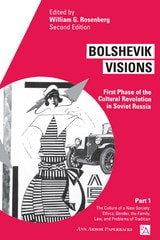
Bolshevik Visions
First Phase of the Cultural Revolution in Soviet Russia, Part 1William G. Rosenberg, Editor
University of Michigan Press, 1990
The first volume of a collection of writings by early Soviet critics and theorists
[more]

Gogol's Afterlife
The Evolution of a Classic in Imperial and Soviet RussiaCaryl Emerson
Northwestern University Press, 2002
Gogol's claim to the title of national literary classic is incontestable. An exemplar of popular audiences no less than for the intelligentsia, Gogol was pressed into service under the tsarist and Soviet regimes for causes both aesthetic and political, official and unofficial. In Gogol's Afterlife, Stephen Moeller-Sally explores how he achieved this peculiar brand of cultural authority and later maintained it, despite dramatic shifts in the organization of Russian literature and society.
Part I charts the historical and cultural currents that shaped Gogol's reputation, devoting particular attention to the models of authorship Gogol himself devised in response to his changing audience and developing authorial mission. Part II takes a panoramic view of the social milieu in which Gogol's status evolved. Finally, Part III examines the place of the classics in Soviet culture, with a focus on Gogol's role in the cultural revolution and his peculiar relationship with state power under Stalinism.
Part I charts the historical and cultural currents that shaped Gogol's reputation, devoting particular attention to the models of authorship Gogol himself devised in response to his changing audience and developing authorial mission. Part II takes a panoramic view of the social milieu in which Gogol's status evolved. Finally, Part III examines the place of the classics in Soviet culture, with a focus on Gogol's role in the cultural revolution and his peculiar relationship with state power under Stalinism.
[more]
Readings in Russian Civilization Volume III
Soviet Russia, 1917-1963Edited by Thomas Riha
University of Chicago Press, 1969
"This new and enlarged version of Readings in Russian Civilization is the result of fairly extensive revisions. There are now 72 instead of 64 items; 20 of the selections are new. The first volume has undergone the least change with 3 new items, of which 2 appear in English for the first time. In the second volume there are 6 new items; all of them appear in English for the first time. The third volume has undergone the greatest revision, with 11 new items, of which 6 are newly translated from the Russian. It is the editor's hope that items left out in the new edition will not be sorely missed, and that the new selections will turn out to be useful and illuminating. The aim, throughout, has been to cover areas of knowledge and periods which had been neglected in the first edition, and to include topics which are important in the study of the Russian past and present.
"The bibliographical headnotes have been enlarged, with the result that there are now approximately twice as many entries as in the old edition. New citations include not only works which have appeared since 1963, but also older books and articles which have come to the editor's attention."—From the Editor's Preface
". . . a judicious combination of seminal works and more recent commentaries that achieves the editor's purpose of stimulating curiosity and developing a point of view."—C. Bickford O'Brien, The Russian Review
"These three volumes cover quite well the main periods of Russian civilization. The choice of the articles and other material is made by a competent and unbiased scholar."—Ivan A. Lopatin, Professor of Asian and Slavic Studies, University of Southern California
[more]
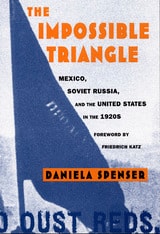
The Impossible Triangle
Mexico, Soviet Russia, and the United States in the 1920sDaniela Spenser
Duke University Press, 1999
During the 1920s, Mexico was caught in a diplomatic struggle between the ideologies of two strong states. In The Impossible Triangle Daniela Spenser explores the tangled relationship between Russia and Mexico in the years following their own dramatic revolutions, as well as the role played by the United States during this turbulent period. Bringing together Mexican, Soviet, and North American (as well as British) perspectives, Spenser shows how the convergence of each country’s domestic and foreign policies precluded them from a harmonious triangular relationship.
Based on documents from the archives of several nations—including reports by former Mexican diplomats in Moscow that have never before been studied—the book analyzes the Mexican government’s motivation for establishing relations with the Soviet Union in the face of continued imperialist pressure and harsh opposition from the United States. After explaining how Mexico established diplomatic ties with the Soviet Union in 1924 in an attempt to broaden the spectrum of its alliances after several years of uneven relations with the United States, Spenser reveals the troubled nature of the relationship that ensued. Soviet policy toward Mexico was characterized by a series of profound contradictions, varying from neglect to strong involvement in Mexican politics and the belief that Mexico could become a center of world revolution. Working to resolve and explain these contradictions, Spenser explores how, despite U.S. objections to Mexico’s relations with the Soviet Union, Mexico continued its association with the Soviets until the United States adopted the Good Neighbor Policy and softened its stance toward Mexico’s revolutionary program after 1927.
With a foreword by Friedrich Katz and illustrated by illuminating photographs, The Impossible Triangle contributes to an understanding of the international dimension of the Mexican revolution. It will interest students and scholars of history, revolutionary theory, political science, diplomacy, and international relations.
[more]