Results by title
4 books match the query 'Soviet occupation, 1979-1989'

Among the Afghans
Arthur Bonner
Duke University Press, 1987
Bonner therefore brings both recent experience and the sharp eye of a veteran journalist to an analysis of the Afghan situation: the tenacity and courage of the resistance, the massive emmigration, and the toll taken by the seemingly endless conflict on the country and its people.
The author has seen both the great and small of Afghanistan--both the seared flesh of the hand that an Afghan mujahidin held in the fire to demonstrate his courage and the geopolitical reasons that impelled the former Soviet Union of set its might and treasure against a people who resisted with a fierce and sometimes (to Western eyes) thoughtless courage. This is the story of these antagonists--sobering, chilling, and finally enlightening.
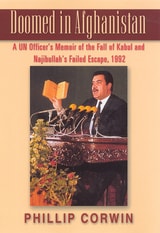
Doomed in Afghanistan
A U.N. Officer's Memoir of the Fall of Kabul and Najibullah's Failed Escape, 1992Corwin, Phillip
Rutgers University Press, 2002
To understand more deeply the tragic events of September 11, 2001, it is critical to know Afghanistan’s recent and turbulent past. Doomed inAfghanistan provides a first-hand account of how failed diplomacy led to an Islamic fundamentalist victory in a war-torn country, and subsequently, to a Taliban takeover and a home for Osama bin Laden’s Al Qaeda terrorist network.
In April of 1992, Phillip Corwin was part of a United Nations team in Afghanistan whose mission was to help ensure the transfer of power from the Soviet-installed communist regime of President Najibullah to an interim government (that would prepare for elections). Without the support of the Soviet Union, Najibullah’s regime crumbled, and he was convinced to resign in favor of a national unity government, with the understanding that he would be evacuated to a neutral country (India). Due to a series of miscalculations and machinations, the U.N.’s diplomatic mission failed. Kabul fell to groups of mujahiddin before Najibullah could be evacuated. The inability of the various mujahiddin factions to unite led to their eventual defeat by the Taliban, who four years later routed Najibullah from his safe haven at the U.N. compound, and executed him.
Corwin gives a vivid account of the seminal event of Najibullah’s failed evacuation and the frenzied negotiations that were unable to forestall the anarchy and chaos that followed.
Parties and Elections in Greece
The Search for LegitimacyRichard Clogg
Duke University Press, 1987
Untying the Afghan Knot
Negotiating Soviet WithdrawalRiaz M. Khan
Duke University Press, 1991
Riaz M. Khan, a senior Pakistani diplomat, participated actively in all meetings on Afghanistan in the United Nations, the Non-Aligned Movement, and the Organization of the Islamic Conference, and in all of the Geneva negotiating rounds (1882–1988). Drawing upon his personal experience, official documents, scholarly literature, and press accounts, he provides a unique insider’s view of these precedent-setting negotiations, which were often shrouded in secrecy and misperceptions.
Khan examines the interests, positions, and behind-the-scenes maneuverings of the major players—Afghan governments and resistance groups, Pakistan, the Soviet Union, the United States, and UN mediators—and assesses the impact of military and political developments inside Afghanistan and elsewhere, including the advent of Mikhail Gorbachev. Khan’s authoritative account of these critical diplomatic initiatives sheds important light on the internal dynamics of the multilateral Afghanistan negotiations.