Results by title
4 books match the query 'Space (Architecture) in literature'
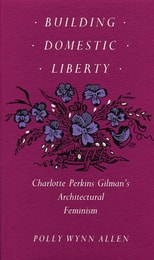
Building Domestic Liberty
Charlotte Perkins Gilman's Architectural FeminismPolly Wynn Allen
University of Massachusetts Press, 1988
Building Domestic Liberty offers a critical and admiring analysis of feminist philosopher Charlotte Perkins Gilman (1860–1935). Polly Allen examines Gilman's approach to architecture, landscape, and neighborhood design and discusses Gilman's case against prevailing household design and looks at her philosophy of world improvement.
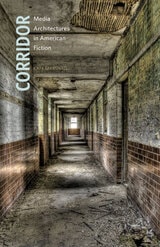
Corridor
Media Architectures in American FictionKate Marshall
University of Minnesota Press, 2013
Corridor offers a series of conceptually provocative readings that illuminate a hidden and surprising relationship between architectural space and modern American fiction. By paying close attention to fictional descriptions of some of modernity’s least remarkable structures, such as plumbing, ductwork, and airshafts, Kate Marshall discovers a rich network of connections between corridors and novels, one that also sheds new light on the nature of modern media.
The corridor is the dominant organizational structure in modern architecture, yet its various functions are taken for granted, and it tends to disappear from view. But, as Marshall shows, even the most banal structures become strangely visible in the noisy communication systems of American fiction. By examining the link between modernist novels and corridors, Marshall demonstrates the ways architectural elements act as media. In a fresh look at the late naturalist fiction of the 1920s, ’30s, and ’40s, she leads the reader through the fetus-clogged sewers of Manhattan Transfer to the corpse-choked furnaces of Native Son and reveals how these invisible spaces have a fascinating history in organizing the structure of modern persons.
Portraying media as not only objects but processes, Marshall develops a new idiom for Americanist literary criticism, one that explains how media studies can inform our understanding of modernist literature.

Space in Greek Tragedy (BICS Supplement 131)
Edited by Vassiliki Kampourelli
University of London Press, 2016
The Spaces of Violence
James R. Giles
University of Alabama Press, 2006
Exploring the landscapes, cultures, and psychological spaces where violence takes root in contemporary American fiction.
The Spaces of Violence is an insightful work of literary criticism in which James R. Giles investigates the complex relationship between violence and space in contemporary American fiction. Through close readings of novels by influential writers including Russell Banks, Cormac McCarthy, Lewis Nordan, Dorothy Allison, Don DeLillo, Denis Johnson, Sherman Alexie, Robert Stone, and Bret Easton Ellis, Giles demonstrates how violence is shaped by the physical, social, and psychological environments in which it occurs.
Drawing on spatial and cultural theory, Giles argues that these novels inhabit a distinctive "fourthspace," a realm existing at the margins of mainstream society where violence permeates everyday life and destabilizes traditional boundaries of identity, community, and morality. Whether set in rural landscapes, urban centers, suburban communities, football stadiums, or transient spaces such as highways and bus stations, the works examined reveal how environments become intertwined with systems of power, alienation, trauma, and destruction.
The book concludes by extending its analysis to representations of violence within family structures, highlighting the far-reaching effects of social and cultural fragmentation. Offering a sophisticated framework for understanding violence in literature, The Spaces of Violence is an important contribution to contemporary literary and cultural studies.