Results by title
7 books match the query 'Space and time in motion pictures'
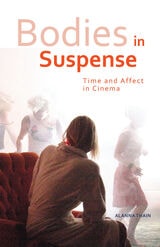
Bodies in Suspense
Time and Affect in CinemaAlanna Thain
University of Minnesota Press, 2017
Bodies in Suspense presents a powerful new way to think through postdigital cinema and the affective turn in critical theory. According to Alanna Thain, suspense films allow us to experience the relation between two bodies: that of the film and that of the viewer. Through the “time machine” of suspense, film form, gender, genre, and spectatorship are revealed in innovative and different ways. These films not only engage us directly in ethical concerns, but also provide a key for understanding corporeal power in the digital era.
Offering a new framework for understanding cinematic suspense, Bodies in Suspense argues that the “body in time” enables us to experience the temporal dimension of the body directly. This is the first book to link two contemporary frames of analysis: questions of cinematic temporality and contemporary affect theory. Thain conducts close readings of influential suspense films by Alfred Hitchcock, David Lynch, Christian Marclay, Rian Johnson, and Lou Ye, and sets forth a compelling new theory of cinema, reading for the productivity of the “crime of time” that stages the duplicity of cinematic bodies. Through these films that foreground doubled characters and looping, Thain explores Gilles Deleuze’s claim that “the direct time-image is the phantom which has always haunted cinema.”
A vital new addition to film theory, corporeality and affect theory, feminist theory, and the philosophy of time—and one of the first books to explore David Lynch’s Hollywood trilogy—Bodies in Suspense asks us to pay attention, above all, to the ways in which the condition of spectatorship creates a doubling sensation with important philosophical repercussions.
Framed Time
Toward a Postfilmic CinemaGarrett Stewart
University of Chicago Press, 2007

German Ways of War
The Affective Geographies and Generic Transformations of German War FilmsJaimey Fisher
Rutgers University Press, 2022
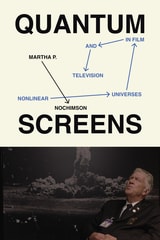
Quantum Screens
Nonlinear Universes in Film and TelevisionMartha P. Nochimson
University of Texas Press, 2026
An exploration of how nonlinear storytelling opens a post-Newtonian reality and changes both the hero’s journey and how we understand history in film and television.
Begin at the beginning and keep going until the end. That’s the cardinal rule of conventional storytelling. But ever since the modernists of the early twentieth century, popular narratives have occasionally eschewed this linear approach to temporality. It’s as though our stories, formerly unfolding in the stable, predictable universe of Newtonian physics, can now take place in multidimensional time where anything and anyone can be as incalculable as Schrödinger’s cat.
Quantum Screens is a journey through the past and present of nonlinear time in film and television. Moving beyond the early experiments of Luis Buñuel and the first nonlinear commercial films, such as 2001: A Space Odyssey, Martha Nochimson shows how risk-taking auteurs David Lynch, Damon Lindelof, and Terrence Malik have opened new horizons and a new concept of beauty in storytelling through their revelatory creations. Quantum Screens takes us deep into the audience’s experience of nonlinearity, exploring the emotional dislocations such storytelling creates, using television programs such as Twin Peaks, Westworld, and Watchmen, and films including The Tree of Life, BlacKkKlansman, and Arrival. Indeed, viewers are at the heart of a changing aesthetics of nonlinearity, Nochimson argues. Amid innovations like on-demand viewing, unlimited replay, and binge-watching, the experience of real time is more malleable than ever, and creators are responding by structuring their stories in compelling new ways.
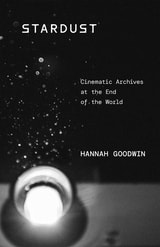
Stardust
Cinematic Archives at the End of the WorldHannah Goodwin
University of Minnesota Press, 2024
An exploration of the fundamental bond between cinema and the cosmos
The advent of cinema occurred alongside pivotal developments in astronomy and astrophysics, including Albert Einstein’s theories of relativity, all of which dramatically altered our conception of time and provided new means of envisioning the limits of our world. Tracing the many aesthetic, philosophical, and technological parallels between these fields, Stardust explores how cinema has routinely looked toward the cosmos to reflect our collective anxiety about a universe without us.
Employing a “cosmocinematic gaze,” Hannah Goodwin uses the metaphorical frameworks from astronomy to posit new understandings of cinematic time and underscore the role of light in generating archives for an uncertain future. Surveying a broad range of works, including silent-era educational films, avant-garde experimental works, and contemporary blockbusters, she carves out a distinctive area of film analysis that extends its reach far beyond mainstream science fiction to explore films that reckon with a future in which humans are absent.
This expansive study details the shared affinities between cinema and the stars in order to demonstrate how filmmakers have used cosmic imagery and themes to respond to the twentieth century’s moments of existential dread, from World War I to the atomic age to our current moment of environmental collapse. As our outlook on the future continues to change, Stardust illuminates the promise of cinema to bear witness to humanity’s fragile existence within the vast expanse of the universe.
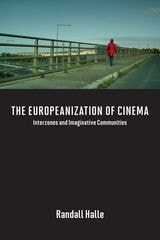
The Europeanization of Cinema
Interzones and Imaginative CommunitiesRandall Halle
University of Illinois Press, 2014
He focuses especially on films about borders, borderlands, and cultural zones as he traces the development of interzones from the inception of central European cinema to the avant-garde films of today. Throughout, he shows how cinema both reflects and engenders interzones that explore the important questions of Europe's social order: imperialism and nation-building in the late nineteenth and early twentieth centuries; "first contact" between former adversaries (such as East and West Germany) following World War II and the Cold War; and migration, neo-colonialism, and cultural imperialism in the twenty-first century.
Ultimately, Halle argues that today's cinema both produces and reflects imaginative communities. He demonstrates how, rather than simply erasing boundaries, the European Union instead fosters a network of cultural interzones that encourage cinematic exploration of the new Europe's processes and limits of connectivity, tolerance, and cooperation.
The Planetary Turn
Relationality and Geoaesthetics in the Twenty-First CenturyEdited by Amy J. Elias and Christian Moraru
Northwestern University Press, 2015
A groundbreaking essay collection that pursues the rise of geoculture as an essential framework for arts criticism, The Planetary Turn shows how the planet—as a territory, a sociopolitical arena, a natural space of interaction for all earthly life, and an artistic theme—is increasingly the conceptual and political dimension in which twenty-first-century writers and artists picture themselves and their work. In an introduction that comprehensively defines the planetary model of art, culture, and cultural-aesthetic interpretation, the editors explain how the living planet is emerging as distinct from older concepts of globalization, cosmopolitanism, and environmentalism and is becoming a new ground for exciting work in contemporary literature, visual and media arts, and social humanities. Written by internationally recognized scholars, the twelve essays that follow illustrate the unfolding of a new vision of potential planetary community that retools earlier models based on the nation-state or political “blocs” and reimagines cultural, political, aesthetic, and ethical relationships for the post–Cold War era.