Results by title
4 books match the query 'Space in motion pictures'
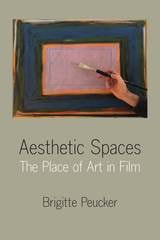
Aesthetic Spaces
The Place of Art in FilmBrigitte Peucker
Northwestern University Press, 2019
The films studied in these chapters include those by Abbas Kiarostami, Alfred Hitchcock, Michelangelo Antonioni, Jean-Luc Godard, Carl Th. Dreyer, Peter Greenaway, Rainer Werner Fassbinder, Ingmar Bergman, Jacques Rivette, Fritz Lang, F. W. Murnau, Lars von Trier, Spike Jonze, Éric Rohmer, Lech Majewski, and others. Where two media are in evidence in these films, there is usually a third, and often theater mediates between film and painting. Aesthetic Spaces interrogates issues of cinematic space and mise-en-scène from different but interconnected theoretical perspectives, organizing its chapters around some of the formal principles—space, spectator, frame, color and lighting, props, décor, and actor—that shape films.
Drawing on the older arts to renew cinema, the films examined deploy paintings as material: Poussin and Bruegel, Rembrandt, Hals and Klimt, and medieval illustrations and modernist abstractions are used to expand our notions of cinematic space. Peucker shows that when different media come together in film, they create effects of dissonance out of which new modes of looking may arise.

Bigger Than Life
The Close-Up and Scale in the CinemaMary Ann Doane
Duke University Press, 2021

Taking Place
Location and the Moving ImageJohn David Rhodes
University of Minnesota Press, 2011
Taking Place argues that the relation between geographical location and the moving image is fundamental and that place grounds our experience of film and media. Its original essays analyze film, television, video, and installation art from diverse national and transnational contexts to rethink both the study of moving images and the theorization of place. Through its unprecedented—and at times even obsessive— attention to actual places, this volume traces the tensions between the global and the local, the universal and the particular, that inhere in contemporary debates on global cinema, television, art, and media.
Contributors: Rosalind Galt, U of Sussex; Frances Guerin, U of Kent; Ji-hoon Kim; Hugh S. Manon, Clark U; Ara Osterweil, McGill U; Brian Price, U of Toronto; Linda Robinson, U of Wisconsin–Whitewater; Michael Siegel; Noa Steimatsky, U of Chicago; Meghan Sutherland, U of Toronto; Mark W. Turner, Kings College London; Aurora Wallace, New York U; Charles Wolfe, U of California, Santa Barbara.
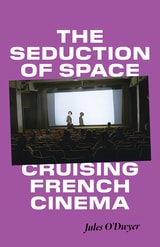
The Seduction of Space
Cruising French CinemaJules O'Dwyer
University of Minnesota Press, 2025
A bold and far-reaching new study of French queer cinema reimagines the relationship between sexuality and space
Spatiality has long been a crucial and potent lens for understanding French culture and aesthetics. While canonical greats of French cinema such as Jean-Luc Godard, Agnès Varda, and Louis Malle invoked the notion of flânerie to explore ideas of modernism, spatial exploration, and urban sociality, Jules O’Dwyer demonstrates how a more recent generation of French queer filmmakers continues to engage with—and contest—this legacy by focusing attention on the cognate practice of cruising.
Through the work of Jacques Nolot, Sébastien Lifshitz, Christophe Honoré, Vincent Dieutre, Alain Guiraudie, and others, The Seduction of Space draws film theory, queer studies, and spatial inquiry into close proximity to examine the politics of cruising and the gendering of space. Making the case that cinema not only documents the queer spaces of the past but continues to produce them, O’Dwyer maps the relationships between sex and spatiality as he takes up such varied topics as public sex in the porn theater, racial eroticization in the banlieue, and the ecocritical valences of rural cruising.
Foregrounding the crucial role that spatiality plays in shaping the parameters of France’s visual cultures and political imaginary, The Seduction of Space is both an urgent queer reconceptualization of this tradition and a clarion call for film scholars to tarry with the politics of sexuality in all its messiness.
Retail e-book files for this title are screen-reader friendly with images accompanied by short alt text and/or extended descriptions.