Results by title
8 books match the query 'Space perception'
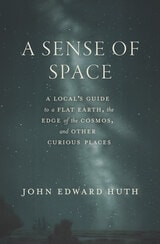
A Sense of Space
A Local’s Guide to a Flat Earth, the Edge of the Cosmos, and Other Curious PlacesJohn Edward Huth
University of Chicago Press, 2025
When you give directions, do you tell someone to go straight ahead and turn left? Or do you suggest that they head north before moving west? Your answer reveals more than you might think.
In A Sense of Space, writer and physicist John Edward Huth uses these two kinds of navigation—either centered on or independent of people—to help readers chart a path through evolving spatial models. In doing so, he offers an astonishing exploration of how changing scientific models of space alter our social perceptions, and vice versa. New visions of space can emanate from human considerations, he argues, and those new visions can in turn spawn new cultural phenomena. With accessible introductions to topics including mental maps, astrology, astronomy, particle physics, and Einstein’s relativity, Huth makes clear that, although our minds have evolved to comprehend space in terrestrial distances, we routinely extend this understanding to realms far removed from our everyday experiences, from cosmological to subatomic scales.
Taking us across the eons from the myth of a flat earth to the mysteries of the multiverse, A Sense of Space is an energetic, thoughtful guide to how we orient ourselves in our world—and beyond.
Geographies of Writing
Inhabiting Places and Encountering DifferenceNedra Reynolds
Southern Illinois University Press, 2004
Twenty-first-century technological innovations have revolutionized the way we experience space, causing an increased sense of fragmentation, danger, and placelessness. In Geographies of Writing: Inhabiting Places and Encountering Difference, Nedra Reynolds addresses these problems in the context of higher education, arguing that theories of writing and rhetoric must engage the metaphorical implications of place without ignoring materiality.
Geographies of Writing makes three closely related contributions: one theoretical, to reimagine composing as spatial, material, and visual; one political, to understand the sociospatial construction of difference; and one pedagogical, to teach writing as a set of spatial practices. Aided by seven maps and illustrations that reinforce the book’s visual rhetoric, Geographies of Writing shows how composition tasks and electronic space function as conduits for navigating reality.
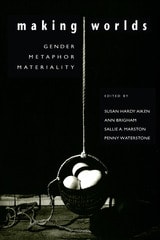
Making Worlds
Gender, Metaphor, MaterialityEdited by Susan Hardy Aiken, Ann Brigham, Sallie A. Marston, and Penny Waterstone
University of Arizona Press, 1997
In recent years these questions have occasioned intensifying debates, but they have seldom extended beyond the boundaries of individual academic disciplines or crossed the divide that has traditionally separated the academy from the "outside" world. Making Worlds both questions and traverses those divisions by combining personal essays, activist political rhetoric, oral history, poetry, iconography, and performance art with interdisciplinary academic discourses.
Representing a wide range of perspectives, Making Worlds develops a provocative conversation about gender and spatiality in the interwoven symbolic and material environments we create. The contributors engage such issues as the body as site of symbolic action, fabrication, and desire; the place and play of sexualities; the cultural implications of everyday life—home, travel, work, childbirth, food, disease, and death; technology and mass media; surveillance, confinement, and the law; the dynamics of race and ethnicity; imperialism, oppression, and resistance; the politics of urban spaces; landscape and cultural memory; the experience of time; and the nature of "Nature." For students and scholars in cultural studies, geography, literary criticism, anthropology, history, and women's studies, it offers new ways of thinking about space, place, and the spatial contexts of social thought and action.
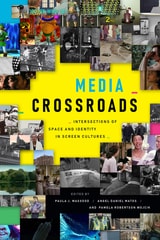
Media Crossroads
Intersections of Space and Identity in Screen CulturesPaula J. Massood, Angel Daniel Matos, and Pamela Robertson Wojcik, editors
Duke University Press, 2021
Contributors. Amy Corbin, Desirée J. Garcia, Joshua Glick, Noelle Griffis, Malini Guha, Ina Rae Hark, Peter C. Kunze, Paula J. Massood, Angel Daniel Matos, Nicole Erin Morse, Elizabeth Patton, Matthew Thomas Payne, Merrill Schleier, Jacqueline Sheean, Sarah Louise Smyth, Erica Stein, Kirsten Moana Thompson, John Vanderhoef, Pamela Robertson Wojcik
Mysticism and Space
Space and Spatiality in the Works of Richard Rolle, The Cloud of Unknowing Author, and Julian of NorwichCarmel Bendon Davis
Catholic University of America Press, 2008

Seeking Spatial Justice
Edward W. Soja
University of Minnesota Press, 2010
Shaping the Discourse on Space
Charity and Its Wards in Nineteenth-Century San Juan, Puerto RicoBy Teresita Martínez-Vergne
University of Texas Press, 1999
As an inchoate middle class emerged in Puerto Rico in the early nineteenth century, its members sought to control not only public space, but also the people, activities, and even attitudes that filled it. Their instruments were the San Juan town council and the Casa de Beneficencia, a state-run charitable establishment charged with responsibility for the poor.
In this book, Teresita Martínez-Vergne explores how municipal officials and the Casa de Beneficencia shaped the discourse on public and private space and thereby marginalized the worthy poor and vagrants, "liberated" Africans, indigent and unruly women, and destitute children. Drawing on extensive and innovative archival research, she shows that the men who comprised the San Juan ayuntamiento and the board of charity regulated the public discourse on topics such as education, religious orthodoxy, hygiene, and family life, thereby establishing norms for "correct" social behavior and chastising the "deviant" lifestyles of the working poor.
This research clarifies the ways in which San Juan's middle class defined itself in the midst of rapid social and economic change. It also offers new insights into notions of citizenship and the process of nation-building in the Caribbean.
Space and Time under Persecution
The German-Jewish Experience in the Third ReichGuy Miron
University of Chicago Press, 2023
In Space and Time under Persecution, Guy Miron considers how social exclusion, economic decline, physical relocation, and, later, forced evictions, labor, and deportation under Nazi rule forever changed German Jews’ experience of space and time. Facing ever-mounting restrictions, German Jews reimagined their worlds—devising new relationships to traditional and personal space, new interpretations of their histories, and even new calendars to measure their days. For Miron, these tactics reveal a Jewish community’s attachment to German bourgeois life as well as their defiant resilience under Nazi persecution.