Results by title
9 books match the query 'Spanish poetry'
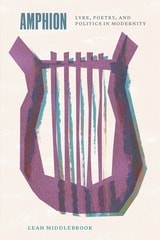
Amphion
Lyre, Poetry, and Politics in ModernityLeah Middlebrook
University of Chicago Press, 2024
Amphion is the figure in Greek mythology who played so skillfully on a lyre that stones moved of their own accord to build walls for Thebes. While Amphion still presides over music and architecture, he was once fundamental to the concept of lyric poetry. Amphion figured the human power to inspire action, creating and undoing polities by means of language. In contrast to the individual inspiration we associate with the better-known Orpheus, Amphion represents the relentless, often violent, play of harmony and disorder in human social life.
In this wide-ranging study, Leah Middlebrook introduces readers to Amphion-inspired poetics and lyrics and traces the tradition of the Amphionic from the Renaissance through modernist and postmodern poetry and translation from the Hispanic, Anglophone, French, Italian, and ancient Roman worlds. Amphion makes a significant contribution to scholarship on the connection between poetry and politics and the history of the lyric, offering an account well-suited to our times.
Dreams of Waking
An Anthology of Iberian Lyric Poetry, 1400-1700Edited and Translated by Vincent Barletta, Mark L. Bajus, and Cici Malik
University of Chicago Press, 2013
In this anthology, Vincent Barletta, Mark L. Bajus, and Cici Malik treat the Iberian lyric in the late Middle Ages and early modernity as a deeply multilingual, transnational genre that needs to break away from the old essentialist ideas about language, geography, and identity in order to be understood properly. More and more, scholars and students are recognizing the limitations of single-language, nationalist, and period-bound canons and are looking for different ways to approach the study of literature. The Iberian Peninsula is an excellent site for this approach, where the history and politics of the region, along with its creative literature, need to be read and studied together with the way the works were composed by poets and eventually consumed by readers.
With a generous selection of more than one hundred poems from thirty-three poets, Dreams of Waking is unique in its coverage of the three main languages—Catalan, Portuguese, and Spanish—and lyrical styles employed by peninsular poets. It contains new translations of canonical poems but also translations of many poems that have never before been edited or translated. Brief headnotes provide essential details of the poets’ lives, and a general introduction by the volume editors shows how the poems and languages fruitfully intersect. With helpful annotations to the poetry, as well as a selected bibliography containing the most important editions and translations from all three of the main Iberian languages, this volume will be an indispensable tool for both specialists and students in comparative literature.
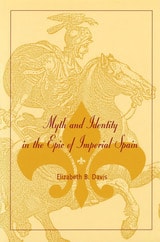
Myth and Identity in the Epic of Imperial Spain
Elizabeth B. Davis
University of Missouri Press, 2026
The first in-depth analysis of some of the most important epic poems of the Spanish Golden Age, Myth and Identity in the Epic of Imperial Spain breathes new life into five of these long- neglected texts. Elizabeth Davis demonstrates that the epic must not be overlooked, for doing so creates a significant gap in one's ability to appraise not only the cultural practice of the imperial age, but also the purest expression of its ideology.
Davis's study focuses on heroic poetry written from 1569 to 1611, including Alonso de Ercilla's La Araucana, undeniably the most significant epic poem of its time. Also included are Diego de Hojeda's La Christiada, Juan Rufo's La Austriada,. Lope de Vega's Jerusalén Conquistada, and Cristóbal de Virués's Historia del Monserrate.
Examining these epics as the major site for the construction of cultural identities and Renaissance nationalist myths, Davis analyzes the means by which the epic constructs a Spanish sense of self. Because this sense of identity is not easily susceptible to direct representation, it is often derived in opposition to an "other," which serves to reaffirm Spanish cultural superiority. The Spanish Christian caballeros are almost always pitted against Amerindians, Muslims, Jews, or other adversaries portrayed as backward or heathen for their cultural and ethnic differences.
The pro-Castilian elite of sixteenth-century Spain faced the daunting task of constructing unity at home in the process of expansion and conquest abroad, yet ethnic and regional differences in the Iberian Peninsula made the creation of an imperial identity particularly difficult. The epic, as Davis shows, strains to convey the overriding image of a Spain that appears more unified than the Spanish empire ever truly was.
An important reexamination of the Golden Age canon, Myth and Identity in the Epic of Imperial Spain brings a new twist to the study of canon formation. While Davis does not ignore more traditional approaches to the literary text, she does apply recent theories, such as deconstruction and feminist criticism, to these poems, resulting in an innovative examination of the material.
Confronting such issues as canonicity, gender, the relationship between literature and Golden Age culture, and that between art and power, this publication offers scholars a new perspective for assessing Golden Age and Transatlantic studies.
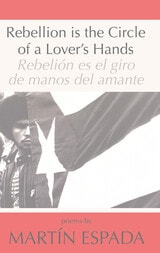
Rebellion Is the Circle of a Lover's Hands/Rebelió
Martín Espada
Northwestern University Press, 1995
Ruin and Restitution
Reinterpreting Romanticism in SpainPhilip W. Silver
Vanderbilt University Press, 1997
Selected Poems of Garcilaso de la Vega
A Bilingual EditionGarcilaso de la Vega
University of Chicago Press, 2009
Garcilaso de la Vega (ca. 1501–36), a Castilian nobleman and soldier at the court of Charles V, lived a short but glamorous life. As the first poet to make the Italian Renaissance lyric style at home in Spanish, he is credited with beginning the golden age of Spanish poetry. Known for his sonnets and pastorals, gracefully depicting beauty and love while soberly accepting their passing, he is shown here also as a calm student of love’s psychology and a critic of the savagery of war.
This bilingual volume is the first in nearly two hundred years to fully represent Garcilaso for an Anglophone readership. In facing-page translations that capture the music and skill of Garcilaso’s verse, John-Dent Young presents the sonnets, songs, elegies, and eclogues that came to influence generations of poets, including San Juan de la Cruz, Luis de Leon, Cervantes, and Góngora. The Selected Poems of Garcilaso de la Vega will help to explain to the English-speaking public this poet’s preeminence in the pantheon of Spanish letters.
Subtle Subversions
Reading Golden Age Sonnets by Iberian WomenGwyn Fox
Catholic University of America Press, 2008
The Poetics of Epiphany in the Spanish Lyric of Today
Judith Nantell
Bucknell University Press, 2020
Published by Bucknell University Press. Distributed worldwide by Rutgers University Press.

Women Poets of Spain, 1860-1990
TOWARD A GYNOCENTRIC VISIONJohn C. Wilcox
University of Illinois Press, 1997