Results by title
13 books match the query 'Spatial behavior'
Composing Place
Digital Rhetorics for a Mobile WorldJacob Greene
Utah State University Press, 2022
Greene identifies three emerging “modalities” through which mobile technologies are being used by digital writers. First, to counter dominant discourses in contested spaces; second, to historicize entrenched narratives in iconic spaces; and third, to amplify marginalized voices in mundane spaces. Through these modalities, Greene employs Indigenous philosophies and theories that upend the ways that the discipline has centered placed-based rhetorics, offering digital writers better strategies for using mobile media as a platform for civic deliberation, social advocacy, and political action.
Composing Place offers close analyses of mobile media experiences created by various artists and digital media practitioners, as well as detailed overviews of Greene’s own projects (also accessible through the companion website: www.composingplace.com). These projects include a digital “countertour” of SeaWorld that demonstrates the ways in which the attraction is driven by capitalism; an augmented reality tour of Detroit’s Woodward Avenue; and a mobile advocacy project in Jacksonville, Florida, that demonstrates the inequitable effects of car-centric public infrastructure. Ultimately, by engaging with these theoretical frameworks, rhetorical design principles, and pedagogical practices of mobile writing, readers can utilize the unique affordances of mobile media in various teaching and research contexts.

Family Fantasies and Community Space
Aitken, Stuart C
Rutgers University Press, 1998
Family forms are changing rapidly in Western society, and with them, the microenvironments within which men, women, and children live together. Stuart Aitken argues that, whether environment is taken as physical space or as a metaphor for the social, economic, and psychological basis of families, there remains a tendency to keep defining the meaning of families and communities in terms of older, traditional, "imagined," and idealized structures of politics, gender, and geography.
Using the stories of several families in San Diego, Aitken describes geographies of everyday life that contest definitions of cities and communities as mosaics reflecting patterns of social relations. He begins inside the family circle, looking at patriarchal power and the subordination of women, men, and children. Moving beyond the household, he then stresses the importance of place in defining the social and political character of communities and families' interplay within them--whether "communities" are viewed as neighborhoods, towns, or organizations that provide space for fellowship and common purpose. In turn, he shows that as the individual child reaches beyond family life to find a place in these communities, political cultures are reproduced through the child.
Aitken suggests ways in which individual and family identities are complexly intertwined with the cultural politics of communities, cities, and regions. He concludes that family and community spaces reproduce and reconstruct themselves daily according to divisions of race, class, gender, and differential access to housing, work, and child-care.

Gender in medieval places, spaces and thresholds
Edited by Victoria Blud, Diane Heath, and Einat Klafter
University of London Press, 2019

Get Yo' Life
Black Queer PlacemakingR. J. Millhouse
The Ohio State University Press, 2025
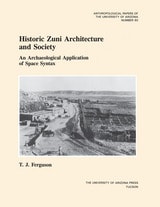
Historic Zuni Architecture and Society
An Archaeological Application of Space SyntaxT. J. Ferguson
University of Arizona Press, 1996
Historic Zuni Architecture and Society utilizes an interdisciplinary approach, analyzing archaeological data using method, theory, and techniques from the fields of architecture, planning, and ethnology. Archaeologists will find in the book an innovative application of space syntax to archaeological problems, and cultural anthropologists and others interested in the history of the Zuni Indians will value its observations about changes that are currently taking place in Zuni social organization.
Hostels, Sexuality, and the Apartheid Legacy
Malevolent GeographiesGlen S. Elder
Ohio University Press, 2003
In the last decade, the South African state has been transformed dramatically, but the stubborn, menacing geography of apartheid still stands in the way of that country’s visions of change. Environmentally degraded old homelands still scar the rural geography of South Africa.
Formerly segregated, now gated, neighborhoods still inhibit free movement. Hostels, Sexuality, and the Apartheid Legacy is a study of another such space, the converted “male” migrant worker hostel.
Professor Glen Elder identifies hostels as sites of public and domestic violence, literal destruction and rebuilding, and as an important node in the spread of HIV/AIDS.
Hostels have also become home to increasing numbers of “invisible” female residents. Finding that one way to understand hostel space is through women’s experiences, Professor Elder turned to thirty black migrant women living in an East Rand hostel to map the everyday geographies of South Africa’s time of change.
By following the lives of these women, Elder identifies spatialized forms of marginalization, impoverishment, infection, and disempowerment. But, as he points out, the women’s survival strategies may provide signposts to the way out of apartheid’s malevolent geography.
Hostels, Sexuality, and the Apartheid Legacy argues that the gendered geography of the migrant labor system developed in South Africa was premised upon sexual assumptions about men, women, and their bodies, and that feminist and queer analyses of space can inform public policy decisions.
Intrasite Spatial Analysis of Mobile and Semisedentary Peoples
Analytical Approaches to Reconstructing Occupation HistoryEdited by Amy E. Clark and Joseph A. M. Gingerich
University of Utah Press, 2022
This volume includes studies that span archaeological and ethnographic contexts, from highly mobile Paleoindian foragers to semi-sedentary preagriculturalists of the Epipaleolithic and modern pastoralists in Mongolia. The authors hold that commonalities in human behavior lead to similar patterns in the organization and maintenance of space by people. They present a series of ideas and approaches to make it easier to recognize universals in human behaviors, which allow archaeologists to better compare intrasite spatial patterns. The book creates a baseline for new intrasite spatial analyses in the twenty-first century.

Making Worlds
Gender, Metaphor, MaterialityEdited by Susan Hardy Aiken, Ann Brigham, Sallie A. Marston, and Penny Waterstone
University of Arizona Press, 1997
In recent years these questions have occasioned intensifying debates, but they have seldom extended beyond the boundaries of individual academic disciplines or crossed the divide that has traditionally separated the academy from the "outside" world. Making Worlds both questions and traverses those divisions by combining personal essays, activist political rhetoric, oral history, poetry, iconography, and performance art with interdisciplinary academic discourses.
Representing a wide range of perspectives, Making Worlds develops a provocative conversation about gender and spatiality in the interwoven symbolic and material environments we create. The contributors engage such issues as the body as site of symbolic action, fabrication, and desire; the place and play of sexualities; the cultural implications of everyday life—home, travel, work, childbirth, food, disease, and death; technology and mass media; surveillance, confinement, and the law; the dynamics of race and ethnicity; imperialism, oppression, and resistance; the politics of urban spaces; landscape and cultural memory; the experience of time; and the nature of "Nature." For students and scholars in cultural studies, geography, literary criticism, anthropology, history, and women's studies, it offers new ways of thinking about space, place, and the spatial contexts of social thought and action.
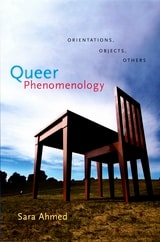
Queer Phenomenology
Orientations, Objects, OthersSara Ahmed
Duke University Press, 2006
Ahmed proposes that a queer phenomenology might investigate not only how the concept of orientation is informed by phenomenology but also the orientation of phenomenology itself. Thus she reflects on the significance of the objects that appear—and those that do not—as signs of orientation in classic phenomenological texts such as Husserl’s Ideas. In developing a queer model of orientations, she combines readings of phenomenological texts—by Husserl, Heidegger, Merleau-Ponty, and Fanon—with insights drawn from queer studies, feminist theory, critical race theory, Marxism, and psychoanalysis. Queer Phenomenology points queer theory in bold new directions.
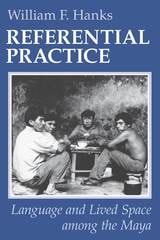
Referential Practice
Language and Lived Space among the MayaWilliam F. Hanks
University of Chicago Press, 1990
As his central case, Hanks undertakes a comprehensive analysis of deixis—linguistic forms that fix reference in context, such as English I, you, this, that, here, and there. He shows that Maya deixis is a basic cultural construct linking language with body space, domestic space, agricultural and ritual practices, and other fields of social activity. Using this as a guide to ethnographic description, he discovers striking regularities in person reference and modes of participation, the role of perception in reference, and varieties of spatial orientation, including locative deixis. Traditionally considered a marginal area in linguistics and virtually untouched in the ethnographic literature, the study of referential deixis becomes in Hanks's treatment an innovative and revealing methodology.
Referential Practice is the first full-length study of actual deictic use in a non-Western language, the first in-depth study of speech practice in Yucatec Maya culture, and the first detailed account of the relation between routine conversation, embodiment, and ritual discourse.

Space, Place, and Gender
Doreen Massey
University of Minnesota Press, 1994
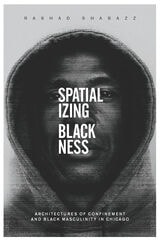
Spatializing Blackness
Architectures of Confinement and Black Masculinity in ChicagoRashad Shabazz
University of Illinois Press, 2015
A geographic study of race and gender, Spatializing Blackness casts light upon the ubiquitous--and ordinary--ways carceral power functions in places where African Americans live. Moving from the kitchenette to the prison cell, and mining forgotten facts from sources as diverse as maps and memoirs, Rashad Shabazz explores the myriad architectures of confinement, policing, surveillance, urban planning, and incarceration. In particular, he investigates how the ongoing carceral effort oriented and imbued black male bodies and gender performance from the Progressive Era to the present. The result is an essential interdisciplinary study that highlights the racialization of space, the role of containment in subordinating African Americans, the politics of mobility under conditions of alleged freedom, and the ways black men cope with--and resist--spacial containment.
A timely response to the massive upswing in carceral forms within society, Spatializing Blackness examines how these mechanisms came to exist, why society aimed them against African Americans, and the consequences for black communities and black masculinity both historically and today.

The Edge of the Woods
Iroquoia, 1534-1701Jon Parmenter
Michigan State University Press, 2010