Results by title
11 books match the query 'Speak'

A Time to Speak
The Story of a Young American Lawyer's Struggle for His City—and HimselfCharles Morgan Jr., With a New Foreword by Senator Doug Jones
University of Alabama Press, 2022
Brings back into print a classic account of courage and calamity in the long march toward racial justice in the South, and the nation
On September 15, 1963, a bomb exploded at the Sixteenth Street Baptist Church in Birmingham, Alabama, killing four young Black girls. The very next day, a prominent white lawyer named Charles Morgan Jr. was scheduled to speak at a luncheon held by the Young Men’s Business Club of Birmingham. A well-regarded figure in the city’s legal and business establishment, Morgan had been mentioned frequently as a candidate for political office. To the shock of his longtime friends and associates, Morgan deviated from his planned remarks, instead using his platform to place the blame for the murder of the four young girls squarely on the shoulders of the city’s white middle-class establishment, those seated before him.
As much as his stand was admired nationally, in Birmingham the results were destructive for him personally. Threats against his life and the lives of his family poured in daily by phone and mail, his political career was finished, and he was faced with financial ruin. Within weeks, he moved his family out of the state, and thenceforward committed himself to legal action in the name of racial justice. In 1964, he established the regional office of the ACLU in Atlanta. In the 1964 Supreme Court case Reynolds v. Sims, Morgan successfully argued that districts in state legislatures needed to be of nearly equal size, establishing the principle of “one man, one vote” to effectively end the use of gerrymandering.
A Time to Speak was originally published in 1964, a mere year after Morgan and his family fled Birmingham. The memoir recounts not only his speech, but his entire upbringing and the political, cultural, and social milieus in which he was raised and which gave rise to the cowardice, institutional silence, fear, and hate that those conditions nursed. This new edition features a foreword from US Senator Doug Jones.

Back Talk
Teaching Lost Selves to SpeakJoan Weimer
University of Chicago Press, 1996
In this elegant, humorous, and brutally frank memoir, Weimer's discoveries—documentative and imaginative, historical and personal—reveal much about what motivates research, and what motivates healing.

How Machines Came to Speak
Media Technologies and Freedom of SpeechJennifer Petersen
Duke University Press, 2022
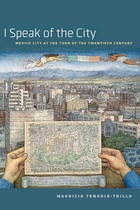
I Speak of the City
Mexico City at the Turn of the Twentieth CenturyMauricio Tenorio-Trillo
University of Chicago Press, 2013
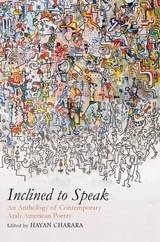
Inclined to Speak
An Anthology of Contemporary Arab American PoetryHayan Charara
University of Arkansas Press, 2008

Paris, So to Speak
Navid Kermani
Seagull Books, 2022
A writer has penned a novel about the great love of his youth. After a public reading, he is approached by a woman he doesn’t recognize—but it’s his lover. He is the author; she, the figure in his novel. The young girl from back then has turned into an interesting and attractive woman—but she’s also married. Soon the situation becomes a little strange: they sit down together, have a glass of wine, talk about French romantic novels, ask each other what one expects of love when one grows older. And all the while her husband is sitting in the next room. How is this going to end? Navid Kermani has written a romantic novel like no other—surprising, witty, profound—and one can barely put it down.
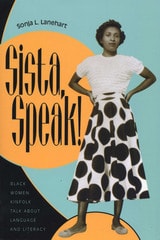
Sista, Speak!
Black Women Kinfolk Talk about Language and LiteracyBy Sonja L. Lanehart
University of Texas Press, 2002
2003 — Honorable Mention, Myers Outstanding Book Award – The Gustavus Myers Center for the Study of Bigotry and Human Rights in North America
The demand of white, affluent society that all Americans should speak, read, and write "proper" English causes many people who are not white and/or middle class to attempt to "talk in a way that feel peculiar to [their] mind," as a character in Alice Walker's The Color Purple puts it. In this book, Sonja Lanehart explores how this valorization of "proper" English has affected the language, literacy, educational achievements, and self-image of five African American women—her grandmother, mother, aunt, sister, and herself.
Through interviews and written statements by each woman, Lanehart draws out the life stories of these women and their attitudes toward and use of language. Making comparisons and contrasts among them, she shows how, even within a single family, differences in age, educational opportunities, and social circumstances can lead to widely different abilities and comfort in using language to navigate daily life. Her research also adds a new dimension to our understanding of African American English, which has been little studied in relation to women.
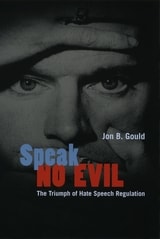
Speak No Evil
The Triumph of Hate Speech RegulationJon B. Gould
University of Chicago Press, 2005
Although college speech codes have been overturned by the courts, Speak No Evil argues that their rise has still had a profound influence on curtailing speech in other institutions such as the media and has also shaped mass opinion and common understandings of constitutional norms. Ultimately, Gould contends, this kind of informal law can have just as much power as the Constitution.
Speak to Me Words
Essays on Contemporary American Indian PoetryEdited by Dean Rader and Janice Gould
University of Arizona Press, 2003
Speak to Me Words is a stimulating blend of classic articles and original pieces that reflect the energy of modern American Indian literary studies. Highlighting various aspects of poetry written by American Indians since the 1960s, it is a wide-ranging collection that balances the insights of Natives and non-Natives, men and women, old and new voices. Included here are such landmark articles as "Answering the Deer" by Paula Gunn Allen, "Herbs of Healing" by Carter Revard, and "Song, Poetry and Language—Expression and Perception" by Simon Ortiz—all pieces that have shaped how we think about Native poetry. Among the contributions appearing for the first time are Elaine Jahner writing on Paula Gunn Allen's use of formal structures; Robert Nelson addressing pan-Indian tropes of emergence, survival, return, and renewal; and Janet McAdams focusing on Carter Revard's "angled mirrors." Although many Native writers may disregard distinctions between genres, together these writings help readers see the difference between American Indian poetry and other forms of Native literature.
These essays are as broad, encompassing, and provocative as Native poetry itself, branching off from and weaving back into one another. In showing how American Indian poetry redefines our social order and articulates how Indian communities think about themselves, these writers establish a new foundation for the study—and enjoyment—of this vital art.

Speak to Me!
Marcia Forecki
Gallaudet University Press, 1985
Marcia Calhoun Forecki has written an engrossing, personal account of her life with Charlie, an adorable, active, deaf seven-year-old. Speak to Me! is the story of an ordinary hearing person confronted with an overwhelming reality—the fact that her son is deaf. Forecki’s struggle as a single parent to care for her child, to find the “right” schools, and to establish communication with her son will strike a familiar chord in all hearing parents of deaf children. All readers, parents or not, will be touched by the mixture of pathos and humor in this well-written account.
To Speak and Be Heard
Seeking Good Government in Uganda, ca. 1500–2015Holly Elisabeth Hanson
Ohio University Press, 2021
A history of a political practice through which East Africans have sought to create calm, harmonious polities for five hundred years.
“To speak and be heard” is a uniquely Ugandan approach to government that aligns power with groups of people that actively demonstrate their assent both through their physical presence and through essential gifts of goods and labor. In contrast to a parliamentary democracy, the Ugandan system requires a level of active engagement much higher than simply casting a vote in periodic elections.
These political strategies—assembly, assent, and powerful gifts—can be traced from before the emergence of kingship in East Africa (ca. 1500) through enslavement, colonial intervention, and anticolonial protest. They appear in the violence of the Idi Amin years and are present, sometimes in dysfunctional ways, in postcolonial politics. Ugandans insisted on the necessity of multiple voices contributing to and affirming authority, and citizens continued to believe in those principles even when colonial interference made good governance through building relationships almost impossible.
Through meticulous research, Holly Hanson tells a history of the region that differs from commonly accepted views. In contrast to the well-established perception that colonial manipulation of Uganda’s tribes made state failure inevitable, Hanson argues that postcolonial Ugandans had the capacity to launch a united, functional nation-state and could have done so if leaders in Buganda, Britain, and Uganda’s first governments had made different choices.