Results by title
6 books match the query 'Special Forces'
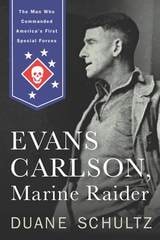
Evans Carlson, Marine Raider
The Man Who Commanded America's First Special ForcesDuane Schultz
Westholme Publishing, 2014
On August 17, 1942, ten days after American marines had stormed Guadalcanal in the Solomon Islands, two U.S. submarines secretly delivered a small force from the newly formed 2nd Marine Raider Battalion to Japanese-occupied Makin Island one thousand miles to the north. The raid was intended to gather intelligence and divert attention from the main American attack to the south. News of the success of this special operation took hold of the American imagination and provided a much needed boost to morale. The battalion’s leader was Evans Carlson, a forty-six-year-old career marine office who had most recently served in China as a military observer. Carlson was also a friend of President Franklin D. Roosevelt and he had proposed to him the creation of a small elite raider force similar to the British Commandos. Having accompanied Chinese guerrillas in their war against Japan, Carlson incorporated some of their tactics into his raider training, including a method of esprit de corps called “gung ho,” a word still used today for loyal enthusiasm. Carlson’s raiders went on to conduct a lengthy operation behind enemy lines in Guadalcanal, contributing to the American victory. After months of exertion, Carlson fell ill and returned stateside. Despite his notoriety and willingness to return to the front, this decorated officer would never command again.
In Evans Carlson, Marine Raider: The Man Who Commanded America’s First Special Forces, psychologist and acclaimed history writer Duane Schultz presents a fascinating and absorbing portrait of this complex officer. Son of a Congregational preacher, Carlson left home at an early age, and when he was just seventeen, the tall, lanky underage teenager bluffed his way into the army. He began his eventful military career against Pancho Villa, and continued through World War I and the unrest in Central America and in China. Despite Carlson’s personal bravery, loyalty, and long service, Schultz reveals that his active career was cut short by the Marine command who were envious of the attention he and his men received from the press and public; foreshadowing the paranoia of the McCarthy era, he was also rumored to be a communist. His raiders remained staunchly loyal to their former commander, and when he died in 1947, they ensured he would be buried in Arlington National Cemetery. Famed army and political cartoonist Bill Mauldin said, “There were only two brass hats whom ordinary GIs respected: Dwight Eisenhower and Evans Carlson.” This is Carlson’s story.
In Evans Carlson, Marine Raider: The Man Who Commanded America’s First Special Forces, psychologist and acclaimed history writer Duane Schultz presents a fascinating and absorbing portrait of this complex officer. Son of a Congregational preacher, Carlson left home at an early age, and when he was just seventeen, the tall, lanky underage teenager bluffed his way into the army. He began his eventful military career against Pancho Villa, and continued through World War I and the unrest in Central America and in China. Despite Carlson’s personal bravery, loyalty, and long service, Schultz reveals that his active career was cut short by the Marine command who were envious of the attention he and his men received from the press and public; foreshadowing the paranoia of the McCarthy era, he was also rumored to be a communist. His raiders remained staunchly loyal to their former commander, and when he died in 1947, they ensured he would be buried in Arlington National Cemetery. Famed army and political cartoonist Bill Mauldin said, “There were only two brass hats whom ordinary GIs respected: Dwight Eisenhower and Evans Carlson.” This is Carlson’s story.
[more]
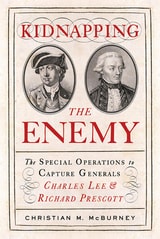
Kidnapping the Enemy
The Special Operations to Capture Generals Charles Lee and Richard PrescottChristian M. McBurney
Westholme Publishing, 2024
The Daring Raid to Kidnap a British General in Order to Gain Freedom for the Highest Ranking Continental Officer Captured During the American Revolution
On the night of December 12, 1776, while on a reconnaissance mission in New Jersey, Lieutenant Colonel William Harcourt and Cornet Banastre Tarleton of the British dragoons learned from Loyalist informers that Major General Charles Lee, the second-in-command in the Continental army behind only George Washington, was staying at a tavern at nearby Basking Ridge. Gaining valuable information as they rode, by threatening captured American soldiers with death if Lee’s whereabouts was not revealed, Harcourt and Tarleton, surrounded the tavern, and after a short but violent struggle, captured him. The dragoons returned through a hostile country by a different route, arriving safely at their British post at New Brunswick with their quarry in hand. With Lee’s capture, the British were confident the rebellion would soon be over.
Stung by Lee’s kidnapping, the Americans decided to respond with their own special operation, perhaps the most outstanding one of the war. On the dark night of July 10, 1777, Lieutenant Colonel William Barton led a handpicked party in whaleboats across Narragansett Bay—carefully avoiding British navy ships—to Newport, Rhode Island. Although the town was occupied by more than 3,000 enemy soldiers, after landing Barton led his men up a hidden path and stealthily hurried to a farmhouse where General Richard Prescott had taken to spending nights. Surrounding the house, they forced open the doors and seized the sleeping Prescott, as well as his aidede- camp and a sentry, and then quickly returned to their waiting boats. Despite British artillerymen firing rockets and cannon to alert the British vessels in the bay, the bold band of Americans reached the mainland safely. Not only had Barton kidnapped a British major general who could be exchanged for Lee, he had removed from action a man who had gained a reputation for his harsh treatment of American Patriots.
In Kidnapping the Enemy: The Special Operations to Capture Generals Charles Lee and Richard Prescott, Christian M. McBurney relates the full story of each of these remarkable raids, the subsequent exchange of the two generals, and the impact of these kidnappings on the Revolutionary War. He then follows the subsequent careers of the major players, including Lee, Barton, Prescott, and Tarleton. The author completes his narrative with descriptions of other attempts to kidnap high-ranking military officers and government officials during the war, including ones organized by and against George Washington. The low success rate of these operations makes the raids that captured Lee and Prescott even more impressive.
[more]
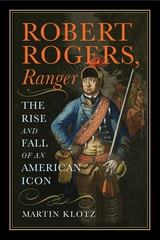
Robert Rogers, Ranger
The Rise and Fall of an American IconMartin Klotz
Westholme Publishing, 2026
Robert Rogers, commander of Rogers’ Rangers during the French and Indian War, was the war’s best-known colonial military hero and, in the ensuing peace, one of the best-known Americans of any description, rivaling Benjamin Franklin in popularity. He was revered in the colonies as an example of the self-made man based on merit, in contrast to the hide-bound, hierarchical British military establishment. Yet this American icon ultimately alienated his peers,fought as a loyalist in the Revolutionary War, ruined himself financially, and died in obscurity in London, estranged from the country of his birth. Rogers is known today for his role in developing the mystique of the modern Ranger, but what explains his meteoric rise and his long, depressing fall?
Robert Rogers, Ranger: The Rise and Fall of an American Icon by Martin Klotz is a fresh look at the life of this famous, yet highly flawed man. Rogers undeniably had great personal strengths. He was brave nearly to the point of fearlessness. He was physically robust, always the one to cover the retreat, carry the wounded, or go for help when no one else could carry on. He was an intrepid explorer who wrote with eloquence about the splendors of the American frontier. He was bold and unconventional, good at thinking outside the box. He was an outstanding scout and intelligence gatherer who provided invaluable service to a British army inexperienced in woodland warfare. At the same time Rogers had enormous weaknesses that undermined his ability to lead effectively. His boldness was never tempered by judgment, and he was prone to grandiose schemes that came to nothing or, worse, to disaster. His constant self-promotion—including embellishing and lying about his battlefield successes—contributed to his popularity but damaged his reputation with peers and superiors. He succumbed to alcoholism and gambling, was profligate, especially with money—his debts were enormous—and routinely skirted the edges of the law. Rogers never found a comfortable place in America. Instead, his aristocratic patrons in London, who knew him mostly from his own self-description, gave him his most valuable opportunities, including commanding an important military and trading center on the colonial frontier and establishing the Queen’s Rangers to fight alongside Crown forces during the Revolution. But when the British cause failed in America, Rogers became an anathema on both sides of the Atlantic. A fascinating inquiry into an eighteenth-century life, Robert Rogers, Ranger presents this American legend as he lived, crossing the line between fame and misfortune.
Robert Rogers, Ranger: The Rise and Fall of an American Icon by Martin Klotz is a fresh look at the life of this famous, yet highly flawed man. Rogers undeniably had great personal strengths. He was brave nearly to the point of fearlessness. He was physically robust, always the one to cover the retreat, carry the wounded, or go for help when no one else could carry on. He was an intrepid explorer who wrote with eloquence about the splendors of the American frontier. He was bold and unconventional, good at thinking outside the box. He was an outstanding scout and intelligence gatherer who provided invaluable service to a British army inexperienced in woodland warfare. At the same time Rogers had enormous weaknesses that undermined his ability to lead effectively. His boldness was never tempered by judgment, and he was prone to grandiose schemes that came to nothing or, worse, to disaster. His constant self-promotion—including embellishing and lying about his battlefield successes—contributed to his popularity but damaged his reputation with peers and superiors. He succumbed to alcoholism and gambling, was profligate, especially with money—his debts were enormous—and routinely skirted the edges of the law. Rogers never found a comfortable place in America. Instead, his aristocratic patrons in London, who knew him mostly from his own self-description, gave him his most valuable opportunities, including commanding an important military and trading center on the colonial frontier and establishing the Queen’s Rangers to fight alongside Crown forces during the Revolution. But when the British cause failed in America, Rogers became an anathema on both sides of the Atlantic. A fascinating inquiry into an eighteenth-century life, Robert Rogers, Ranger presents this American legend as he lived, crossing the line between fame and misfortune.
[more]
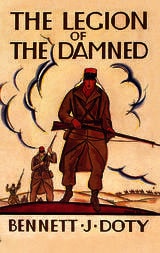
The Legion of the Damned
The Adventures of Bennett J. Doty in the French Foreign Legion as Told by HimselfBennett J. Doty
Westholme Publishing, 2020
The Riveting Memoir of an American Volunteer in the French Foreign Legion during the 1925 Revolt in Syria
“You see there was down South a girl I liked. And she is now married . . . not to me.” So Bennett J. Doty confessed when he sailed for France and enlisted in the French Foreign Legion in 1924. A World War I veteran and University of Virginia student, Doty first trained in Morocco and Algeria before being shipped off to the French-controlled State of Syria. There, he and his fellow “bleus,” who hailed from Belgium, Poland, Italy, Senegal, Spain, Germany, Russia, and other countries, found themselves at the spearhead of the attempt to quell the revolt against French rule in the area. The fighting, mostly against the Druze, was fierce, merciless, and unrelenting. Fought in villages and at isolated outposts, there was no quarter. Entire villages were razed, fields destroyed, and prisoners were not taken by either side. In the engagement where Doty and several other of his “copains”—“buddies”—earned the Croix de Guerre, his unit became isolated and withstood days of attacks which claimed more than half of the Legionnaires until they were finally relieved by a French colonial column. With the immediate fighting over, the Legion was put to heavy manual labor under the hot desert sun. Doty became disillusioned, and with four other soldiers, fled in an attempt to reach British-controlled Jordan. They were caught, tried, and Doty was sentenced to eight years in a French prison. When word reached the United States, diplomatic efforts ultimately gained Doty a pardon and honorable discharge from service.
Originally published in 1928, Legion of the Damned, Doty’s acclaimed account of his time in the Legion, is a remarkable memoir that requires no additional drama to allow the reader to experience the desperation, exhilaration, fear, and disgust of a colonial war. Here, Doty shows how drunken, unruly, vicious veterans would transform into capable, cool, and orderly soldiers as soon as a battle began—the élan that earned the French Foreign Legion its reputation as a legendary fighting unit.
[more]

War Against the People
Israel, the Palestinians and Global PacificationJeff Halper
Pluto Press, 2015
* Shortlisted for the Palestine Book Awards 2016*
Modern warfare has a new form. The days of international combat are fading. So how do major world powers maintain control over their people today?
This book is a disturbing insight into the new ways world powers such as the US, Israel, Britain and China forge war today. It is a subliminal war of surveillance and whitewashed terror, conducted through new, high-tech military apparatuses, designed and first used in Israel against the Palestinian population. Including nano-technology, hidden camera systems, information databases on civilian activity, automated targeting systems and unmanned drones, it is used to control the very people the nation's leaders profess to serve.
Jeff Halper reveals that this practice is much more insidious than was previously thought. As Western governments claw back individual liberties, War Against the People is a reminder that fundamental human rights are being compromised for vast sections of the world, and that this is a subject that should concern everyone.
[more]
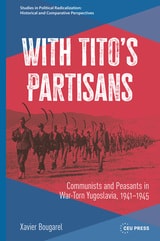
With Tito’s Partisans
Communists and Peasants in War-Torn Yugoslavia, 1941–1945Xavier Bougarel
Central European University Press, 2026
Who still remembers Tito’s Yugoslav Partisans? Once worshipped by some, now disparaged by others (or even by the very same), they remain largely unknown to the English-speaking public. This book enables readers to discover them through a meticulous reconstruction of their everyday life in the liberated territories. How did the Partisans stop interethnic violence? How did they foster the political participation of young people and women? What was the role of the Communist Party? What were the principles of the economy in the liberated territories? What were the Partisans’ views on justice, revenge and forgiveness? These are just some of the questions the author seeks to answer. The book also goes further, however, showing what makes up a resistance or revolutionary movement in the extreme conditions of war—where everyone must prove themselves, or perish.
[more]