Results by title
23 books match the query 'Spectacle'

A Spectacle of Suffering
Clara Morris on the American StageBarbara Wallace Grossman
Southern Illinois University Press, 2009
Once called "America's greatest actress," renowned for the passion and power of her performances, Clara Morris (1847-1925) has been largely forgotten. A Spectacle of Suffering: Clara Morris on the American Stage is the first full-length study of the actress's importance as a feminist in the late nineteenth and early twentieth centuries. Detailing her daunting health problems and the changing tastes in entertainment that led to her retirement from the stage, Barbara Wallace Grossman explores Morris's dramatic reinvention as an author. During a second robust career, she published hundreds of newspaper and magazine articles and nine books—six works of fiction and three memoirs.
Grossman draws on the fifty-four-volume diary that Morris kept from 1868 until 1924, as well as on the manuscript fragments and notes of journalist George T. MacAdam, who died in 1929 before completing the actress's biography. Grossman provides a dramatic account of Morris's life and work from her troubled early years, through an unhappy marriage, morphine addiction, and invalidism, to the challenges of touring, the decline of her artistic reputation, and the demands of the writing career she pursued so tenaciously. A Spectacle of Suffering reveals how Morris, even after experiencing blindness and the loss of her home, livelihood, and family, did not succumb to despair and found comfort in the small pleasures of her circumscribed life.
A Spectacle of Suffering recovers an important figure in American theatre and ensures that Morris will be remembered not simply as an actress but as a respected writer and beloved public figure, admired for her courage in dealing with adversity. The book, which is enhanced by twenty-four illustrations, is the only published biography of Clara Morris. It is as much a tribute to the power of the human spirit as it is an effective means of exploring American theatre and society in the Gilded Age.
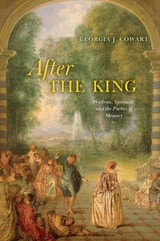
After the King
Watteau, Spectacle, and the Poetics of MemoryGeorgia J. Cowart
University of Chicago Press, 2026
Musicologist Georgia J. Cowart explores how Antoine Watteau’s late paintings reimagine the symbolic order of absolutism in the wake of Louis XIV’s death.
Antoine Watteau has long been known for the theatricality of his paintings, but what that theatricality signifies has remained elusive. In After the King, Georgia Cowart contends that this mode of painting takes shape in response to the spectacle of Louis XIV’s absolutism, which the painter’s late works transform into a new aesthetic language.
The king’s death marked a turning point in Watteau’s art. In the six years that followed, his paintings turned more decisively toward the musical stage. Evoking theatrical plots, frontispieces, and costume types, they conjured a world in which the legacy of absolutist culture lingered as stylized memory—its rituals, emblems, and pleasures recast through theatrical illusion and ironic distance.
Rather than treating Watteau as a painter of nostalgic reverie or Rococo charm, Cowart situates his art within the immersive performance culture of Versailles and the vibrant Parisian stage, at a time when the opéra-ballet, popular opera, and the commedia dell’arte were charting new theatrical landscapes. Drawing on art history, musicology, theater studies, and Pierre Nora’s theory of lieux de mémoire, she proposes a new framework that understands Watteau’s paintings as acts of theatrical memory and cultural recomposition.
Elegantly written and conceptually ambitious, After the King reveals how Watteau recoded the symbols of monarchy to stage a post-absolutist cultural imagination shaped by irony, sensuality, and poetic transformation.
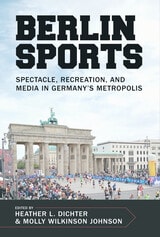
Berlin Sports
Spectacle, Recreation, and Media in Germany’s MetropolisHeather L. Dichter
University of Arkansas Press, 2024
This book begins with a long-distance equestrian race in the 1890s and continues with the role of media in spectacle, celebrity, urban life, and gender from the 1890s to the 1920s.It then turns to grassroots sport participation and spectatorship as well as sport diplomacy at the elite international level during the postwar period and the years of German division. Next, it explores recreational sport associations within the context of immigration and youth counterculture. It concludes with the 2015 European Maccabi Games, an international Jewish sports festival through which Berlin sought to grapple with the infamous 1936 Olympics and showcase Berlin as a cosmopolitan and multicultural city. Taken together, the book’s scholarly essays on all of these sporting endeavors reveal the rich and varied sporting culture in Berlin and yield fresh insights into spectacle, recreation, and media in the city.
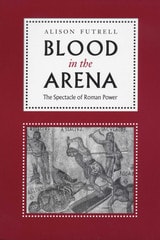
Blood in the Arena
The Spectacle of Roman PowerBy Alison Futrell
University of Texas Press, 1997
From the center of Imperial Rome to the farthest reaches of ancient Britain, Gaul, and Spain, amphitheaters marked the landscape of the Western Roman Empire. Built to bring Roman institutions and the spectacle of Roman power to conquered peoples, many still remain as witnesses to the extent and control of the empire.
In this book, Alison Futrell explores the arena as a key social and political institution for binding Rome and its provinces. She begins with the origins of the gladiatorial contest and shows how it came to play an important role in restructuring Roman authority in the later Republic. She then traces the spread of amphitheaters across the Western Empire as a means of transmitting and maintaining Roman culture and control in the provinces.
Futrell also examines the larger implications of the arena as a venue for the ritualized mass slaughter of human beings, showing how the gladiatorial contest took on both religious and political overtones. This wide-ranging study, which draws insights from archaeology and anthropology, as well as Classics, broadens our understanding of the gladiatorial contest and its place within the highly politicized cult practice of the Roman Empire.
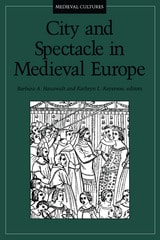
City and Spectacle in Medieval Europe
Barbara Hanawalt
University of Minnesota Press, 1994
Medieval Europe is known for its sense of ceremony and drama. Knightings, tournaments, coronations, religious processions, and even private celebrations such as baptisms, weddings, and funerals were occasions for ritual, feasting, and public display. This volume is the first to take a comprehensive look at the many types of city spectacles that entertained the masses and confirmed various messages of power in late medieval Europe. Bringing together leading scholars in history, art history, and literature, this interdisciplinary collection sets new standards for the study of medieval popular culture.
Drawing examples from Spain, England, France, Italy, and the Netherlands, most of them in the fifteenth century, the authors explore the uses of ceremony as statements of political power, as pleas for divine intercession, and as expressions of popular culture. Their essays show us spectacles meant to confirm events such as victories, the signing of a city charter, or the coronation of a king. In other circumstances, the spectacle acts as a battleground where a struggle for the control of the metaphors of power is played out between factions within cities or between cities and kings. Still other ceremonies called upon divine spiritual powers in the hope that their intervention might save the urban inhabitants. We see here a public cognizant of the power of symbols to express its goals and achievements, a society reaching the height of sophistication in its manipulation of popular and elite culture for grand shows.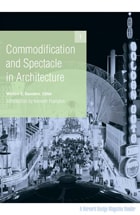
Commodification and Spectacle in Architecture
A Harvard Design Magazine ReaderWilliam Saunders
University of Minnesota Press, 2005
Framed with a provocative introduction by Kenneth Frampton, the contributions to Commodification and Spectacle in Architecture stake out a variety of positions in the debate over the extent to which it is possible—or desirable—to escape from, resist, or suggest plausible alternatives to the dominant culture of consumer capitalism. Rejecting any dreamy nostalgia for an idealized present or past in which design is completely divorced from commerce—and, in some cases, celebrating the pleasures of spectacle—the individual essays range from indictments of particular architects and critiques of the profession to broader concerns about what the phenomenon of commodification means for the practice of democracy and the health of society.
Bringing together an impressive and varied group of critics and practitioners, Commodification and Spectacle in Architecture will help to sharpen the discussion of how design can respond to our hypercommodified culture.
Contributors: Michael Benedikt, Luis Fernández-Galiano, Thomas Frank, Kevin Ervin Kelley, Daniel Naegele, Rick Poynor, Michael Sorkin, Wouter Vanstiphout.
William S. Saunders is editor of Harvard Design Magazine and assistant dean for external relations at the Harvard Design School. He is the author of Modern Architecture: Photographs by Ezra Stoller.
Kenneth Frampton is Ware Professor of Architecture at Columbia University Graduate School of Architecture, Planning, and Preservation and author of many books, including Labour, Work, and Architecture.
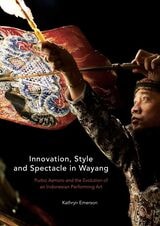
Innovation, Style and Spectacle in Wayang
Purbo Asmoro and the Evolution of an Indonesian Performing ArtKathryn Emerson
National University of Singapore Press, 2022
Wayang, the traditional puppet theater form of Java, fascinates and endures thanks to the many ways it works as a medium—bearing the weight of Javanese culture and tradition as a key component of rites of passage, as a medium of ritual and spiritual practice, as public spectacle, and as entertainment of the broadest sort, performed live, broadcast, or streamed. Over the past forty years, the form has been subject to a great deal of experimentation and innovation, pulled in many directions within an ever-changing media landscape. In this book, Kathryn Anne Emerson outlines both significant contributions by a number of key figures and the social and political influences propelling such innovations. She also describes deeper and more lasting changes in wayang, based on what the art form's most accomplished practitioners have to say about it. At the core of the book is one pivotal figure, Purbo Asmoro of the Indonesian Institute of the Arts in Surakarta, who, Emerson argues, has taken the individual and singular innovations of the era and integrated them into a new system of performance practice, one that has shaped the key Surakarta school of performance. Grounded in an unprecedented, decades-long participatory research project involving hundreds of interlocutors, the book is beautifully illustrated and will be of considerable interest in Indonesian studies.
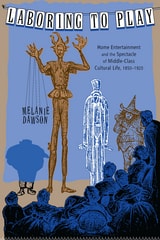
Laboring to Play
Home Entertainment and the Spectacle of Middle-Class Cultural Life, 1850-1920Melanie Dawson
University of Alabama Press, 2005
Where Leisure Became Labor and the Parlor Became a Stage for American Middle-Class Identity.
The changing styles of middle-class home entertainments, Melanie Dawson argues, point to evolving ideas of class identity in U.S. culture. Drawing from 19th- and early-20th-century fiction, guidebooks on leisure, newspaper columns, and a polemical examination of class structures, Laboring to Play interrogates the ways that leisure performances (such as parlor games, charades, home dramas, and tableaux vivants) encouraged participants to test out the boundaries that were beginning to define middle-class lifestyles.
From 19th-century parlor games involving grotesque physical contortions to early-20th-century recitations of an idealized past, leisure employments mediated between domestic and public spheres, individuals and class-based affiliations, and ideals of egalitarian social life and visible hierarchies based on privilege. Negotiating these paradigms, home entertainments provided their participants with unique ways of performing displays of individual ambitions within a world of polite social interaction.
Laboring to Play deals with subjects as wide ranging as social performances, social history (etiquette and gentility), literary history, representations of childhood, and the history of the book.
Making a Spectacle
Feminist Essays on Contemporary Women's TheatreEdited and with an Introduction by Lynda Hart
University of Michigan Press, 1988
News Parade
The American Newsreel and the World as SpectacleJoseph Clark
University of Minnesota Press, 2020
A fascinating look at the United States’ conflicted relationship with news and the media, through the lens of the newsreel
When weekly newsreels launched in the early twentieth century, they offered the U.S. public the first weekly record of events that symbolized “indisputable evidence” of the news. In News Parade, Joseph Clark examines the history of the newsreel and how it changed the way Americans saw the world. He combines an examination of the newsreel’s methods of production, distribution, and reception with an analysis of its representational strategies to understand the newsreel’s place in the history of twentieth-century American culture and film history.
Clark focuses on the sound newsreel of the 1930s and 1940s, arguing that it represents a crucial moment in the development of a spectacular society where media representations of reality became more fully integrated into commodity culture. Using several case studies, including the newsreel’s coverage of Charles Lindbergh’s transatlantic flight and the Sino–Japanese War, News Parade shows how news film transformed the relationship between its audience and current events, as well as the social and political consequences of these changes. It pays particular attention to how discourses of race and gender worked together with the rhetoric of speed, mobility, and authority to establish the power and privilege of newsreel spectatorship.
In the age of fake news and the profound changes to journalism brought on by the internet, News Parade demonstrates how new technologies and media reshaped the American public’s relationship with the news in the 1930s—a history that can help us to better understand the transformations happening today.
Optical Play
Glass, Vision, and Spectacle in Russian CultureJulia Bekman Chadaga
Northwestern University Press, 2014
Longlist finalist, 2015 Historia Nova Prize for Best Book on Russian Intellectual and Cultural History
Julia Bekman Chadaga’s ambitious study posits that glass—in its uses as a material and as captured in culture—is a key to understanding the evolution of Russian identity from the eighteenth century onward. From the contemporary perspective, it is easy to overlook how glass has profoundly transformed vision. Chadaga shows the far-reaching effects of this phenomenon.
Her book examines the similarities between glass and language, the ideological uses of glass, and the material’s associations with modernity, while illuminating the work of Lomonosov, Dostoevsky, Zamyatin, and Eisenstein, among others. In particular, Chadaga explores the prominent role of glass in the discourse around Russia’s contentious relationship with the West—by turns admiring and antagonistic—as the nation crafted a vision for its own future. Chadaga returns throughout to the spectacular aspect of glass and shows how both the tendentious capacity and the playfulness of this material have shaped Russian culture.

Recasting Commodity and Spectacle in the Indigenous Americas
Edited by Helen Gilbert and Charlotte Gleghorn
University of London Press, 2014
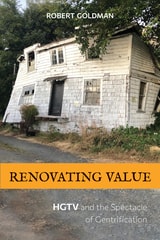
Renovating Value
HGTV and the Spectacle of GentrificationRobert Goldman
Temple University Press, 2021
HGTV has perfected stories about creating and capturing value in the housing market. But according to Robert Goldman, this lifestyle network’s beloved flagship programs, Flip or Flop, Property Brothers, and Fixer Upper—where people revitalize modern spaces and reinvent property values—offer “fairy tales” in the wake of the 2008 economic crisis. The cable channel’s seductive, bingeable programs may show how to find and extract value from properties, but, in fact, they insidiously ignore the realities of the real estate and mortgage markets, housing inequality, gentrification, economic insecurity, and even homelessness. In effect, HGTV has turned house flipping into a master narrative about getting ahead in America during an era of otherwise uneasy economic prospects.
HGTV pictures its insular moral economy as an alternative to a crisis-ridden neoliberal finance system that shaped landscapes of foreclosure and financial uncertainty for millions of households. Renovating Value explores the circuitry of consumer credit and debt, and a rent-gap model of gentrification that charts a path to the rehabilitation of Value. Goldman shrewdly critiques the aspirational myth of adding value to a home simply by using imagination, elbow grease, and aesthetic know-how.
Secrets, Sex, and Spectacle
The Rules of Scandal in Japan and the United StatesMark D. West
University of Chicago Press, 2006
A leader of a global superpower is betrayed by his mistress, who makes public the sordid details of their secret affair. His wife stands by as he denies the charges. Debates over definitions of moral leadership ensue. Sound familiar? If you guessed Clinton and Lewinsky, try again. This incident involved former Japanese prime minister Sosuke Uno and a geisha.
In Secrets, Sex, and Spectacle, Mark D. West organizes the seemingly random worlds of Japanese and American scandal—from corporate fraud to baseball cheaters, political corruption to celebrity sexcapades—to explore well-ingrained similarities and contrasts in law and society. In Japan and the United States, legal and organizational rules tell us what kind of behavior is considered scandalous. When Japanese and American scandal stories differ, those rules—rules that define what’s public and what’s private, rules that protect injuries to dignity and honor, and rules about sex, to name a few—often help explain the differences. In the cases of Clinton and Uno, the rules help explain why the media didn’t cover Uno’s affair, why Uno’s wife apologized on her husband’s behalf, and why Uno—and not Clinton—resigned.
Secrets, Sex, and Spectacle offers a novel approach to viewing the phenomenon of scandal—one that will be applauded by anyone who has obsessed over (or ridiculed) these public episodes.
Sensations
French Archaeology between Science and Spectacle, 1890–1940Daniel J. Sherman
University of Chicago Press, 2025
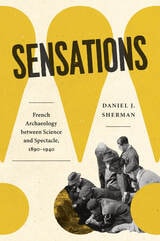
For well over a century, from Heinrich Schliemann’s sensational discoveries at Troy in the 1880s, through the Tutankhamun excavations of the 1920s, to the recent LIDAR-aided uncovering of lost Maya cities, archaeology has made headlines. In this new history of archaeology and its archival traces, Daniel J. Sherman treats the friction between science and spectacle as constitutive of the field. By exploring two long-running controversies that roiled the French archaeological world and its wider public in the first third of the twentieth century, he gives the science/media relationship a unique place in the history of archaeology—and its present.
The first controversy involves a dispute over the conduct of excavations at Carthage in Tunisia, then under French colonial rule. In the second, accusations of forgery clouded what seemed to be a stunning Neolithic find at a hamlet called Glozel, in the Auvergne region in central France. The affair divided the scholarly community and attracted enormous media attention across Europe and North America. Both controversies occurred at a transitional moment between what has been called the heroic age of archaeology, dominated by explorers and adventurers with little specialized training, and the beginnings of its professionalization. As Sherman shows, the two affairs put the methods, procedures, and networks of archaeology in the spotlight and profoundly shaped its history.
Shock and Awe
American Exceptionalism and the Imperatives of the Spectacle in Mark Twain’s A Connecticut Yankee in King Arthur’s CourtWilliam V. Spanos
Dartmouth College Press, 2013

Spectacle & Pigsty
Kiwao Nomura
Omnidawn, 2011
Spectacle and Topophilia
Reading Early Modern and Postmodern Hispanic CulturesDavid R. Castillo
Vanderbilt University Press, 2011
The Nature of Spectacle
On Images, Money, and Conserving CapitalismJim Igoe
University of Arizona Press, 2017
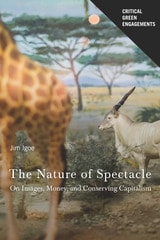
In The Nature of Spectacle, Jim Igoe embarks on multifaceted explorations of how we imagine nature and how nature shapes our imaginations. The book traces spectacular productions of imagined nature across time and space—from African nature tourism to transnational policy events to green consumer appeals in which the push of a virtual button appears to initiate a chain of events resulting in the protection of polar bears in the Arctic or jaguars in the Amazon rainforest. These explorations illuminate the often surprising intersections of consumerism, entertainment, and environmental policy. They show how these intersections figure in a strengthening and problematic policy consensus in which economic growth and ecosystem health are cast as mutually necessitating conditions. They also take seriously the potential of these intersections and how they may facilitate other alignments and imaginings that may become the basis of alternatives to our current socioecological predicaments.
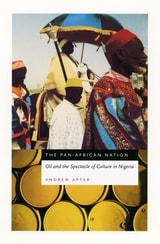
The Pan-African Nation
Oil and the Spectacle of Culture in NigeriaAndrew Apter
University of Chicago Press, 2005
According to Apter, FESTAC expanded the horizons of blackness in Nigeria to mirror the global circuits of its economy. By showcasing masks, dances, images, and souvenirs from its many diverse ethnic groups, Nigeria forged a new national culture. In the grandeur of this oil-fed confidence, the nation subsumed all black and African cultures within its empire of cultural signs and erased its colonial legacies from collective memory. As the oil economy collapsed, however, cultural signs became unstable, contributing to rampant violence and dissimulation.
The Pan-African Nation unpacks FESTAC as a historically situated mirror of production in Nigeria. More broadly, it points towards a critique of the political economy of the sign in postcolonial Africa.

The Spectacle of Democracy
Spanish Television, Nationalism, and Political TransitionRichard Maxwell
University of Minnesota Press, 1994
The Spectacle of Democracy was first published in 1994. Minnesota Archive Editions uses digital technology to make long-unavailable books once again accessible, and are published unaltered from the original University of Minnesota Press editions.
In this age of increased global communication the media seem like juggernauts paving the way from dictatorship to democracy. Richard Maxwell's study of television in Spain overturns this myth of technological power. He shows us how transitions themselves have a profound impact on the media, as controllers of national television clash with commercial media promoters and with regionalists who want television to extend their nationalist politics and collective identity.
Maxwell's sophisticated analysis of the many variables shaping communication policy within the nation-state draws on a decade of research into Spanish culture, mass media, and political economy. Although focused on Spain, his work provides general insight into the nature of communication policy debates in today's globalized economy. A study of the transformation of television in Spain following the end of Franco's dictatorship, Maxwell's book examines the politics of the privatization of television, the rise of regional television, and the transnational realignment of national media space.Richard Maxwell is assistant professor in the department of radio, television, and film in the School of Speech at Northwestern University.
The Spectacle of History
Speech, Text, and Memory at the Iran-Contra HearingsMichael Lynch and David Bogen, eds.
Duke University Press, 1996
Lynch and Bogen detail the practices through which the historical agents at the center of the hearings composed, confirmed, used, erased, and denied the historical record. They show how partisan skirmishes over the disclosure of records and testimony led to a divided and irresolute outcome, an outcome further facilitated by the “applied deconstruction” deployed by North and his allies. The Spectacle of History immerses the reader in a crowded field of texts, utterances, visual displays, and media commentaries, but, more than a case study, it develops unique insight into problems at the heart of society and social theory—lying and credibility, the production of civic spectacle, the relationship between testimony and history, the uses of memory, and the interplay between speech and writing.
Drawing on themes from sociology, literary theory, and ethnomethodology and challenging prevailing concepts held by contemporary communication and cultural studies, Lynch and Bogen extract valuable theoretical lessons from this specific and troubling historical episode.

The Spectacle of Women
Imagery of the Suffrage Campaign 1907-14Lisa Tickner
University of Chicago Press, 1988