Results by title
7 books match the query 'Specters'
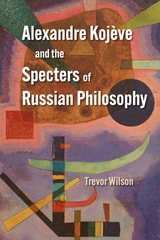
Alexandre Kojève and the Specters of Russian Philosophy
Trevor Wilson
Northwestern University Press, 2025
Recounts Kojève’s key role in the pivotal exchange of ideas between Eastern and Western European intellectuals in the early twentieth century
This book shines critical new light on the story of Alexandre Kojève’s intellectual origins and his role in the emigration of Russian philosophy into the West in the early twentieth century. Trevor Wilson illustrates how Kojève, at once adversarial to the insular communities of émigré philosophy and yet dependent on their networks and ideas for professional success, navigated the specters of the Russian tradition in pursuit of an autonomous self-definition as a philosopher and intellectual.
Alexandre Kojève and the Specters of Russian Philosophy analyzes the philosopher’s complicated relationship to the interwar diaspora and the complex role played by the Russian tradition in his intellectual formation. Wilson examines Kojève’s early writings in the émigré press on Russian religious philosophy, Soviet politics, and Eurasianism and argues for their enduring relevance for understanding Kojève in his mature period. Crucially, he contextualizes Kojève’s famed seminars on Hegel and examines how Kojève’s thought became embedded in the politics of the Cold War. Based on newly transcribed and translated archival material, he highlights a previously unacknowledged, transnational exchange of ideas between Eastern and Western European intellectuals and shows how it played a pivotal role in twentieth-century intellectual history—and its legacy in the twenty-first.
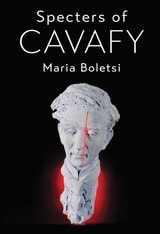
Specters of Cavafy
Maria Boletsi
University of Michigan Press, 2024
Winner of the European Society of Modern Greek Studies Best Monograph Award
The Greek Alexandrian poet C. P. Cavafy (1863–1933) has been recognized as a central figure in European modernism and world literature. His poetry explored the conditions for animating the past and making lost worlds or people haunt the present. Yet he also described himself as “a poet of the future generations.” Indeed, his writings address concerns and desires that permeate the twentieth and twenty-first centuries. How does poetry concerned with the past, memory, loss, and death, carry futurity? How does it haunt, and how is it haunted by, future presents?
Specters of Cavafy broaches these questions by proposing spectral poetics as a novel approach to Cavafy’s work. Drawing from theorizations of specters and haunting, it develops spectrality as a lens for revisiting Cavafy’s poetry and prose, fiction and nonfiction, as well as his poetry’s bearing on our present. By examining Cavafy’s spectral poetics, the book’s first part shows how conjurations work in his writings, and how the spectral permeates the entanglement of modernity and haunting, and of irony and affect. The second part traces the afterlives of specific poems in the Western imagination since the 1990s, in Egypt’s history of debt and colonization, and in Greece during the country’s recent debt crisis. Beyond its original contribution to Cavafy studies, the book proposes tools and modes of reading that are broadly applicable in literary and cultural studies.
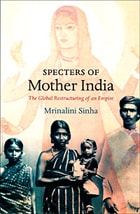
Specters of Mother India
The Global Restructuring of an EmpireMrinalini Sinha
Duke University Press, 2006
Sinha provides a rich historical narrative of the controversy surrounding Mother India, from the book’s publication through the passage in India of the Child Marriage Restraint Act in the closing months of 1929. She traces the unexpected trajectory of the controversy as critics acknowledged many of the book’s facts only to overturn its central premise. Where Mayo located blame for India’s social backwardness within the beliefs and practices of Hinduism, the critics laid it at the feet of the colonial state, which they charged with impeding necessary social reforms. As Sinha shows, the controversy became a catalyst for some far-reaching changes, including a reconfiguration of the relationship between the political and social spheres in colonial India and the coalescence of a collective identity for women.
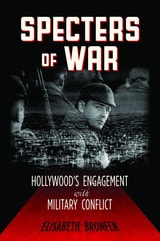
Specters of War
Hollywood's Engagement with Military ConflictBronfen, Elisabeth
Rutgers University Press, 2012
Specters of War looks at the way war has been brought to the screen in various genres and at different historical moments throughout the twentieth century and into the twenty-first. Elisabeth Bronfen asserts that Hollywood has emerged as a place where national narratives are created and circulated so that audiences can engage with fantasies, ideologies, and anxieties that take hold at a given time, only to change with the political climate.
Such cultural reflection is particularly poignant when it deals with America’s traumatic history of war. The nation has no direct access to war as a horrific experience of carnage and human destruction; we understand our relation to it through images and narratives that transmit and interpret it for us. Bronfen does not discuss actual conflicts but the films by which we have come to know and remember them, including All Quiet on the Western Front, The Best Years of Our Lives, Miracle at St. Anna, The Deer Hunter, and Flags of Our Fathers. Battles and campaigns, the home front and women-who-wait narratives, war correspondents, and court martials are also explored as instruments of cultural memory. Bronfen argues that we are haunted by past wars and by cinematic re-conceptualizations of them, and reveals a national iconography of redemptive violence from which we seem unable to escape.
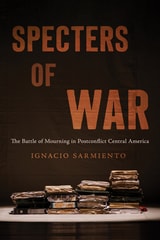
Specters of War
The Battle of Mourning in Postconflict Central AmericaIgnacio Sarmiento
University of Arizona Press, 2025
Specters of War explores mourning practices in postwar Central America, particularly in El Salvador and Guatemala. Ignacio Sarmiento delves into the intricate dynamics of grieving through an interdisciplinary lens, analyzing expressions of mourning in literature, theater, and sites of memory. At the heart of this analysis is the contention over who has the right to mourn, how mourning is performed, and who is included in this process. Sarmiento reveals mourning not as a private affair but as a battleground where different societal factions vie for the possibility of grieving the dead.
Through meticulous research and theoretical nuance, Specters of War sheds light on the politics of mourning in postconflict societies. Sarmiento argues that mourning is not merely a personal experience but a deeply political act intertwined with power struggles and societal divisions. From victims of state terrorism to military elites, various groups engage in a complex dance of grief, revealing the fraught nature of public mourning in postwar Central America. By examining cultural artifacts and memorialization projects, Sarmiento uncovers the multifaceted nature of mourning and its implications for memory, justice, and reconciliation.
This groundbreaking work is essential reading for scholars, students, and professionals interested in Central American history and culture, as well as post-authoritarian societies. Specters of War promises to deepen our understanding of postwar Central America and the legacy of loss in shaping collective identities and narratives of the past.
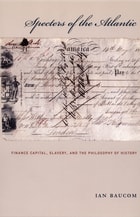
Specters of the Atlantic
Finance Capital, Slavery, and the Philosophy of HistoryIan Baucom
Duke University Press, 2005
Baucom contends that the massacre and the trials that followed it bring to light an Atlantic cycle of capital accumulation based on speculative finance, an economic cycle that has not yet run its course. The extraordinarily abstract nature of today’s finance capital is the late-eighteenth-century system intensified. Yet, as Baucom highlights, since the late 1700s, this rapacious speculative culture has had detractors. He traces the emergence and development of a counter-discourse he calls melancholy realism through abolitionist and human-rights texts, British romantic poetry, Scottish moral philosophy, and the work of late-twentieth-century literary theorists. In revealing how the Zong tragedy resonates within contemporary financial systems and human-rights discourses, Baucom puts forth a deeply compelling, utterly original theory of history: one that insists that an eighteenth-century atrocity is not past but present within the future we now inhabit.
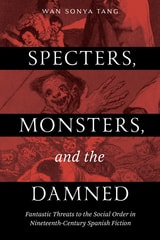
Specters, Monsters, and the Damned
Fantastic Threats to the Social Order in Nineteenth-Century Spanish FictionWan Sonya Tang
Vanderbilt University Press, 2024
Tang offers innovative readings of eleven fantastic short stories and one novella as they first appeared, some serialized and others illustrated, in Spanish periodicals from the late 1800s and early 1900s. Drawing on original archival research, she demonstrates how these stories—in which the everyday is suddenly and inexplicably disrupted by the supernatural—often employ gothic imagery (specifically that of the specter, the monster, and the curse) to depict as threatening those who deviate from cultural norms in terms of class, gender, and race. Tang argues, however, that these unsettling, open‑ended narratives likewise allow readers to question how and why certain designated groups are privileged by society. She contends that the fantastic depiction of reality as unstable in these works ultimately facilitates an interrogation of those values that are accepted as natural by the reigning social order, gesturing toward the inhumanity not of the marginalized, but of the dominant group.