Results by title

12 books match the query 'Speculative fiction'
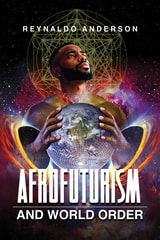
cover of Afrofuturism and World Order

Afrofuturism and World Order

Reynaldo Anderson

The Ohio State University Press, 2025

In Afrofuturism and World Order, Reynaldo Anderson delves into the evolution of Black speculative thought and Afrofuturism from the early twentieth century to the present day. By locating Afrofuturism within an African geography of reason, he situates the past, present, and future of people of African descent at the intersection of speculative philosophy, science fiction, futurology, artificial intelligence, climate change, and geopolitics. Historically, Afrofuturism theorized futures for Black Americans through merging their lived experiences with science fiction, technology, music, and art. Drawing from adaptations in Black culture and speculative thought during the Cold War, Anderson addresses the shifting focus of the genre from American to transnational, as well as the implications of modern existential threats such as the COVID-19 pandemic. By tracing the Black speculative tradition from its overlaps with Africana esotericism and certain African diaspora regions, to its intersections with astroculture and modernism, to the works of Malcolm X, Amiri Baraka, W. E. B. Du Bois, and Octavia Butler, to the aesthetic politics of the Black Speculative Arts movement, and beyond, Anderson illuminates how Afrofuturism participates in an increasingly multipolar world.
[more]
cover of Black Speculative Feminisms: Memory and Liberated Futures in Black Women's Fiction

Black Speculative Feminisms

Memory and Liberated Futures in Black Women's Fiction

Cassandra L. Jones

The Ohio State University Press, 2024

How do Black women writing speculative fiction explore the use of memory as a potential strategy for liberation? In Black Speculative Feminisms, Cassandra L. Jones looks at the writings of Octavia E. Butler, Tananarive Due, Nalo Hopkinson, Rasheedah Phillips, and Nnedi Okorafor to chart those moments where characters harness, or fail to harness, the power of memory. These instances transform memory—individual and collective, bodily and archival—from passive recollection into direct or indirect social action. Taking a Black feminist approach, Jones addresses several emancipatory themes within Afrofuturism: the decolonization of time that can be found in fiction employing non-Western and non-linear expressions of time, exploring futurity and the projection of a full range of expressions of Black humanity into anticipated futures, and imagining new worlds and novel approaches to old problems. Drawing on critical fabulation and restorative justice, she forwards restorative fabulation as the mechanism by which speculative fiction offers a healing site for authors and readers to process generational trauma while imagining more equitable futures.
[more]
cover of Bodyminds Reimagined: (Dis)ability, Race, and Gender in Black Women's Speculative Fiction

Bodyminds Reimagined

(Dis)ability, Race, and Gender in Black Women's Speculative Fiction

Sami Schalk

Duke University Press, 2018

In Bodyminds Reimagined Sami Schalk traces how black women's speculative fiction complicates the understanding of bodyminds—the intertwinement of the mental and the physical—in the context of race, gender, and (dis)ability. Bridging black feminist theory with disability studies, Schalk demonstrates that this genre's political potential lies in the authors' creation of bodyminds that transcend reality's limitations. She reads (dis)ability in neo-slave narratives by Octavia Butler (Kindred) and Phyllis Alesia Perry (Stigmata) not only as representing the literal injuries suffered under slavery, but also as a metaphor for the legacy of racial violence. The fantasy worlds in works by N. K. Jemisin, Shawntelle Madison, and Nalo Hopkinson—where werewolves have obsessive-compulsive-disorder and blind demons can see magic—destabilize social categories and definitions of the human, calling into question the very nature of identity. In these texts, as well as in Butler’s Parable series, able-mindedness and able-bodiedness are socially constructed and upheld through racial and gendered norms. Outlining (dis)ability's centrality to speculative fiction, Schalk shows how these works open new social possibilities while changing conceptualizations of identity and oppression through nonrealist contexts.
[more]
cover of Breaking the World: Black Insecurity and the Horizons of Speculative Fiction

Breaking the World

Black Insecurity and the Horizons of Speculative Fiction

Justin L. Mann

Duke University Press, 2026

In Breaking the World, Justin L. Mann argues that Black speculative fictions are an essential but overlooked archive for understanding the modern security ambitions of the United States. Foregrounding how the contemporary security state renders Black life insecure, Mann theorizes worldbreaking: speculative narrative, aesthetic, and ethical strategies that Black writers, musicians, and artists employ to unmake the processes by which state and parastate agents augment and build up the tools, techniques, and infrastructures intended to make people safer. He shows how the techniques of worldbreaking in the works of Octavia E. Butler, Colson Whitehead, N.K. Jemisin, Janelle Monáe, and the Marvel and DC Cinematic Universes chart the distinction between securitization and Black insecurity. These works illuminate the difference between the antiblackness of state security and the power of Black collectivity. Contending that speculative worldbreaking is a vital part of the Black radical imagination, Mann shows that its destructive strategies can help transform worlds of securitization to worlds of liberation.
[more]
cover of Doom Patterns: Latinx Speculations and the Aesthetics of Violence

Doom Patterns

Latinx Speculations and the Aesthetics of Violence

Maia Gil'Adí

Duke University Press, 2025
In Doom Patterns, Maia Gil’Adí takes up speculative fiction as a site for theorizing Latinx identity across national and ethnic borders and shows the vital role of historical trauma in its formation. Her analysis moves beyond reparative modes of reading to consider how literary representations of violence, destruction, and pain also elicit pleasurable affective and aesthetic experiences. Gil’Adí theorizes the paradox of pleasurable violence through the notion of doom patterns—narrative devices that include thematic repetition, nonlinear narration, character fragmentation, and unresolved plots. Doom patterns return the reader to instances of historical violence and destruction, revealing them as excessive and otherworldly processes that require the tropes of speculative fiction. Examining novels by established Latinx authors such as Junot Díaz and Cristina García as well as multiethnic writers such as Colson Whitehead and Sesshu Foster, Gil’Adí challenges definitions of what constitutes Latinx literature and notions of the speculative by dismantling generic boundaries and entrenched definitions of race, ethnicity, and nationhood. In so doing, she allows for a more capacious consideration of the speculative, realism, history, and the role of violence in literature.
[more]
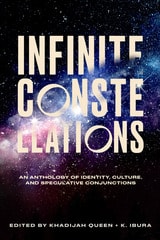
cover of Infinite Constellations: An Anthology of Identity, Culture, and Speculative Conjunctions

Infinite Constellations

An Anthology of Identity, Culture, and Speculative Conjunctions

Edited by Khadijah Queen and K. Ibura

University of Alabama Press, 2023

A galaxy of voices. A universe of belonging.

The innovative fictions in Infinite Constellations showcase the voices and visions of 30 remarkable writers, both new and established, from the global majority: Native American/First Nation writers, South Asian writers, East Asian writers, Black American writers, Latinx writers, and Caribbean and Middle Eastern writers. These are visions both familiar and strange, but always rooted in the mystery of human relationships, the deep honoring of memory, and the rootedness to place and the centering of culture.

The writers in this anthology mirror, instruct, bind and unbind, myth-make and myth-invert, transform and transmute, make us belly-laugh or hum our understanding, gasp or whisper gently, and remember that sometimes we need to holler and fight as we grieve. Any dangers herein, imagined or observed in poem and story, transport us: moving from latent to extant, then unleashed.

This work does not presume; it presents and blossoms, creating a constellation of appearances, a symphony of belonging.

“In collecting this work,” note editors Khadijah Queen and K. Ibura, “we felt humbled by the love threaded throughout the voices speaking to us in stories and poems that vault beyond expectation and settle in our consciousness as an expansion of what’s possible when we tend to one another with intention. We felt lifted, held aloft in these arrangements of language. We hope that as you read each story and poem, you will find the same sense of empowerment and celebration that we know has sustained us over countless generations, and in their beauty and humor and intelligence and complexity, continue to enrich us still.”

CONTRIBUTORS
George Abraham / Kenzie Allen / Shreya lla Anasuya / Thea Anderson / Wendy Chin-Tanner / Alton Melvar M. Depanas / Yohanca Delgado / Jennifer Elise Foerster / Aerik Francis / André O. Hoilette / Brian K. Hudson / K. Ibura / Pedro Iniguez / Ruth Ellen Kocher / Ra’Niqua Lee / Tonya Liburd / Kenji C. Liu / Shalewa Mackall / Lucien Darjeun Meadows / Melanie Merle / Juan J. Morales / Thirii Myo Kyaw Myint / Cindy Juyound Ok / Daniel José Older / Soham Patel / Lynn C. Pitts/ Khadijah Queen / Sheree Renée Thomas /  Sarah Sophia Yanni / dg nanouk okpik / shakirah peterson
 

[more]
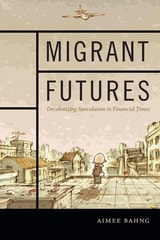
cover of Migrant Futures: Decolonizing Speculation in Financial Times

Migrant Futures

Decolonizing Speculation in Financial Times

Aimee Bahng

Duke University Press, 2018

In Migrant Futures Aimee Bahng traces the cultural production of futurity by juxtaposing the practices of speculative finance against those of speculative fiction. While financial speculation creates a future based on predicting and mitigating risk for wealthy elites, the wide range of speculative novels, comics, films, and narratives Bahng examines imagines alternative futures that envision the multiple possibilities that exist beyond capital’s reach. Whether presenting new spatial futures of the US-Mexico borderlands or inventing forms of kinship in Singapore in order to survive in an economy designed for the few, the varied texts Bahng analyzes illuminate how the futurity of speculative finance is experienced by those who find themselves mired in it. At the same time these displaced, undocumented, unbanked, and disavowed characters imagine alternative visions of the future that offer ways to bring forth new political economies, social structures, and subjectivities that exceed the framework of capitalism.
[more]
cover of Nostalgic Futures: The Reactionary Fantasies of Speculative Fiction Fandoms

Nostalgic Futures

The Reactionary Fantasies of Speculative Fiction Fandoms

Max Dosser

Rutgers University Press, 2026

Speculative fiction imagines impossible futures and alternative pasts, alien species and angelic monsters, technological marvels and magical solutions. In recent years, however, many in its fandoms have protested the inclusion of nonwhite, nonmale, and nonheterosexual characters as betrayals of their beloved media for the sake of “wokeness.” Nostalgic Futures: The Reactionary Fantasies of Speculative Fiction Fandoms examines how contemporary fan controversies— particularly those surrounding gender, race, and sexuality in speculative fiction media—intersect with reactionary movements within and beyond fandom. This book explores how the nostalgic fantasies of fans and far-right movements contribute to broader reactionary discourses, shaping not only the past they long for but the future they fear. From the Hugo Awards and PuppyGate to Star Wars’ #NotMyJedi to Mass Effect and The Last of Us boycotts, Nostalgic Futures reveals how speculative fiction fandom has become a site of contestation over our visions of the past, present, and future.

[more]
cover of Out of This World: Speculative Fiction in Translation from the Cold War to the New Millennium

Out of This World

Speculative Fiction in Translation from the Cold War to the New Millennium

Rachel S. Cordasco

University of Illinois Press, 2021

The twenty-first century has witnessed an explosion of speculative fiction in translation (SFT). Rachel Cordasco examines speculative fiction published in English translation since 1960, ranging from Soviet-era fiction to the Arabic-language dystopias that emerged following the Iraq War. Individual chapters on SFT from Korean, Czech, Finnish, and eleven other source languages feature an introduction by an expert in the language's speculative fiction tradition and its present-day output. Cordasco then breaks down each chapter by subgenre--including science fiction, fantasy, and horror--to guide readers toward the kinds of works that most interest them. Her discussion of available SFT stands alongside an analysis of how various subgenres emerged and developed in a given language. She also examines the reasons a given subgenre has been translated into English.

An informative and one-of-a-kind guide, Out of This World offers readers and scholars alike a tour of speculative fiction's new globalized era.
[more]
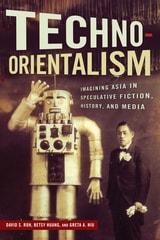
cover of Techno-Orientalism: Imagining Asia in Speculative Fiction, History, and Media

Techno-Orientalism

Imagining Asia in Speculative Fiction, History, and Media

Roh, David S.

Rutgers University Press, 2015

What will the future look like? To judge from many speculative fiction films and books, from Blade Runner to Cloud Atlas, the future will be full of cities that resemble Tokyo, Hong Kong, and Shanghai, and it will be populated mainly by cold, unfeeling citizens who act like robots. Techno-Orientalism investigates the phenomenon of imagining Asia and Asians in hypo- or hyper-technological terms in literary, cinematic, and new media representations, while critically examining the stereotype of Asians as both technologically advanced and intellectually primitive, in dire need of Western consciousness-raising. 
 
The collection’s fourteen original essays trace the discourse of techno-orientalism across a wide array of media, from radio serials to cyberpunk novels, from Sax Rohmer’s Dr. Fu Manchu to Firefly.  Applying a variety of theoretical, historical, and interpretive approaches, the contributors consider techno-orientalism a truly global phenomenon. In part, they tackle the key question of how these stereotypes serve to both express and assuage Western anxieties about Asia’s growing cultural influence and economic dominance. Yet the book also examines artists who have appropriated techno-orientalist tropes in order to critique racist and imperialist attitudes. 
 
Techno-Orientalism is the first collection to define and critically analyze a phenomenon that pervades both science fiction and real-world news coverage of Asia. With essays on subjects ranging from wartime rhetoric of race and technology to science fiction by contemporary Asian American writers to the cultural implications of Korean gamers, this volume offers innovative perspectives and broadens conventional discussions in Asian American Cultural studies. 


[more]
cover of Theory for the World to Come: Speculative Fiction and Apocalyptic Anthropology

Theory for the World to Come

Speculative Fiction and Apocalyptic Anthropology

Matthew J. Wolf-Meyer

University of Minnesota Press, 2019

Can social theories forge new paths into an uncertain future?

The future has become increasingly difficult to imagine. We might be able to predict a few events, but imagining how looming disasters will coincide is simultaneously necessary and impossible. Drawing on speculative fiction and social theory, Theory for the World to Come is the beginning of a conversation about theories that move beyond nihilistic conceptions of the capitalism-caused Anthropocene and toward generative bodies of thought that provoke creative ways of thinking about the world ahead. Matthew J. Wolf-Meyer draws on such authors as Kim Stanley Robinson and Octavia Butler, and engages with afrofuturism, indigenous speculative fiction, and films from the 1970s and ’80s to help think differently about the future and its possibilities.


Forerunners: Ideas First
Short books of thought-in-process scholarship, where intense analysis, questioning, and speculation take the lead
[more]
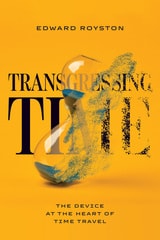
cover of Transgressing Time: The Device at the Heart of Time Travel

Transgressing Time

The Device at the Heart of Time Travel

Edward Royston

The Ohio State University Press, 2026

The first systemic analysis of time travel as narrative device, Edward Royston’s Transgressing Time argues that as a fictional conceit, time travel can most fruitfully be understood from a narratological perspective that sidesteps questions of its plausibility. In service of this goal, Royston identifies the precise narrative device, “anachronic metalepsis,” that powers time travel. Existing at the confluence of narrative’s power to manipulate temporality and fiction’s power to transgress and displace across ontological boundaries, anachronic metalepsis demonstrates that the power of narrative itself is what enables time travel.

Royston bolsters this concept through readings of classics such as Back to the Future and Octavia E. Butler’s Kindred, contemporary works such as the video game Outer Wilds and Scott Alexander Howard’s The Other Valley, and lesser-known works such as the nineteenth-century Spanish novel El Anacronópete. These readings demonstrate how time travel functions across different mediums and genres and spotlights the ways authors and creators have used anachronic metalepsis to contend with themes of exile, freedom and consequences, the powers and pitfalls of nostalgia, the nature of history and our relationship to it, and the nature of time itself.
[more]