Results by title
12 books match the query 'Spelling & Vocabulary'
Academic Speaking and the Boundaries of Routinized Lexical Phrases
Susan M. Barone and Summer Dickinson
University of Michigan Press, 2022
Academic Vocabulary Building in English, Intermediate
Volume 2Betsy Davis, Alan Juffs, Dawn E. McCormick, Greg Mizera, M. Christine O'Neill, Stacy Ranson, Missy Slaathaug, Dorolyn Smith
University of Michigan Press, 2015
Each unit contains sections that emphasize various components of word learning. First, each chapter opens with a chart of target words and their various morphological forms. The next step establishes form-meaning mappings: Each word is listed with a definition and two example sentences. The lists and definitions are followed by exercises that concentrate students’ attention on establishing form-meaning links. These exercises consist of practice opportunities that require multiple retrievals in order to promote label-to-concept links and begin awareness of derivational and inflectional variations. Follow-up exercises focus on collocations related to the unit’s theme. Each chapter closes with exercises that can be used as quizzes. By the time students have finished a unit, they should have had both receptive and productive practice with the form, meaning, morphosyntax, and collocational properties of each lexical item.
Academic Word Lists
What Every Teacher Needs to KnowKeith S. Folse
University of Michigan Press, 2020
Bioscientific Terminology
Words from Latin and Greek StemsDonald M. Ayers
University of Arizona Press, 1972
Separate sections on Latin and Greek derivations. Each section has 20 lessons—with assignments following each lesson—giving the user a vast technical vocabulary and increased word-recognition ability.
A Definitive Reference:
Hundreds of Greek and Latin stems, prefixes, and suffixes show the precise application of the classical languages to biological and medical usage. Topic-organized bibliography, index of bases.
English Words Instructor's Manual
R. L. Cherry
University of Arizona Press, 1986
English Words from Latin and Greek Elements
Donald M. Ayers; Revised by Thomas D. Worthen
University of Arizona Press, 1986
Since its first publication in 1965, English Words from Latin and Greek Elements by Donald M. Ayers has empowered thousands of students to expand their vocabulary by uncovering the classical roots embedded in modern English. Now in its enduring second edition, this trusted resource proves that vocabulary is most effectively learned through understanding—not memorization.
Why dedicate an entire book to this approach? Because Ayers goes beyond the basics. Students are introduced to a broad spectrum of Latin and Greek roots, encounter new vocabulary in meaningful context, and reinforce their learning through targeted exercises. This method equips learners with lifelong tools to decode unfamiliar words and deepen their command of English.
Written for English learners—not classical language scholars—this book requires no prior knowledge of Latin or Greek. It’s proven effective across high school and college classrooms, and adaptable for both remedial and accelerated programs.
Exploring Options in Academic Writing
Effective Vocabulary and Grammar UseJan Frodesen and Margi Wald
University of Michigan Press, 2016
Following a unit on using resources for vocabulary development, the contents are divided into three parts: Showing Relationships within Sentences, Connecting and Focusing across Sentences, and Qualifying Statements and Reporting Research. Part 1 focuses on verbs and modifiers that express increases and decreases, verbs and abstract nouns that describe change, connectors and verbs describing causal relationships, and parallel structures. Part 2 explores the words that help connect ideas and add cohesion. Part 3 discusses how to express degrees of certainty and accuracy and the use of reporting verbs.
Fulfulde (Maasina) - English - French Lexicon
A Root-Based Compilation Drawn from Extant SourcesDonald W. Osborn
Michigan State University Press, 1993
The Lexicon brings together lexical material from a wide range of published and non-published sources to create an extensive compilation of the vocabulary of Fulfulde as it is spoken in that part of central Mali known as Masina (in Fulfulde, Maasina). The Lexicon is intended primarily for non-Fulfulde speakers who are learning the language at the intermediate or advanced levels and who need access to a comprehensive reference source on Fulfulde vocabulary. Scholars, development workers, and others whose research or fieldwork involves use of the Fulfulde of Masina may find it helpful as well in clarifying nuances of meaning and standardized spelling for the less familiar terms they might encounter. It is also intended that the present work, beyond the matter of organizing vocabulary, will contribute significantly to the expanding lexicographical and linguistic investigations of Fulfulde.
Teaching Vocabulary Is the Writing Teacher's Job
Why and HowKeith S. Folse
University of Michigan Press, 2020
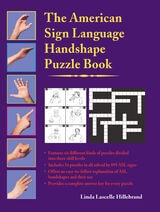
The American Sign Language Handshape Puzzle Book
Linda Lascelle Hillebrand
Gallaudet University Press, 2005
The American Sign Language Handshape Puzzle Book features 54 different puzzles to help students learn, review, and strengthen their signing vocabulary. Inspired by the bestselling dictionary, this unique workbook offers a variety of puzzles at three different levels — easy, medium, and difficult. Author Linda Lascelle Hillebrand provides a concise explanation of the basic handshapes used in American Sign Language (ASL), then invites readers to have fun while solving all sorts of sign puzzles.
Users can practice sign identification with Crossword and Word Search puzzles that have signs as clues rather than words. Easy puzzles show as few as six signs while advanced puzzles contain as many as 30 signs each. Some of the crossword puzzles provide spaces both across and down for the multiple meanings that many signs can represent.
Handshape Order puzzles require users to identify the handshape of the sign in an illustration, then list the sign’s meaning in English. Match puzzles also challenge readers to find corresponding signs for English glosses. Solutions to It Doesn’t Belong and Sign Description puzzles depend upon knowing the parameters of ASL signs—handshape, orientation, location, and movement—to deduce which word in a list doesn’t belong, and to write the English word for the described signs. The American Sign Language Handshape Puzzle Book is a new, different, and entertaining way to practice ASL that students of all ages are sure to enjoy.
The Clan of the Flapdragon and Other Adventures in Etymology by B. M. W. Schrapnel, Ph.D.
Richard McKee
University of Alabama Press, 1997
This potpourri of satire on language use in Western culture will trigger chuckles and guffaws from an eclectic readership
In The Clan of the Flapdragon and Other Adventures in Etymology by B. M. W. Schrapnel, Ph.D., the pseudonymous critic satirizes a variety of subjects in and out of academe. These adventurous essays include lampoons on writing, language, and literature, and the collection is a delightful spoof of much in contemporary culture—especially areas of intellectual pretension. Readers will be entertained by anachronistic allusions, improbable parodies, whimsical etymologies, tongue-in-cheek word play, and stunning purple prose—examples of just some of the liberties Schrapnel takes with the language.
Dr. Schrapnel includes a wide array of audience reactions in the form of bogus letters from fictional readers, confirming that language and literature are everyone’s business. He also offers an annual list of words that writers and speakers should use more often—a lexicographer’s equivalent to the endangered species list—and coins terms such as prufrockery and grendelish.
Workbook to Accompany the Second Edition of Donald M. Ayers's English Words from Latin and Greek Elements
Revised EditionHelena Dettmer and Marcia Lindgren
University of Arizona Press, 2005
The Workbook has now been revised to make it more relevant and useful. It features a new dictionary exercise and word analysis exercises, the replacement of true-false exercises that have caused the most difficulty for students, and the elimination of archaic words and other items that have become dated. The authors have also improved the clarity of the instructions for individual exercises, in some cases adding notes or providing sample answers. As part of the revised front matter, there is a new introduction written just for students to help them get the most out of the workbook. English Words and the Workbook have met with unqualified success in English and Classics courses at both the advanced secondary and college levels. This revision of the Workbook helps to ensure the continuing relevance of the roots approach to vocabulary building for tomorrow’s students.