Results by title
2 books match the query 'Spicer, Michael W.'

In Defense of Politics in Public Administration
A Value Pluralist PerspectiveMichael W. Spicer
University of Alabama Press, 2009
Where values collide, politics guides the way.
Scholars of public administration have historically too often been disdainful towards politics in the field, viewing political activities and interests as opportunities for corruption, mismanagement, and skewed priorities. Supporters of this anti-political stance have become even more strident in recent years, many of them advancing scientific models for the study and practice of public administration and governance.
Michael Spicer argues that politics deserves to be defended as a vital facet of public administration on the grounds that it can promote moral conduct in government and in public administration, principally by bringing to the foreground the role of values in administrative practice. Politics can facilitate the resolution of conflicts that naturally arise from competing values, or conceptions of the good, while minimizing the use of force or violence. Drawing on the writings of Isaiah Berlin, Bernard Crick, and Stuart Hampshire, In Defense of Politics in Public Administration argues that value conflict is an integral part of our moral experience, both in making our own moral choices and in dealing with those whose values conflict with our own. This book is a spirited declaration of principles and a timely contribution to a dialogue that is redefining public administration, both in theory and in practice.
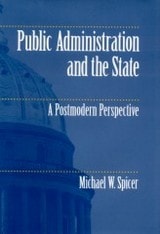
Public Administration and the State
A Postmodern PerspectiveMichael W. Spicer
University of Alabama Press, 2005
A critical examination of public administration's pervasive vision of a powerful state
Woodrow Wilson argued for a state led by a powerful government, guided by science and enlightened experts, for the accomplishment of a set of collective purposes—in other words, a purposive state. Michael Spicer contends that though Wilson and those who followed him have not typically explored questions of political and constitutional theory in their writing, a clear and strong vision of the state has emerged in their work nonetheless.
Building upon the work of Dwight Waldo and others who have sought to explore and reveal the political theory behind the seemingly neutral language of administration, Spicer explores the roots—both historical and philosophical—of the purposive state. He considers the administrative experience of 18th-century Prussia and its relationship to the vision of the purposive state, and examines the ways this idea has been expressed in the 20th century. He then looks at the practical problems such a vision creates for public policy in a fragmented postmodern political culture. Finally, Spicer explores an alternative view of public administration—one based on a civil association model appropriate to our constitutional traditions and contemporary culture.