Results by title
3 books match the query 'Spider'
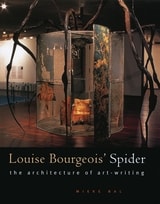
Louise Bourgeois' Spider
The Architecture of Art-WritingMieke Bal
University of Chicago Press, 2001
The sculptor Louise Bourgeois is best known for her monumental abstract sculptures, one of the most striking of which is the installation Spider (1997). Too vast in scale to be viewed all at once, this elusive structure resists simple narration. It fits both no genre and all of them—architecture, sculpture, installation. Its contents and associations evoke social issues without being reducible to any one of them. Here, literary critic and theorist Mieke Bal presents the work as a theoretical object, one that can teach us how to think, speak, and write about art.
Known for her commentary on the issue of temporality in art, Bal argues that art must be understood in relationship to the present time of viewing as opposed to the less-immediate contexts of what has preceded the viewing, such as the historical past of influences and art movements, biography and interpretation. In ten short chapters, or "takes," Bal demonstrates that the closer the engagement with the work of art, the more adequate the result of the analysis. She also confronts issues of biography and autobiography—key themes in Bourgeois's work—and evaluates the consequences of "ahistorical" experiences for art criticism, drawing on diverse sources such as Bernini and Benjamin, Homer and Eisenstein.
This short, beautiful book offers both a theoretical model for analyzing art "out of context" and a meditation on a key work by one of the most engaging artists of our era.
[more]
Mister Pulitzer and the Spider
Modern News from Realism to the DigitalKevin G. Barnhurst
University of Illinois Press, 2018
A spidery network of mobile online media has supposedly changed people, places, time, and their meanings. A prime case is the news. Digital webs seem to have trapped "legacy media," killing off newspapers and journalists' jobs. Did news businesses and careers fall prey to the digital "Spider"?
To solve the mystery, Kevin Barnhurst spent thirty years studying news going back to the realism of the 1800s. The usual suspects--technology, business competition, and the pursuit of scoops--are only partly to blame for the fate of news. The main culprit is modernism from the "Mister Pulitzer" era, which transformed news into an ideology called "journalism." News is no longer what audiences or experts imagine. Stories have grown much longer over the past century and now include fewer events, locations, and human beings. Background and context rule instead.
News producers adopted modernism to explain the world without recognizing how modernist ideas influence the knowledge they produce. When webs of networked connectivity sparked a resurgence in realist stories, legacy news stuck to big-picture analysis that can alienate audience members accustomed to digital briefs.
[more]

The Spider
Aurko Maitra
Seagull Books, 2025
A tale of mercenaries and myths, set amid the political turmoil of Bengal.
In the largely undocumented sphere of political violence in eastern India, Qadir the Spider is a mythological killer and casanova, known for the various assassinations and liaisons he carries out across the region. His oldest son Rahim is the latest entry to the field. A 13-year-old killer, the boy bides his time like his father—killing, farming, and getting high as the battles go on around him. In this world where they only follow orders, mutilation becomes their only expression, the nature of violence their only meaningful form of autonomy in the various power struggles of interior Bengal.
After his first year in the field, as the child is groomed by his father to carry on the ways of their mercenary clan, he begins to confront the various legends surrounding the Spider. However, while roaming the strange, spectral forests surrounding the town, his chance encounter with a pair of wandering musicians leads him to question the killings that pattern his life. As he searches for the answers around him, he is slowly led to confront the man his father truly is, as well as the man he knows he will become.
A gripping tale of inherited violence and identity in politically volatile Bengal, Aurko Maitra’s The Spider contains powerful, disturbing parallels to modern-day conflicts. Boldly interrogating our concepts of autonomy and survival in chaos, this revelatory novel explores the impact of political violence and timeless issues of legacy and intergenerational violence.
[more]