Results by title
5 books match the query 'Spiritual Growth'
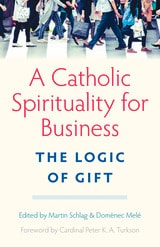
A Catholic Spirituality for Business
Martin Schlag
Catholic University of America Press, 2019
Spirituality and gift are notions that are en vogue. Topics such as spirituality at the workplace, spirituality management, spirituality in leadership, organizational spirituality and other related topics are trending in management literature. The “logic of gift” is also appearing more frequently, especially in attempts to rethink the way our economy works in order to include the marginalized.
<
The expression “logic of gift” was introduced into official Catholic social teaching by Pope Benedict XVI, who presented it in association with the principle of gratuitousness, which in turn is an expression of fraternity. However, before Caritas in Veritate and ever since Marcel Mauss’s groundbreaking work The Gift, the importance of gift for human relationships and for the cohesion of society had been increasingly recognized. Alain Caillé and Jacques T. Godbout further fleshed out the implication of gift for contemporary society in the context of secular social sciences, striving to overcome utilitarianism. It was the “civil economy” movement, however, that exercised greatest influence on Benedict XVI’s encyclical Caritas in Veritate
This present volume reflects on the general scope of these notions for business and society. This is done by structuring the book in two parts, each dedicated to one of the two concepts. Each part has two general chapters and two that apply the notions to business and to business education. The authors are a mix of well-known emeritus professors and younger talented emerging scholars. We have also been careful to combine European with American authors.
A Catholic Spirituality for Business: The Logic of Gift does not seek to provide a definitive answer to all social challenges, but to make a contribution to a better understanding of Christian spirituality and gift in connection with business organizations. The authors in this book are convinced that markets can be ethical and social, that moral change towards ethical capitalism is possible.
[more]

Meditation as Spiritual Therapy
Bernard of Clairvaux's <i>De consideratione</i>Matthew McWhorter
Catholic University of America Press, 2024
Christian persons today might seek spiritual development and ponder
the benefit of mindfulness exercises but also maintain concerns if they perceive such exercises to originate from other religious traditions. Such persons may not be aware of a long tradition of meditation practice in Christianity that promotes personal growth.
This spiritual tradition receives a careful formulation by Christian mo-
nastic authors in the twelfth century. One such teaching on meditation is found in the treatise De consideratione written by St. Bernard of Clairvaux (d. 1153) to Pope Eugene III (d. 1153). In textual passages where St. Bernard exhibits a clear concern for the mental health of the Pope (due to numerous ongoing ecclesial, political, and military problems), St. Bernard reminds Eugene III of his original monastic vocation and the meditation exercises associated with that vocation. The advice that St. Bernard gives to Eugene III can be received today in a way that provides a structure for Christian meditation practice which is relevant for personal develop-
ment, spiritual direction, and civil psychotherapy that integrates a client’s spirituality into the course of treatment. St. Bernard thus might be interpreted as a teacher of a kind of Christian mindfulness that can benefit both a person’s mental health as well as a person’s relationship with God. Meditation as Spiritual Therapy examines the historical context of Bernard’s work, his purpose for writing it, as well as the numerous Christian sources he drew upon to formulate his teaching. Bernard’s teaching on the course of meditation itself is explored in depth and in dialogue with
his other treatises, letters, and sermons.
Lastly, a contemporary summary of Bernard’s teaching is provided with reflections concerning the relationship of this teaching to contemporary spiritual direction and spiritually integrated civil psychotherapy.
[more]
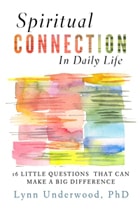
Spiritual Connection in Daily Life
Sixteen Little Questions That Can Make a Big DifferenceLynn Underwood
Templeton Press, 2013
How often do you find moments of deep peace and satisfaction in your day-to-day life? How often does connection with other people, the divine, or nature make you feel more alive? How often are you touched by a sense of awe-inspiring beauty, compassionate love, or pure joy? For many of us, these kinds of experiences tend to be fleeting and all too rare. Fortunately, new research is suggesting that a regular practice of paying attention to experiences like these can help any of us find them more often and cultivate richer, deeper, and more satisfying lives.
In Spiritual Connection in Daily Life, Lynn Underwood introduces her Daily Spiritual Experience Scale (DSES), which is comprised of sixteen simple, multiple-choice questions that invite us to become more attuned tothese extraordinary experiences in ordinary life. The DSES is the definitive set of questions for measuring the experience of spiritual connection and has been used in hundreds of studies, translated into over twenty languages, and used around the world by counselors, therapists, nurses, social workers, clergy from multiple faiths, and business leaders.
Spiritual Connection in Daily Life offers a step-by-step guide to using the DSES to improve our abilities to sense the “more than” in the midst of our days. Embraced by people from many different cultures, religious traditions, and professional backgrounds, the DSES doesn’t require any extraordinary experience like hearing divine voices or embarking upon a dramatic religious conversion. Nor does it belabor the exact definition of “spirituality.” Rather, it simply invites us to focus on aspects of our daily lives such as deep peace, sense of inner strength, longing, and compassionate love. The sixteen questions also provide a common, nonpolarizing language for communicating with others about the role of the “more than” in our lives.
Adherents of all faith traditions, as well as people with no religious leanings whatsoever, have experienced profound and lasting benefits from having these experiences, including improved health behaviors, better relationships, decreased stress and burnout, and improvements in daily mood. Now all of us can reap these same long-term benefits with just a little bit of self-reflection and Dr. Underwood’s expert guidance.
[more]
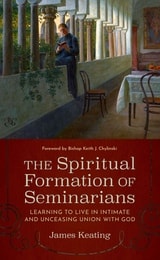
The Spiritual Formation of Seminarians
Learning to Live in Intimate and Unceasing Union with GodJames Keating
Catholic University of America Press, 2025
In this book, Deacon James Keating provides an opportunity for one spiritual director to introduce his mind to the minds of other directors with the hope that his ideas may season their own already developed method of direction. The book does not attend to all the possible realities a director may encounter within his or her training or within the daily execution of this ministry. The author wishes to share his approach to directing seminarians by reflecting upon themes and experiences which regularly appear within direction sessions. Spiritual direction certainly has some universal components to it. All directors want their directees to internalize a habit of prayer, to choose a life of remaining with God, to suffer the vulnerability necessary to know divine love and to then embody that love as heralds of the Gospel. But each director approaches his or her directees from within their own skin, from within a personality that is unique, and by way of a formation that reflects the unique attractions of each director and his or her own sufferings, failures, and fidelities. These unique embodiments no one writer can know or capture in a book. And so, this book simply begins a conversation that the author invites other directors to enter and add to according to their own insights. The spiritual life of those in seminary occupies the integrating center of a projected life of priestly ministry. Time needed to secure an interior life of prayer is one of the key reasons the Church demands years of formation before the celibate state is entered. Such a state in life is entered as a testimony to the reality that God lives and loves. In light of such love a man enters seminary to discern if he desires to surrender his whole life in response to God sharing His own. To live as a cleric without a vital interior life leaves a man in a state of meaninglessness. Instilling the virtue of prayer during priestly formation can help assure that celibate priesthood retains its inspiration and meaning throughout the life of a priest. Spiritual directors minister to assist a future priest to secure a lifetime habit of prayer so as to secure his commitment to communicate with the living God.
[more]
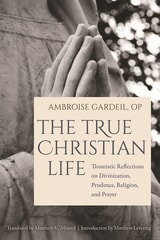
The True Christian Life
Thomistic Reflections on Divinization, Prudence, Religion, and PrayerAmbroise Gardeil, OP
Catholic University of America Press, 2022
Although not well-known in the English-speaking world, Fr. Ambroise Gardeil, OP (1859-1931) was a Dominican of significant influence in French Catholic thought at the turn of the 20th century. Conservative theologians like Frs. Reginald Garrigou-Lagrange, OP, Michel Labourdette, OP, Jean-Hervé Nicolas, OP and many others hailed him as a careful expositor of the supernaturality of faith, a defender of the theological nature of rational apologetics, and a spiritual master. In his controversial Le Saulchoir: Une école de théologie, Fr. Marie-Dominique Chenu, OP praised Fr. Gardeil as an important Dominican initiator of reforms in historical theology, presenting the latter as a kind of precursor to one of the streams of what is now referred to historically as the “Nouvelle Théologie.” And one cannot read the words of Fr. Gardeil’s contemporary Fr. Antoine Lemonnyer, OP, without hearing echoes and re-echoes of common cause regarding our lofty spiritual vocation, resounding within the halls of the Saulchoir. With such a broad appeal, it is no surprise that in private correspondence, a young Yves Simon, writing to Jacques Maritain, referred to Fr. Gardeil as “The Great Gardeil.”
The True Christian Life provides a thorough and stirring introduction to Fr. Gardeil’s work in spiritual theology. The volume was originally published posthumously through the collaboration of Fr. Gardeil’s nephew, Fr. Henri-Dominique Gardeil, OP and Jacques Maritain. Fr. Ambroise, prior to beginning work on his masterpiece on spiritual experience, La Structure de l'âme et l'expérience mystique, drafted nearly eight-hundred pages that would have set forth a full presentation of moral-ascetical theology. While drafting this massive work, his reflection on the soul’s receptive capacity for grace led him to the two-volume study, La Structure, and he never was able to finish his original designs for a comprehensive study of the Christian moral-spiritual life. Soon after his death, his nephew gathered several essays from the Revue thomiste and Revue de Jeunes, along with a complete-but-unpublished study on prayer. Drafting a lengthy introduction on the basis of Fr. Ambroise’s unpublished notes, Fr. Henri-Dominique assembled a volume of moral / spiritual theology that sets out the principles of many important themes: divinization through grace, Christian prudence /conscience, the virtue of religion, devotion, and prayer.
In his In memoriam written after the passing of Fr. Gardeil, Fr. Reginald Garrigou-Lagrange emphasized Fr. Gardeil’s ability to meditate on a given topic’s central principles, like someone who sees the highest peaks that give structure to the entire mountain range of theology. In this volume, the reader will find a clear and rhetorically striking presentation of the central mysteries of the spiritual life, presented with stirring and beautiful rhetoric by a theological master from the Thomist tradition.
[more]