Results by title

5 books match the query 'Spiritual formation'
cover of Beyond Mary or Martha: Reclaiming Ancient Models of Discipleship

Beyond Mary or Martha

Reclaiming Ancient Models of Discipleship

Jennifer S. Wyant

SBL Press, 2019

Explore a tale of two sisters

Beyond Mary or Martha: Reclaiming Ancient Models of Discipleship dives into the complicated reception history of Mary and Martha of Bethany, who have been at the center of many debates for almost two thousand years. Jennifer S. Wyant begins her study with a close reading of the sisters’ first encounter with Jesus in Luke 10:38-42, then moves on to patristic, medieval, and modern interpretations of that narrative. Wyant tracks how Mary and Martha both became paradigms of discipleship, revealing the inherent tension within Christianity between contemplative practices and acts of service. By placing ancient debates alongside more modern ones, she argues that, contrary to discussions today within academic and religious circles, gender is not the most important aspect of their story.

Features:

  • A thorough examination of the textual variants in the passage to show how variants affected interpretation throughout history
  • Interpretations from medieval women and their contributions to interpretation of Mary and Martha
  • A visual exegesis of the art representing the passage throughout history
[more]
cover of Called to Holiness

Called to Holiness

Pope Emeritus Benedict XVI Pope Emeritus Benedict XVI

Catholic University of America Press, 2017
This edited collection is the first to gather in one volume the most relevant addresses, speeches, and homilies of His Holiness, Pope Emeritus Benedict XVI to seminarians and consecrated men and women into a single volume for the English-speaking world.
[more]
cover of Imagined Spiritual Communities in Britain's Age of Print

Imagined Spiritual Communities in Britain's Age of Print

Joshua King

The Ohio State University Press, 2015

In Imagined Spiritual Communities in Britain’s Age of Print, Joshua King demonstrates how nineteenth-century Britons turned to the printed page to imagine themselves in Christian communities spanning their nation. In contrast with traditional views of the nineteenth century, which regard the period as a turning point for religion from a public life to a privatized decline, Imagined Spiritual Communities argues that the rapid growth of print culture and a voluntary religious market inspired vigorous efforts to form virtual national congregations of readers.
 
Focusing primarily on the work of Anglicans between the 1820s and 1890s, this study begins by freshly interpreting reading and educational programs promoted by Samuel Taylor Coleridge, Frederick Denison Maurice, and Matthew Arnold. King then traces the emergence of John Keble’s Christian Year as a catalyst for competing visions of a Christian nation united by private reading. He argues that this phenomenon illuminates the structure and reception of best-selling poetic cycles as diverse as Alfred Tennyson’s In Memoriam and Christina Rossetti’s late Verses.  Ultimately, Imagined Spiritual Communities reveals how dreams of print-mediated spiritual communion generated new poetic genres and rhetorical strategies, theories and theologies of media and reading, and ambitious schemes of education and church reform.
[more]
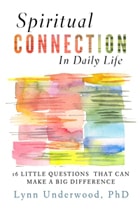
cover of Spiritual Connection in Daily Life: Sixteen Little Questions That Can Make a Big Difference

Spiritual Connection in Daily Life

Sixteen Little Questions That Can Make a Big Difference

Lynn Underwood

Templeton Press, 2013

How often do you find moments of deep peace and satisfaction in your day-to-day life? How often does connection with other people, the divine, or nature make you feel more alive? How often are you touched by a sense of awe-inspiring beauty, compassionate love, or pure joy? For many of us, these kinds of experiences tend to be fleeting and all too rare. Fortunately, new research is suggesting that a regular practice of paying attention to experiences like these can help any of us find them more often and cultivate richer, deeper, and more satisfying lives.
 
In Spiritual Connection in Daily Life, Lynn Underwood introduces her Daily Spiritual Experience Scale (DSES), which is comprised of sixteen simple, multiple-choice questions that invite us to become more attuned tothese extraordinary experiences in ordinary life. The DSES is the definitive set of questions for measuring the experience of spiritual connection and has been used in hundreds of studies, translated into over twenty languages, and used around the world by counselors, therapists, nurses, social workers, clergy from multiple faiths, and business leaders.
 
Spiritual Connection in Daily Life offers a step-by-step guide to using the DSES to improve our abilities to sense the “more than” in the midst of our days. Embraced by people from many different cultures, religious traditions, and professional backgrounds, the DSES doesn’t require any extraordinary experience like hearing divine voices or embarking upon a dramatic religious conversion. Nor does it belabor the exact definition of “spirituality.” Rather, it simply invites us to focus on aspects of our daily lives such as deep peace, sense of inner strength, longing, and compassionate love. The sixteen questions also provide a common, nonpolarizing language for communicating with others about the role of the “more than” in our lives.
 
Adherents of all faith traditions, as well as people with no religious leanings whatsoever, have experienced profound and lasting benefits from having these experiences, including improved health behaviors, better relationships, decreased stress and burnout, and improvements in daily mood. Now all of us can reap these same long-term benefits with just a little bit of self-reflection and Dr. Underwood’s expert guidance.

[more]
cover of The Spiritual Formation of Seminarians: Learning to Live in Intimate and Unceasing Union with God

The Spiritual Formation of Seminarians

Learning to Live in Intimate and Unceasing Union with God

James Keating

Catholic University of America Press, 2025

In this book, Deacon James Keating provides an opportunity for one spiritual director to introduce his mind to the minds of other directors with the hope that his ideas may season their own already developed method of direction. The book does not attend to all the possible realities a director may encounter within his or her training or within the daily execution of this ministry. The author wishes to share his approach to directing seminarians by reflecting upon themes and experiences which regularly appear within direction sessions. Spiritual direction certainly has some universal components to it. All directors want their directees to internalize a habit of prayer, to choose a life of remaining with God, to suffer the vulnerability necessary to know divine love and to then embody that love as heralds of the Gospel. But each director approaches his or her directees from within their own skin, from within a personality that is unique, and by way of a formation that reflects the unique attractions of each director and his or her own sufferings, failures, and fidelities. These unique embodiments no one writer can know or capture in a book. And so, this book simply begins a conversation that the author invites other directors to enter and add to according to their own insights. The spiritual life of those in seminary occupies the integrating center of a projected life of priestly ministry. Time needed to secure an interior life of prayer is one of the key reasons the Church demands years of formation before the celibate state is entered. Such a state in life is entered as a testimony to the reality that God lives and loves. In light of such love a man enters seminary to discern if he desires to surrender his whole life in response to God sharing His own. To live as a cleric without a vital interior life leaves a man in a state of meaninglessness. Instilling the virtue of prayer during priestly formation can help assure that celibate priesthood retains its inspiration and meaning throughout the life of a priest. Spiritual directors minister to assist a future priest to secure a lifetime habit of prayer so as to secure his commitment to communicate with the living God.
[more]