Results by title
13 books match the query 'Spiritual healing'

Borderlands Curanderos
The Worlds of Santa Teresa Urrea and Don Pedrito JaramilloBy Jennifer Koshatka Seman
University of Texas Press, 2021
2022 Americo Paredes Award, Center for Mexican American Studies at South Texas College
A historical exploration of the worlds and healing practices of two curanderos (faith healers) who attracted thousands, rallied their communities, and challenged institutional powers.
Santa Teresa Urrea and Don Pedrito Jaramillo were curanderos—faith healers—who, in the late nineteenth and early twentieth centuries, worked outside the realm of "professional medicine," seemingly beyond the reach of the church, state, or certified health practitioners whose profession was still in its infancy. Urrea healed Mexicans, Indigenous people, and Anglos in northwestern Mexico and cities throughout the US Southwest, while Jaramillo conducted his healing practice in the South Texas Rio Grande Valley, healing Tejanos, Mexicans, and Indigenous people there. Jennifer Koshatka Seman takes us inside the intimate worlds of both "living saints," demonstrating how their effective healing—curanderismo—made them part of the larger turn-of-the century worlds they lived in as they attracted thousands of followers, validated folk practices, and contributed to a modernizing world along the US-Mexico border.
While she healed, Urrea spoke of a Mexico in which one did not have to obey unjust laws or confess one's sins to Catholic priests. Jaramillo restored and fed drought-stricken Tejanos when the state and modern medicine could not meet their needs. Then, in 1890, Urrea was expelled from Mexico. Within a decade, Jaramillo was investigated as a fraud by the American Medical Association and the US Post Office. Borderlands Curanderos argues that it is not only state and professional institutions that build and maintain communities, nations, and national identities but also those less obviously powerful.
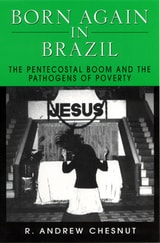
Born Again in Brazil
The Pentecostal Boom and the Pathogens of PovertyR. Andrew Chesnut
Rutgers University Press, 1997
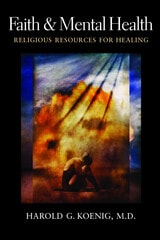
Faith and Mental Health
Religious Resources for HealingHarold G. Koenig
Templeton Press, 2005
Dr. Harold Koenig opens a window on mental health, providing an unprecedented source of practical information about the relationship between religion and mental health. He examines how Christianity and other world religions deliver mental health services today, and he makes recommendations, based on research, expertise, and experience, for new programs to meet local needs.
Meticulously researched and documented, Faith and Mental Health includes
- Research on the relationship between religion and positive emotions, psychiatric illnesses, and severe and persistent mental disorders
- Ways in which religion has influenced mental health historically, and how now and in the future it can be involved with mental health
- A comprehensive description and categorization of Christian and non-Christian faith-based organizations that provide mental health resources
- Resources for religious professionals and faith communities on how to design effective programs
Presenting a combination of the history and current research of mental health and religion along with a thorough examination of faith-based organizations operating in the field, this book is a one-of-a-kind resource for the healthcare community; its valuable research and insights will benefit medical and religious professionals, and anyone concerned with the future of mental health care.
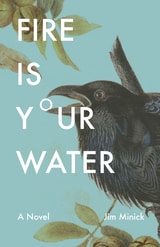
Fire Is Your Water
A NovelJim Minick
Ohio University Press, 2001
Sacred chants are Ada Franklin’s power and her medicine. By saying them, she can remove warts, stanch bleeding, and draw the fire from burns. At age twenty, her reputation as a faith healer defines her in her rural Pennsylvania community. But on the day in 1953 that her family’s barn is consumed by flame, her identity as a healer is upended. The heat, the roar of the blaze, and the bellows of the trapped cows change Ada. For the first time, she fears death and—for the first time—she doubts God. With her belief goes her power to heal. Then Ada meets an agnostic named Will Burk and his pet raven, Cicero.
Fire Is Your Water is acclaimed memoirist Jim Minick’s first novel. Built on magical realism and social observation in equal measure, it never gives way to sentimentality and provides an insider’s glimpse into the culture of Appalachia. A jealous raven, a Greek chorus of one, punctuates the story with its judgments on the characters and their actions, until a tragic accident brings Ada and Will together in a deeper connection.
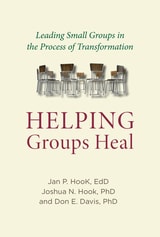
Helping Groups Heal
Leading Groups in the Process of TransformationJan Paul Hook
Templeton Press, 2017
Helping Groups Heal presents “The Healing Cycle,” a grace-based model that facilitates healing and growth in groups. It has been tested with a variety of settings, and can be adapted to nearly any small group, from sex addiction therapy to marriage therapy to Bible studies.
The basic components of “The Healing Cycle” are grace, safety, vulnerability, truth, ownership, and confession. Helping Groups Heal guides the reader through these elements, offering case studies and practical advice from the voices of researchers and practitioners. Each chapter shows how “The Healing Cycle” moves its members to share their truth, own it, and make positive change in their lives. Each step of the process allows participants to move past surface issues and find depth in their understanding of their pain.
Whether you have been leading small groups for years or are about to lead your first session, Helping Groups Heal is an accessible, easy-to-follow guide through “The Healing Cycle” that will give each group member what’s needed to grow, relate, and heal.
Kusamira Music in Uganda
Spirit Mediumship and Ritual HealingPeter J. Hoesing
University of Illinois Press, 2021
In southern Uganda, ritual healing traditions called kusamira and nswezi rely on music to treat sickness and maintain well-being. Peter J. Hoesing blends ethnomusicological fieldwork with analysis to examine how kusamira and nswezi performance socializes dynamic processes of illness, wellness, and health. People participate in these traditions for reasons that range from preserving ideas to generating strategies that allow them to navigate changing circumstances. Indeed, the performance of kusamira and nswezi reproduces ideas that remain relevant for succeeding generations. Hoesing shows the potential of this social reproduction of well-being to shape development in a region where over 80 percent of the population relies on traditional healers for primary health care.
Comprehensive and vivid with eyewitness detail, Kusamira Music in Uganda offers insight into important healing traditions and the overlaps between expressive culture and healing practices, the human and other-than-human, and Uganda's past and future.
Learning from the High Priestess
Affect, Femme Care, and Somatic PracticeAnn Cvetkovich
Duke University Press, 2026
Loose of Earth
A MemoirKathleen Dorothy Blackburn
University of Texas Press, 2024
An arresting memoir of love and unbending religion, toxicity and disease, and one family’s desperate wait for a miracle that never came.
Kathleen Dorothy Blackburn was the oldest of five children, a twelve-year-old from Lubbock, Texas, whose evangelical family eschewed public education for homeschooling, and wove improbable scientific theories into literal interpretations of the Bible. Then her father, a former air force pilot, was diagnosed with cancer at the age of thirty-eight, and, “it was like throwing gasoline on the Holy Spirit.” Stirred by her mother, the family committed to an extreme diet and sought deliverance from equally extreme sources: a traveling tent preacher, a Malaysian holy man, a local faith-healer who led services called “Miracles on 34th Street.”
What they didn’t know at the time was that their lives were entangled with a larger, less visible environmental catastrophe. Fire-fighting foams containing carcinogenic compounds had contaminated the drinking water of every military site where her father worked. Commonly referred to as “forever chemicals,” the presence of PFAS in West Texas besieged a landscape already burdened with vanishing water, taking up residence in wells and in the bloodstreams of people who lived there. An arresting portrait of the pernicious creep of decline, and a powerful cry for environmental justice, Loose of Earth captures the desperate futility and unbending religious faith that devastated a family, leaving them waiting for a miracle that would never come.
Making Health Care Whole
Integrating Spirituality into Patient CareChristina Puchalski
Templeton Press, 2021
In the last fifteen years, the field of palliative care has experienced a surge in interest in spirituality as an important aspect of caring for seriously ill and dying patients. While spirituality has been generally recognized as an essential dimension of palliative care, uniformity of spiritual care practice has been lacking across health care settings due to factors like varying understandings and definitions of spirituality, lack of resources and practical tools, and limited professional education and training in spiritual care.
Pilgrimage and Healing
Edited by Jill Dubisch and Michael Winkelman
University of Arizona Press, 2005
This volume brings together anthropological and interdisciplinary perspectives on these persistent forms of popular religion to expand our understanding of the role of the traditional practice of pilgrimage in what many believe to be an increasingly secular world. Focusing on the healing dimensions of pilgrimage, the authors present case studies grounded in specific cultures and pilgrimage traditions to help readers understand the many therapeutic resources pilgrimage provides for people around the world. The chapters examine a variety of pilgrimage forms, both religious and non-religious, from Nepalese and Huichol shamanism pilgrimage to Catholic journeys to shrines and feast days to Nevada’s Burning Man festival. These diverse cases suggest a range of meanings embodied in the concept of healing itself, from curing physical ailments and redefining the self to redressing social suffering and healing the wounds of the past.
Collectively and individually, the chapters raise important questions about the nature of ritual in general, and healing through pilgrimage in particular, and seek to illuminate why so many participants find pilgrimage a compelling way to address the problem of suffering. They also illustrate how pilgrimage exerts its social and political influence at the personal, local, and national levels, as well as providing symbols and processes that link people across social and spiritual boundaries. By examining the persistence of pilgrimage as a significant source of personal engagement with spirituality, Pilgrimage and Healing shows that the power of pilgrimage lies in its broad transformative powers. As our world increasingly adopts a secular and atheistic perspective in many domains of experience, it reminds us that, for many, spiritual quest remains a potent force.
Ritual Healing in Surburban America
McGuire, Meredith
Rutgers University Press, 1988

To You I Call
Psalms Throughout Our LivesRabbi Jade Sank Ross
Central Conference of American Rabbis, 2024
What Do I Say?
Talking with Patients about SpiritualityElizabeth Johnston-Taylor
Templeton Press, 2007
•How do I answer a "why" question?
•What do I say to a patient who believes a miracle will happen to cure them?
•What if I'm not religious? How can I talk about it?