Results by title
35 books match the query 'Spiritual life'
A Communion of Friendship
Literacy, Spiritual Practice, and Women in RecoveryBeth Daniell
Southern Illinois University Press, 2003
Drawing on interviews and an array of scholarly work, Beth Daniell maps out the relations of literacy and spirituality in A Communion of Friendship: Literacy, Spiritual Practice, and Women in Recovery. Daniell tells the story of a group of women in “Mountain City” who use reading and writing in their search for spiritual growth. Diverse in socioeconomic status, the Mountain City women are, or have been, married to alcoholics. In Al-Anon, they use literacy to practice the Twelve Steps of Alcoholics Anonymous in order to find spiritual solutions to their problems.
In addition, Daniell demonstrates that in the lives of these women, reading, writing, and speaking are intertwined, embedded in one another in rich and complex ways. For the women, private literate practice is of the utmost importance because it aids the development and empowerment of the self. These women engage in literate practices in order to grow spiritually and emotionally, to live more self-aware lives, to attain personal power, to find or make meaning for themselves, and to create community. By looking at the changes in the women’s reading, Daniell shows that Al-Anon doctrine, particularly its oral instruction, serves as an interpretive tool. This discussion points out the subtle but profound transformations in these women’s lives in order to call for an inclusive notion of politics.
Foregrounding the women’s voices, A Communion of Friendship addresses a number of issues important in composition studies and reading instruction. This study examines the meaning of literacy within one specific community, with implications both for pedagogy and for empirical research in composition inside and outside the academy.
A Time for Wisdom
Knowledge, Detachment, Tranquility, TranscendencePaul T. McLaughlin
Templeton Press, 2022
These are volatile times. Fear, suspicion, and cynicism are chronic. A mere tweet inflames the passions of millions while click-bait “hot takes” stoke the amygdalas of everyone with an Internet connection. We treat those not in our tribe as a threat and deem anyone with a different opinion as evil. Mistaking myopia for measure, we lack all sense of proportion in our judgments. We are shortsighted, mired in the present, ignorant of history, and blind to the future. We thought that technology would save us by connecting us to each other and the world’s information. Instead, it enticed our vices, encouraged our biases, and eroded the one virtue we need now more than ever: wisdom.
A Time for Wisdom is for readers who feel beleaguered by the incivility of the modern world, dispirited by its coarse rhetoric and toxic partisanship. It is an invitation to escape the shallow cacophony and restore peace and perspective to our daily lives. Written by two psychologists, the book takes the best scientific research on wisdom and integrates it with timeless concepts that have, for ages, guided troubled souls through life’s hardships. From this foundation, the authors present four steps we can follow to practice wisdom in the 21st Century:
- Receiving knowledge.
- Practicing detachment.
- Experiencing tranquility.
- Cultivating transcendence.
These are profound and spiritual principles that can bring us immense satisfaction when we aspire to live by them.
In A Time for Wisdom, the authors show us how. They commend a course of action towards the Good, the True, and the Beautiful, towards calm and clear moral reasoning. They lead us out of the circus of contemporary life and show us a path beyond our petty self-centeredness. By journeying along that path, we can, like the great sages and scientists before us, rise above the immediacy of the moment and partake of the numinous and the infinite.
Aesthetics of Renewal
Martin Buber's Early Representation of Hasidism as KulturkritikMartina Urban
University of Chicago Press, 2008
Amen
Seeking Presence with Prayer, Poetry, and Mindfulness PracticeRabbi Karyn D. Kedar
Central Conference of American Rabbis, 2020
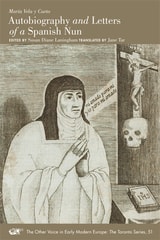
Autobiography and Letters of a Spanish Nun
María Vela y Cueto
Iter Press, 2016
When María Vela y Cueto (1561–1617) declared that God had personally ordered her to take only the Eucharist as food and to restore primitive dress and public penance in her aristocratic convent, the entire religious community, according to her confessor, “rose up in wrath.” Yet, when Vela died, her peers joined with the populace to declare her a saint. In her autobiography and personal letters, Vela speaks candidly of the obstacles, perils, and rewards of re-negotiating piety in a convent where devotion to God was no longer expressed through rigorous asceticism. Vela’s experience, told in her own words, reveals her shrewd understanding of the persuasive power of a woman’s body.
Because My Soul Longs for You
Integrating Theology into Our LivesRabbi Edwin C. Goldberg and Rabbi Elaine S. Zecher
Central Conference of American Rabbis, 2021
Because My Soul Longs for You seeks to answer one of the most enduring human questions: Where can we find God in our lives? While Jewish theologians have long pondered the "God question" from ethical and philosophical perspectives, the last century has made space for a more experiential theology: God is present in our lived experiences. Radical amazement, to use Rabbi Abraham Joshua Heschel's phrase, can be found in everyday life. Contributors to this volume share how they welcome God's presence into their lives, as well as the theological language they use to think and speak about this presence. Chapters explore how we experience God through prayer, text study, poetry, food, music, service, movement, meditation, interpersonal connection, and much more.
Contemplation and the Cross
A Catholic Introduction to the Spiritual LifeThomas Joseph White, OP
Catholic University of America Press, 2025
Discovering the Laws of Life
Sir John Templeton
Templeton Press, 2009
Eve's Longing
The Infinite Possibilities in All ThingsDeborah McKay
University of Alabama Press, 1992
Fleshing the Spirit
Spirituality and Activism in Chicana, Latina, and Indigenous Women’s LivesEdited by Elisa Facio and Irene Lara
University of Arizona Press, 2014
The anthology incorporates different genres of writing—such as poetry, testimonials, critical essays, and historical analysis—and stimulates the reader to engage spirituality in a critical, personal, and creative way. This interdisciplinary work is the first that attempts to theorize the radical interconnection between women of color, spirituality, and social activism. Before transformative political work can be done, the authors say in multiple ways, we must recognize that our spiritual need is a desire to more fully understand our relations with others. Conflict experienced on many levels sometimes severs those relations, separating us from others along racial, class, gender, sexual, national, or other socially constructed lines.
Fleshing the Spirit offers a spiritual journey of healing, health, and human revolution. The book’s open invitation to engage in critical dialogue and social activism—with the spirit and spirituality at the forefront—illuminates the way to social change and the ability to live in harmony with life’s universal energies.
Contributors
Volume Editors
Elisa Facio
Irene Lara
Chapter Authors
Angelita Borbón
Norma E. Cantú
Berenice Dimas
C. Alejandra Elenes
Alicia Enciso Litschi
Oliva M. Espín
Maria Figueroa
Patrisia Gonzales
Inés Hernández- Avila
Rosa María Hernández Juárez
Cinthya Martinez
Lara Medina
Felicia Montes
Sarahi Nuñez- Mejia
Laura E. Pérez
Brenda Sendejo
Inés Talamantez
Michelle Téllez
Beatriz Villegas

Got Religion?
How Churches, Mosques, and Synagogues Can Bring Young People BackNaomi Schaefer Riley
Templeton Press, 2014
The traditional markers of growing up are getting married and becoming financially independent. But young adults are delaying these milestones, sometimes for a full decade longer than their parents and grandparents. This new phase of “emerging adulthood” is diminishing the involvement of young people in religious institutions, sapping the strength and vitality of faith communities, and creating a more barren religious landscape for the young adults who do eventually decide to return to it. Yet, clearly there are some churches, synagogues, and mosques that are making strides in bringing young people back to religion.
Got Religion? offers in-depth, on-the-ground reporting about the most successful of these institutions and shows how many of the structural solutions for one religious group can be adapted to work for another.
The faith communities young people attach themselves to are not necessarily the biggest or the most flashy. They are not the wealthiest or the ones employing the latest technology. Rather, they are the ones that create stability for young people, that give them real responsibility in a community and that help them form the habits of believers that will last a lifetime.
Letters to a Fellow Seeker
A Short Introduction to the Quaker WaySteve Chase
QuakerPress, 2012
Letters, Volume 1
John Barsanuphius and John
Catholic University of America Press, 2006
Letters, Volume 2
John Barsanuphius and John
Catholic University of America Press, 2006

Mountain Dialogues
Frank Waters
Ohio University Press, 1999
“Mysticism is peculiar to the mountainbred,” Frank Waters once told an interviewer for Psychology Today. And in Mountain Dialogues, available for the first time in paperback, the mountainbred Waters proves it true. Ranging over such diverse subjects as silence, spirits, time, change, and the sacred mountains of the world, Waters sounds again and again the radiant, mystic theme of man’s inherent wholeness and his oneness with the cosmos.
Writing in Western American Literature, Charles L. Adams said, “In Mountain Dialogues, we see Frank Waters acknowledging his sources—major influences on a great American thinker and writer. Waters weaves together threads of these influences, adds his own thought, and presents us with a truly cosmic overview. This overview is thoroughly that of an American ‘Westerner’; it also is one that merits international consideration.”
And as the Bloomsbury Review wrote: “Mountain Dialogues is more than just a collection of personal essays. It is an ‘evolutionist’s handbook’ for the sons and daughters of the new West, a guide for those who would transcend the limitations of Western civilization.”
Queering Mesoamerican Diasporas
Remembering Xicana Indigena AncestriesSusy J. Zepeda
University of Illinois Press, 2022
A fascinating exploration of hidden Indígena histories and silences, Queering Mesoamerican Diasporas blends scholarship with spirit practices to reimagine the root work, dis/connection to land, and the political decolonization of Xicana/x peoples.
Reading in the Wilderness
Private Devotion and Public Performance in Late Medieval EnglandJessica Brantley
University of Chicago Press, 2007
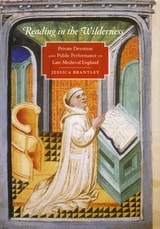
Drawing on the work of W. J. T. Mitchell, Michael Camille, and others working at the image-text crossroads, Reading in the Wilderness addresses the manuscript’s texts and illustrations to examine connections between reading and performance within the solitary monk’s cell and also outside. Brantley reimagines the medieval codex as a site where the meanings of images and words are performed, both publicly and privately, in the act of reading.
Sacred Attunement
A Jewish TheologyMichael Fishbane
University of Chicago Press, 2008
The first part of the book regrounds theology in this setting and opens up new pathways through nature, art, and the theological dimension as a whole. In the second section, Fishbane introduces his hermeneutical theology—one grounded in the interpretation of scripture as a distinctly Jewish practice. The third section focuses on modes of self-cultivation for awakening and sustaining a covenant theology. The final section takes up questions of scripture, authority, belief, despair, and obligation as theological topics in their own right.
The first full-scale Jewish theology in America since Abraham J. Heschel’s God in Search of Man and the first comprehensive Jewish philosophical theology since Franz Rosenzweig’s Star of Redemption, Sacred Attunement is a work of uncommon personal integrity and originality from one of the most distinguished scholars of Judaica in our time.
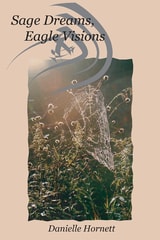
Sage Dreams, Eagle Visions
Danielle M. Hornett
Michigan State University Press, 2004
Amanda Aaron, a woman of mixed Ojibwe and white heritage, spent twenty years living in Milwaukee, away from her home and family. After the deaths of her parents, a short-lived marriage to an abusive non-Indian, and finally a tragic accident in which her friends were killed, she is pushed into a state of depression. Acting on her doctor’s orders, she returns to her grandparents’ cabin on her home reservation in northern Wisconsin, seeking the solitude she needs to recover.
Migizi, the Eagle, the Grandfather’s messenger, gifts Amanda with a feather, then visits her one night in her bedroom. Wanting to believe it was a dream, but knowing it was not, Amanda seeks the advice and counsel of Elders on the reservation who, in turn, introduce Amanda to Noah, a spiritual man who can guide and advise her as her life becomes complicated with unwanted responsibilities. Eventually, Amanda is forced to admit that the void she has been experiencing can only be filled by a return to the reservation—a life that has always enriched her and provided her with the needed strength to achieve her goals.
Selected Prose Works
Commentary on Genesis, Commentary on Exodus, Homily on Our Lord, Letter to PubliusSaint Ephrem the Syrian
Catholic University of America Press, 1994
Simple Lives, Radiant Faith
Beckey Phipps
QuakerPress, 2005
Spiritual Connection in Daily Life
Sixteen Little Questions That Can Make a Big DifferenceLynn Underwood
Templeton Press, 2013
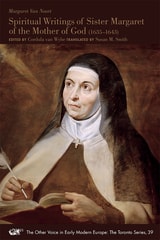
Spiritual Writings of Sister Margaret of the Mother of God (1635-1643)
Margaret Van Noort
Iter Press, 2015
In 1635, as directed by her confessor so that he might understand “the state of her soul,” Margaret Van Noort, a lay sister of the royal convent of Discalced Carmelite nuns in Brussels, composed her spiritual autobiography. This text was followed by two diaries in 1636 and 1637 recording the workings of her inner life and relation to God, and reflecting the cosmopolitan Catholic tradition of her homeland. Now gathered in this volume, these works illustrate Margaret’s development from a troubled young lay sister into a woman of spiritual experience and authority.
The Bonds of Love
St. Peter Damian's Theology of the Spiritual LifeGordon Mursell
Catholic University of America Press, 2022
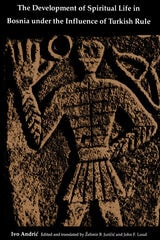
The Development of Spiritual Life in Bosnia under the Influence of Turkish Rule
Ivo Andric
Duke University Press, 1990
Over his long and distinguished career as a diplomat and man of letters Andric never again so directly or discursively addressed, as a social historian, the impact of Turkish hegemony on the Bosnian people (1463–1878), a theme he returns to again and again in his novels. Although Andric’s fiction was embedded in history, scholars know very little of his actual readings in history and have no other comparable treatment of it from his own pen. This dissertation abounds with topics that Andric incorporated into his early stories and later novels, including a focus on the moral stresses and compromises within Bosnia’s four religious confessions: Catholic, Orthodox, Jew, and Muslim.
Z. B. Juricic provides an extensive introduction describing the circumstances under which this work was written and situating it in Andric’s oeuvre. John F. Loud’s original bibliography drawn from this dissertation stands as the only comprehensive inventory of historical sources known to have been closely familiar to the author at this early stage in his development.

The Essential Worldwide Laws of Life
Sir John Templeton
Templeton Press, 2012
What does it mean to live a good life?
The major scriptures of the world, various schools of philosophical thought, storytellers, scientists, artists, and historians have all offered answers to this question. Surprisingly, these answers are common among nearly all sources. Famed investor and philanthropist Sir John Templeton called these commonalities the “laws of life.”
Templeton gathers the best of these teachings in The Essential Worldwide Laws of Life. This handsome volume shows readers of all ages, from all parts of the world, how to make their lives more joyous and useful by learning the universal truths that transcend time and culture.
Each law is presented in an essay format, with stories, commentary, and quotations to illustrate its importance. The material is designed to inspire the reader to put these laws into practice and to enjoy the rewarding life that will result.
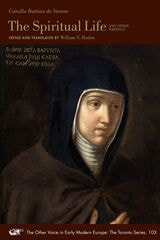
The Spiritual Life and Other Writings
Camilla Battista Da Varano
Iter Press, 2023
Camilla Battista da Varano (1458–1524) was a Franciscan nun and the author of profound spiritual writings in both prose and verse. Raised in the princely household of Camerino in north-central Italy, she put her thorough humanist education to use explaining her own spiritual experience and delivering advice to others. Varano composed ecstatic revelations, prayers, poems, hagiography, spiritual direction, and commentary on convent legislation. She drew on a wide variety of sources, including scripture and Church Fathers, plus popular literature and proverbs. Varano was an erudite woman of considerable complexity, defying many of the commonplace images we associate with religious women of the late fifteenth and early sixteenth centuries.
This Grateful Heart
Psalms and Prayers for a New DayAlden Solovy
Central Conference of American Rabbis, 2017
This Grateful Heart offers an anthology of modern day psalms and prayers to lift us up, inspire our days, and mark our milestones. Written by Jewish poet and liturgist Alden Solovy, the collection provides nearly 100 readings, spanning topics from the simple delights of daily living to the complexities of grief; from the celebration of major turning points like bar and bat mitzvah to the more solemn commemoration of lost lives and ended relationships; and from the awe-filled moments of the High Holy Days to the observance of secular holidays. For clergy, this collection offers supplementary material for use in services and life cycle rituals; for the individual, this collection can serve as a way to give voice to the joys and sorrows of everyday life.
To You I Call
Psalms Throughout Our LivesRabbi Jade Sank Ross
Central Conference of American Rabbis, 2024
Transcendentalism and the Cultivation of the Soul
Barry M. Andrews
University of Massachusetts Press, 2017
Vespers
Contemporary American Poems of Religion and SpiritualityVirgil Suarez
University of Iowa Press, 2003
At the heart of human existence lie fundamental questions that are pondered by philosophers, theologians, poets and thoughtful people from all walks of life. What is the meaning of life? Who or what is a divine being? How can a benevolent deity justify human suffering? Such questions are especially relevant to our lives in the current climate of American society. In Vespers: American Poems of Religion and Spirituality, editors Virgil Suárez and Ryan G. Van Cleave offer the reading world a timely anthology of powerful and passionate poems that cut to the heart of our contemporary theological and spiritual underpinnings.
Featuring fifty of today's most respected American poets, including Pulitzer Prize winners Stephen Dunn and Carolyn Kizer, Vespers allows us to witness and understand the challenging ideas and philosophies surrounding religion and spirituality. Through these poems, we can come to a better understanding of who, what, and why we are.
From deathbed spirituals to initiation songs, transformative ballads to transcendent sonnets, poets of myriad backgrounds—Native American, African American, Asian American, Latino, Protestant, Buddhist, Catholic, Jewish—echo the thoughts, concerns, and fears that linger in our souls. Their poems help us realize that we are not alone, that we're never truly alone, that even in the face of darkness the world is vibrant, beautiful, joyous.
More than a creative exploration of theological concerns—Vespers is a roadmap of where we've been, where we are, and where we are heading in terms of our spiritual and religious existence. It will keep you company, good company, whatever your religious or spiritual background.
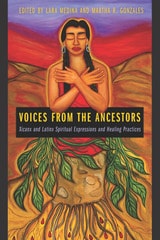
Voices from the Ancestors
Xicanx and Latinx Spiritual Expressions and Healing PracticesEdited by Lara Medina and Martha R. Gonzales
University of Arizona Press, 2019
This wisdom is based on the authors’ oral traditions, research, intuitions, and lived experiences—wisdom inspired by, and created from, personal trajectories on the path to spiritual conocimiento, or inner spiritual inquiry. This conocimiento has reemerged over the last fifty years as efforts to decolonize lives, minds, spirits, and bodies have advanced. Yet this knowledge goes back many generations to the time when the ancestors understood their interconnectedness with each other, with nature, and with the sacred cosmic forces—a time when the human body was a microcosm of the universe.
Reclaiming and reconstructing spirituality based on non-Western epistemologies is central to the process of decolonization, particularly in these fraught times. The wisdom offered here appears in a variety of forms—in reflective essays, poetry, prayers, specific guidelines for healing practices, communal rituals, and visual art, all meant to address life transitions and how to live holistically and with a spiritual consciousness for the challenges of the twenty-first century.
What Makes a Carmelite a Carmelite
Exploring Carmel's CharismKeith J. Egan
Catholic University of America Press, 2022
Why Are We Created
Increasing Our Understanding of Humanity's Purpose on EarthSir John Templeton
Templeton Press, 2003
While many books strive to stimulate thinking through provocative anecdotes and theories, Why Are We Created? takes a different path. It begins with a question and continues with a multitude of questions like these:
•What is the importance of recognizing the presence of the sacred within us and around us?•How can individuals create a purposeful and fruitful way of life?
•How does happiness relate to one's purpose?
Wisdom From World Religions
Pathways Toward Heaven On EarthJohn Marks Templeton
Templeton Press, 2002
Every religion acknowledges certain spiritual principles and records them in its sacred literature and traditions. This book curates these ancient teachings and shows how they apply to modern life with the help of parables, quotations, and commentaries.
By reading Wisdom from World Religions, people from all walks of life will be inspired to pursue their own spiritual growth and to contemplate questions central to our existence, such as how, through love and creativity, can we be agents of divinity on earth?
Uplifting and instructional, this is a book to be treasured, studied, and practiced.