Results by title
10 books match the query 'Spivak, Gayatri Chakravorty'
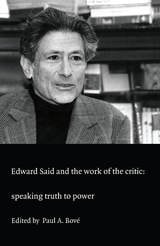
Edward Said and the Work of the Critic
Speaking Truth to PowerPaul A. Bové, ed.
Duke University Press, 2000
In two separate interviews, Said himself comments on a variety of topics, among them the response of the American Jewish community to his political efforts in the Middle East. Yet even as the Palestinian struggle finds a central place in his work, it is essential—as the contributors demonstrate—to see that this struggle rests on and gives power to his general "critique of colonizers" and is not simply the outgrowth of a local nationalism. Perhaps more than any other person in the United States, Said has changed how the U.S. media and American intellectuals must think about and represent Palestinians, Islam, and the Middle East. Most importantly, this change arises not as a result of political action but out of a potent humanism—a breadth of knowledge and insight that has nourished many fields of inquiry. Originally a special issue of boundary 2, the book includes new articles on minority culture and on orientalism in music, as well as an interview with Said by Jacqueline Rose.
Supporting the claim that the last third of the twentieth century can be called the "Age of Said," this collection will enlighten and engage students in virtually any field of humanistic study.
Contributors. Jonathan Arac, Paul A. Bové, Terry Cochran, Barbara Harlow, Kojin Karatani, Rashid I. Khalidi, Sabu Kohsu, Ralph Locke, Mustapha Marrouchi, Jim Merod, W. J. T. Mitchell, Aamir R. Mufti, Jacqueline Rose, Edward W. Said, Gayatri Chakravorty Spivak, Lindsay Waters
Living Translation
Gayatri Chakravorty Spivak
Seagull Books, 2022
Living Translation offers a powerful perspective on the work of distinguished thinker and writer Gayatri Chakravorty Spivak, revealing how, throughout her long career, she has made translation a central concern of the comparative humanities.
Starting with her landmark “Translator’s Preface” to Jacques Derrida’s Of Grammatology in 1976, and continuing with her foreword to Mahasweta Devi’s Draupadi and afterword to Devi’s Chotti MundaandHis Arrow, Spivak has tackled questions of translatability. She has been interested in interrogating the act of translation from the ground up and at the political limit. She sees at play at border checkpoints, at sites of colonial pedagogy, in acts of resistance to monolingual regimes of national language, at the borders of minor literature and schizo-analysis, in the deficits of cultural debt and linguistic expropriation, and, more generally, at theory’s edge, which is to say, where practical criticism yields to theorizing in untranslatables. This volume also addresses how Spivak’s institution-building as director of comparative literature at the University of Iowa—and in her subsequent places of employment—began at the same time. From this perspective, Spivak takes her place within a distinguished line-up of translator-theorists who have been particularly attuned to the processes of cognizing in languages, all of them alive to the coproductivity of thinking, translating, writing.
Nationalism and the Imagination
Gayatri Chakravorty Spivak
Seagull Books, 2010
Gayatri Chakravorty Spivak has distinguished herself as one of the foremost scholars of contemporary literary and postcolonial theory and feminist thought. Known for her translation of Derrida’s On Grammatology and her groundbreaking essay, “Can the Subaltern Speak?,” Spivak has often focused on subaltern, marginalized women and the role of essentialism in feminist thought to unite women from divergent cultural backgrounds. In Nationalism and the Imagination, Spivak expands upon her previous postcolonial scholarship, employing a cultural lens to examine the rhetorical underpinnings of the idea of the nation-state.
In this gripping and intellectually rigorous work, Spivak specifically analyzes the creation of Indian sovereignty in 1947 and the tone of Indian nationalism, bound up with class and religion, that arose in its wake. Spivak was five years old when independence was declared, and she vividly writes: “These are my earliest memories: Famine and blood on the streets.” As well, she recollects the songs and folklore stories that were prevalent at the time in order to examine the role of the mother tongue and the relationship between language and feelings of national identity. She concludes that nationalism colludes with the private sphere of the imagination in order to command the public sphere.
Originally given as an address at the University of Sofia in Bulgaria, Nationalism and the Imagination provides powerful insight into the historical narrative of India as well as compelling ideas that speak to nationalist concerns around the world. Also included in this book is the discussion with Spivak that followed the speech, making this an essential and informative work for scholars of post-colonialism.
Readings
Gayatri Chakravorty Spivak
Seagull Books, 2014
In Readings, Spivak elaborates a utopian vision for the kind of deep and investigative reading that can develop a will for peaceful social justice in coming generations. Through her own analysis of specific works, Spivak demonstrates modes in which such a vision might be achieved. In the examples here, she pays close attention to signposts of character, action, and place in J. M. Coetzee’s Summertime and Elizabeth Gaskell’s North and South. She also offers rereads of two of her own essays, addressing changes in her own thinking and practice over the course of her career. Now in her fifth decade of teaching, Spivak passes on her lessons through anecdote, interpretation, warning, and instruction to students and teachers of literature. She writes, “I urge students of English to understand that utopia does not happen, and yet to understand, also, their importance to the nation and the world. Indeed, I know how hard it is to sustain such a spirit in the midst of a hostile polity, but I urge the students to consider the challenge.”

Ritwik Ghatak
Occasional Essays for a 100th BirthdayEdited by Gayatri Chakravorty Spivak and Surya Parekh
Seagull Books, 2025
The cinema of Ritwik Ghatak (1925–76) continues to resonate across borders and generations. His films—largely shaped by the 1947 Partition of Bengal and the experience of displacement—probe the fractured human condition through bold formal experimentation, unforgettable soundscapes, and a profound sense of myth and memory. Though his body of work was modest in size, Ghatak’s influence has steadily expanded, securing his place as a major figure in world cinema. This distinctive volume, which marks the centenary of this visionary filmmaker, gathers essays by important scholars and thinkers from around the world.
Moving beyond conventional film criticism and area studies, the collection stages new, transnational encounters with Ghatak’s films—approaching them as world texts, as sonic and visual experiments, and as meditations on migration, collectivity, and social existence.
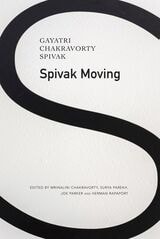
Spivak Moving
Gayatri Chakravorty Spivak
Seagull Books, 2022
The pieces collected in Spivak Moving touch on a variety of topics, including her crucial thinking on pan-Africanism and W. E. B. DuBois, reproductive heteronormativity, art and film, class apartheid in education, practices of institutional critique, and the training of imaginative activism through a sustained engagement with the humanities. She moves from a look at the unsystematized first languages of continental Africa into a broader consideration of human rights, international civil society practice, the question of terror, the “freedom” of the academic, and the place of the digital. About half the essays are collected here for the first time and are not found in Spivak’s several published essay collections.
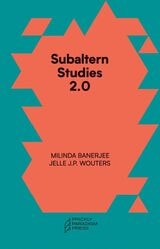
Subaltern Studies 2.0
Being against the CapitaloceneMilinda Banerjee and Jelle J.P. Wouters
Prickly Paradigm Press, 2022
State and Capital reign over the Age of Sorrow. We face inequality, pandemics, ethnocide, climate crisis, and mass extinction. Our desire for security and power governs us as State. Our desire for possessions governs us as Capital. Our desires imprison and rule us beings as Unbeing. Yet, from Nagaland to New Zealand, Bhutan to Bolivia, a second wave of anti-colonial revolutions has begun. Arising from assemblies of humans and other-than-humans, these revolutions replace possessive individualism with non-exploitative interdependence. Naga elders, Bhutanese herders and other indigenous communities, feminists, poets, seers, yaks, cranes, vultures, and fungi haunt this pamphlet. The original Subaltern Studies narrated how Indian peasant communities destroyed the British empire. Subaltern Studies 2.0 prophesies the multi-being demos and liberates Being from Unbeing. Re-kin, Re-nomad, Re-animate, Re-wild! The Animist Revolution has come.
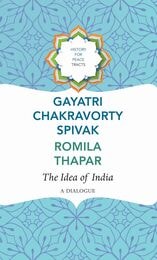
The Idea of India
A DialogueGayatri Chakravorty Spivak and Romila Thapar
Seagull Books, 2024
Through a stimulating dialogue, two old friends trace the history of the idea of India through digressions, anecdotes, and observations. Historian Romila Thapar and theorist Gayatri Chakravorty Spivak reflect on the challenges posed by essentialism and exclusion whenever cultures attempt to define and assert themselves. They also emphasize the role of education in fostering a more inclusive and accurate understanding of the nation’s complex history. Their conversation revolves around the narratives that have shaped Indian identity—from Vedic times to the present—and those whose voices and visions for this land remain unheard and unseen.
Ranging from nationalism to religion and beyond, TheIdea of India discusses an urgent question: What does it mean to be an Indian in contemporary society?

Who Sings the Nation-State?
Language, Politics, BelongingJudith Butler and Gayatri Chakravorty Spivak
Seagull Books, 2007
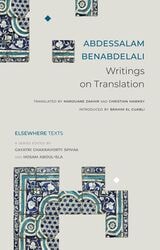
Writings on Translation
Abdessalam Benabdelali
Seagull Books, 2025
Abdessalam Benabdelali is a revered Moroccan philosopher and translator whose work maps an invaluable history of the status of translation in contemporary Arabic thought and language. Bringing together essays from two linked Arabic works by Benabdelali—On Translation and Hosting the Stranger—this volume represents one of the first extended philosophical explorations of translation by a contemporary Arab philosopher. These works reframe Arabic and European cultural histories around translation to counter hegemonic discourses and celebrate translation as a form of philosophical thought and practice, one that both preserves and proliferates difference.
Whether discussing eighteenth-century European perceptions of Arabic culture, classical Arabic literature and its express intent to resist all translation, or contemporary Arabic authors who write in anticipation of translation, Writings on Translation nimbly outlines the key philosophical questions at stake in translation. It concludes with an impassioned argument for translations that “host the stranger” and allow texts to “lift off and migrate.”