Results by title
4 books match the query 'Sports medicine'
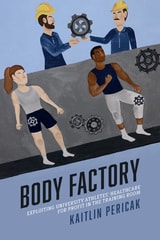
Body Factory
Exploiting University Athletes' Healthcare for Profit in the Training RoomKaitlin Pericak
Temple University Press, 2025
Body Factory enters an NCAA Division I athletic training room to examine the disconnect between what the NCAA states as its goal of athlete healthcare and what is actually happening. Kaitlin Pericak conducts observations in this space and interviews injured athletes and sports medicine staff members to show how institutional control over “best interests” often ends up exploiting the individual athlete. The influences at work are part of a neoliberal paradigm that explains why interest in an athlete’s care is greatly diminished once they are injured and can no longer play.
Body Factory considers how race, gender, and health before and after injury are deciding factors in these university training centers. The bureaucratic organization has a goal of maintaining power to generate profit, and Pericak shows this is almost always at the expense of the athlete.
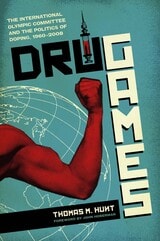
Drug Games
The International Olympic Committee and the Politics of Doping, 1960–2008By Thomas M. Hunt
University of Texas Press, 2011
On August 26, 1960, twenty-three-year-old Danish cyclist Knud Jensen, competing in that year's Rome Olympic Games, suddenly fell from his bike and fractured his skull. His death hours later led to rumors that performance-enhancing drugs were in his system. Though certainly not the first instance of doping in the Olympic Games, Jensen's death serves as the starting point for Thomas M. Hunt's thoroughly researched, chronological history of the modern relationship of doping to the Olympics. Utilizing concepts derived from international relations theory, diplomatic history, and administrative law, this work connects the issue to global political relations.
During the Cold War, national governments had little reason to support effective anti-doping controls in the Olympics. Both the United States and the Soviet Union conceptualized power in sport as a means of impressing both friends and rivals abroad. The resulting medals race motivated nations on both sides of the Iron Curtain to allow drug regulatory powers to remain with private sport authorities. Given the costs involved in testing and the repercussions of drug scandals, these authorities tried to avoid the issue whenever possible. But toward the end of the Cold War, governments became more involved in the issue of testing. Having historically been a combined scientific, ethical, and political dilemma, obstacles to the elimination of doping in the Olympics are becoming less restrained by political inertia.
Sport and Exercise Science
ESSAYS IN THE HISTORY OF SPORTS MEDICINEEdited by Jack W. Berryman and Roberta J. Parks
University of Illinois Press, 1992
athlete's heart, exercise physiology, physical activity and sport for females, women's
health, physical culture and quackery, diet, and more.
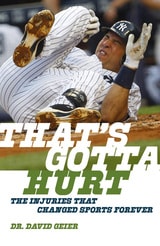
That’s Gotta Hurt
The Injuries That Changed Sports ForeverDr. David Geier
University Press of New England, 2017