Results by title
6 books match the query 'Spread'
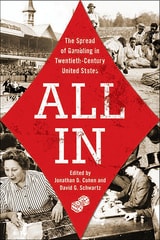
All In
The Spread of Gambling in Twentieth-Century United StatesJonathan D Cohen
University of Nevada Press, 2018
Gambling, the risky enterprise of chance, is one of America’s favorite pastimes. Office March Madness brackets, a day at the race track, a friendly wager, the random ridiculous Super Bowl prop bet, bingo night, or the latest media frenzy over the Powerball jackpot—all emphasize the ubiquity of this major economic force and cultural phenomenon. Approximately 70 percent of Americans regularly engage in some form of betting, amounting to over $140 billion in combined casino and lottery revenue every year. A hundred years ago, however, legal gambling was a rarity in the United States.
A fresh take on the history of modern American gambling, All In provides a closer look at the shifting economic, cultural, religious, and political conditions that facilitated gambling’s expansion and prominence in American consumerism and popular culture. In its pages, a diverse range of essays covering commercial and Native American casinos, sports betting, lotteries, bingo, and more piece together a picture of how gambling became so widespread over the course of the twentieth century.
Drawing from a range of academic disciplines, this collection explores five aspects of American gambling history: crime, advertising, politics, religion, and identity.
In doing so, All In illuminates the on-the-ground debates over gambling’s expansion, the failed attempts to thwart legalized betting, and the consequences of its present ubiquity in the United States.
[more]

Cheating the Spread
Gamblers, Point Shavers, and Game Fixers in College Football and BasketballAlbert J. Figone
University of Illinois Press, 2012
Delving into the history of gambling and corruption in intercollegiate sports, Cheating the Spread recounts all of the major gambling scandals in college football and basketball. Digging through court records, newspapers, government documents, and university archives and conducting private interviews, Albert J. Figone finds that game rigging has been pervasive and nationwide throughout most of the sports' history. The insidious practice has spread to implicate not only bookies and unscrupulous gamblers but also college administrators, athletic organizers, coaches, fellow students, and the athletes themselves.
Naming the players, coaches, gamblers, and go-betweens involved, Figone discusses numerous college basketball and football games reported to have been fixed and describes the various methods used to gain unfair advantage, inside information, or undue profit. His survey of college football includes early years of gambling on games between established schools such as Yale, Princeton, and Harvard; Notre Dame's All-American halfback and skilled gambler George Gipp; and the 1962 allegations of insider information between Alabama coach Paul "Bear" Bryant and former Georgia coach James Wallace "Wally" Butts; and many other recent incidents. Notable events in basketball include the 1951 scandal involving City College of New York and six other schools throughout the East Coast and the Midwest; the 1961 point-shaving incident that put a permanent end to the Dixie Classic tournament; the 1978 scheme in which underworld figures recruited and bribed several Boston College players to ensure a favorable point spread; the 1994-95 Northwestern scandal in which players bet against their own team; and other recent examples of compromised gameplay and gambling.
[more]

Serial Fu Manchu
The Chinese Supervillain and the Spread of Yellow Peril IdeologyRuth Mayer
Temple University Press, 2013
The evil mastermind—and master of disguise—Fu Manchu has long threatened to take over the world. In the past century, his dastardly plans have driven serialized novels, comic books, films, and TV. Yet this sinister Oriental character represents more than an invincible criminal in pop culture; Fu Manchu became the embodiment of the Yellow Peril.
Serial Fu Manchu provides a savvy cultural, historical, and media-based analysis that shows how Fu Manchu’s irrepressibility gives shape to—and reinforces—the persistent Yellow Peril myth. Ruth Mayer argues that seriality is not merely a commercial strategy but essential to the spread of European and American fears of Asian expansion.
Tracing Fu Manchu through transnational serials in varied media from 1913 to the 1970s, Mayer shows how the icon evolved. She pays particular attention to the figure’s literary foundations, the impact of media changes on his dissemination, and his legacy.
In the series Asian American History and Culture, edited by Sucheng Chan, David Palumbo-Liu, Michael Omi, K. Scott Wong, and Linda Trinh Võ
In the series Asian American History and Culture, edited by Sucheng Chan, David Palumbo-Liu, Michael Omi, K. Scott Wong, and Linda Trinh Võ
[more]

The Alchemy of English
The Spread, Functions, and Models of Non-native EnglishesBraj Kachru
University of Illinois Press, 1990
"What emerges from Kachru's fine work is the potential demarcation
of an entire field, rather than merely the fruitful exploration of a topic.
. . . [Kachru] is to be congratulated for having taken us as far as he
already has and for doing so in so stimulating and so productive a fashion."
-- World Englishes
"A potent addition to theoretical, sociolinguistic, attitudinal
and methodological explorations vis-à-vis the spread and functions
of, and innovations in, English from the viewpoint of a non-Western scholar."
-- The Language Teacher
Winner of the Joint First Prize, Duke of Edinburgh English Language
Book Competition of the English-Speaking Union of the Commonwealth, 1987
[more]
The Other Zulus
The Spread of Zulu Ethnicity in Colonial South AfricaMichael R. Mahoney
Duke University Press, 2012
In 1879, the British colony of Natal invaded the neighboring Zulu kingdom. Large numbers of Natal Africans fought with the British against the Zulus, enabling the British to claim victory and, ultimately, to annex the Zulu kingdom. Less than thirty years later, in 1906, many of those same Natal Africans, and their descendants, rebelled against the British in the name of the Zulu king. In The Other Zulus, a thorough history of Zulu ethnicity during the colonial period, Michael R. Mahoney shows that the lower classes of Natal, rather than its elites, initiated the transformation in ethnic self-identification, and they did so for multiple reasons. The resentment that Natal Africans felt toward the Zulu king diminished as his power was curtailed by the British. The most negative consequences of colonialism may have taken several decades to affect the daily lives of most Africans. Natal Africans are likely to have experienced the oppression of British rule more immediately and intensely in 1906 than they had in 1879. Meanwhile, labor migration to the gold mines of Johannesburg politicized the young men of Natal. Mahoney's fine-grained local history shows that these young migrants constructed and claimed a new Zulu identity, both to challenge the patriarchal authority of African chiefs and to fight colonial rule.
[more]
Working the Difference
Science, Spirit, and the Spread of Motivational InterviewingE. Summerson Carr
University of Chicago Press, 2023
A history of motivational interviewing and what its rise reveals about how cultural forms emerge and spread.
Motivational interviewing (MI) is a professional practice, a behavioral therapy, and a self-professed conversation style that encourages clients to talk themselves into change. Originally developed to treat alcoholics, MI quickly spread into a variety of professional fields including corrections, medicine, and sanitation. In Working the Difference, E. Summerson Carr focuses on the training and dissemination of MI to explore how cultural forms—and particularly forms of expertise—emerge and spread. The result is a compelling analysis of the American preoccupations at MI’s core, from democratic autonomy and freedom of speech to Protestant ethics and American pragmatism.
Motivational interviewing (MI) is a professional practice, a behavioral therapy, and a self-professed conversation style that encourages clients to talk themselves into change. Originally developed to treat alcoholics, MI quickly spread into a variety of professional fields including corrections, medicine, and sanitation. In Working the Difference, E. Summerson Carr focuses on the training and dissemination of MI to explore how cultural forms—and particularly forms of expertise—emerge and spread. The result is a compelling analysis of the American preoccupations at MI’s core, from democratic autonomy and freedom of speech to Protestant ethics and American pragmatism.
[more]