Results by title
4 books match the query 'St . Paul'
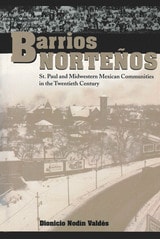
Barrios Norteños
St. Paul and Midwestern Mexican Communities in the Twentieth CenturyBy Dionicio Nodín Valdés
University of Texas Press, 2000
Mexican communities in the Midwestern United States have a history that extends back to the turn of the twentieth century, when a demand for workers in several mass industries brought Mexican agricultural laborers to jobs and homes in the cities. This book offers a comprehensive social, labor, and cultural history of these workers and their descendants, using the Mexican barrio of "San Pablo" (St. Paul) Minnesota as a window on the region.
Through extensive archival research and numerous interviews, Dennis Valdés explores how Mexicans created ethnic spaces in Midwestern cities and how their lives and communities have changed over the course of the twentieth century. He examines the process of community building before World War II, the assimilation of Mexicans into the industrial working class after the war, the Chicano Movement of the 1960s and 1970s, and more recent changes resulting from industrial restructuring and unprecedented migration and population growth. Throughout, Valdés pays particular attention to Midwestern Mexicans' experiences of inequality and struggles against domination and compares them to Mexicans' experiences in other regions of the U.S.
CONTROLLING VICE
REGULATING BROTHEL PROSTITUTION IN ST. PAUL, 1865–1883JOEL BEST
The Ohio State University Press, 1998
For eighteen years following the Civil War, the police in St. Paul, Minnesota, informally regulated brothel prostitution. Each month, the madams who ran the brothels were charged with keeping houses of ill fame and fined in the city’s municipal court. In effect, they were paying licensing fees in order to operate illegal enterprises. This arrangement was open; during this period, the city’s newspapers published hundreds of articles about vice and its regulation.
Joel Best claims that the sort of informal regulation in St. Paul was common in the late nineteenth century and was far more typical than the better known but brief experiment with legalization tried in St. Louis. With few exceptions, the usual approach to these issues of social control has been to treat informal regulation as a form of corruption, but Best’s view is that St. Paul’s arrangement exposes the assumption that the criminal justice system must seek to eradicate crime. He maintains that other policies are possible.
In a book that integrates history and sociology, the author has reconstructed the municipal court records for most of 1865–83, using newspaper articles, an arrest ledger kept by the St. Paul police, and municipal court dockets. He has been able to trace which madams operated brothels and the identities of many of the prostitutes who lived and worked in them.

On Good Ground
The Story of the Sisters of Saint Joseph in St. PaulSister Helen Angela Hurley
University of Minnesota Press, 1951
On Good Ground was first published in 1951. Minnesota Archive Editions uses digital technology to make long-unavailable books once again accessible, and are published unaltered from the original University of Minnesota Press editions.
Besides providing a vivid yet scholarly account of a religious order, this book reflects much of the regional history of the area where the nuns have done their work. The order maintains the College of St. Catherine and numerous other institutions in Minnesota and North Dakota.
St. Paul and Epicurus
Norman Wentworth DeWitt
University of Minnesota Press, 1954
St. Paul and Epicurus was first published in 1954. Minnesota Archive Editions uses digital technology to make long-unavailable books once again accessible, and are published unaltered from the original University of Minnesota Press editions.
Everyone who is interesting in the meaning of the Bible will find this a revealing study, for it opens up a new window on the New Testament, a window that was walled up centuries ago by prejudice. Professor DeWitt throws new light on the writings of the Apostle Paul by showing how they were influenced by the teachings of the Greek philosopher Epicurus.
The Epicureanism could have a place in Christian religion may come as a surprise to those familiar with the conventional concept of the philosophy of Epicurus. As demonstrated in the meaning of the English word epicure,derived from the name of the ancient philosopher, the modern world has long associated Epicurus with the indulgence of sensual pleasure in food and drink.
But, as Professor DeWitt makes clear both in this volume and in its predecessor, Epicurus and His Philosophy, the pleasures which the ancient Greek espoused as constituting the chief good of life were not the pleasures of the flesh. The merit and the lure, however, of the Epicurean ethic, which allied happiness with pleasure, were so appealing and so widely acknowledged that Paul had no choice but to adopt it and bless it for his followers with the sanction of religion. He could not, though, admit indebtedness to a philosopher who had long been accused of sensualism and atheism, and there was no choice, therefore, but to consign Epicurus to anonymity.
Through his scholarly investigation into the Epicurean source of certain portions of the Epistles, Professor DeWitt provides new explanations or translations for seventy-six biblical verses. The close scrutiny of biblical passages is carried out, not in a spirit of vandalism, but in a quest for accuracy, and the result is a challenging, readable, and absorbing book.